
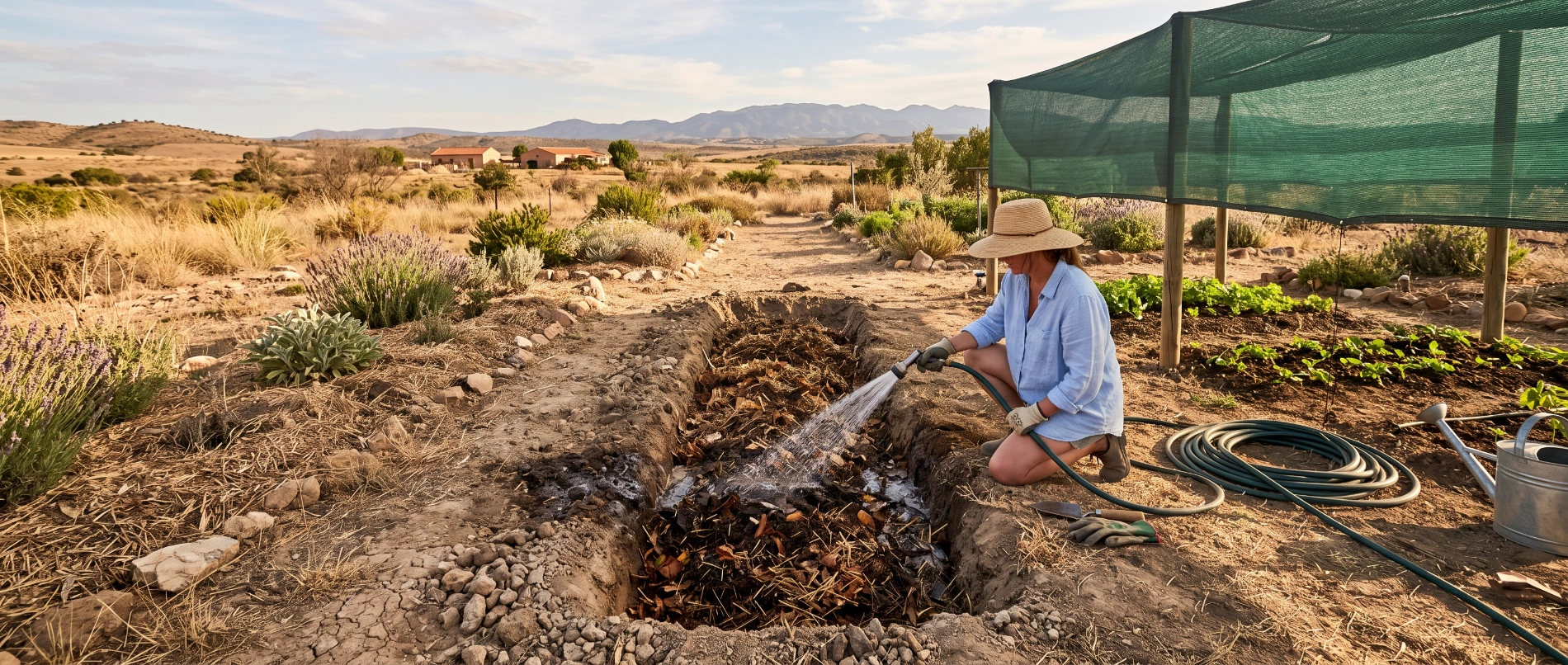
A sunken compost trench being watered in a dry, sun-baked garden with shade cloth nearby
Compost

Arid / Semi-Arid

Home/Compost/Arid / Semi-Arid

An arid or semi-arid climate -- the dry interior of continents, desert-fringe regions and drought-prone drylands, from the US Southwest and the Sahel to inland Australia and the Karoo -- turns the usual composting advice on its head. Here, water, not carbon or nitrogen, is the resource you'll fight hardest to keep. The golden rule: work below ground rather than above it, cover everything, and treat every drop of moisture in the heap as something worth protecting.

The Challenges

  • Rapid moisture loss is the defining problem -- an uncovered heap can dry out and stall within days in full sun and low humidity.
  • Scarce nitrogen-rich "green" material makes balancing the carbon-heavy dry plant matter this climate produces genuinely difficult.
  • Extreme summer heat can overheat a heap past the point of being useful, killing the very organisms doing the composting.
  • Little organic matter in the native soil to begin with means the payoff for finished compost is larger, but building the first batches takes real effort.

The Advantages

  • Fast decomposition and pathogen die-off once moisture is under control -- heat does a lot of the work for free.
  • Low fungal and mould risk compared to wetter climates, since there's rarely enough ambient moisture to support it.
  • Abundant sun makes passive solar heating and sun-scalding weed seed genuinely practical techniques, not gimmicks.
  • Livestock and manure are often locally abundant in dryland pastoral regions, providing a reliable nitrogen source that many wetter climates lack.
⏱
The Golden Rule: in an arid or semi-arid climate, work below ground rather than above it, cover everything, and treat every drop of moisture in the heap as something worth protecting. Heat and speed are on your side once water is under control.

19 Chapters, In Order

Each builds on the last, but every chapter also stands alone if you're looking for something specific.

1
Understanding Your Climate
Why heat, aridity and scarce organic matter change every rule of composting here.
2
Siting & Building Your System
Choosing a shaded, wind-sheltered site and building a system that doesn't cook itself dry.
3
Trench & Pit Composting
Why below-ground composting beats above-ground bays where every litre of moisture counts.
4
Carbon & Nitrogen Balance
Getting the ratio right when carbon is dry and abundant but nitrogen is genuinely scarce.
5
Complete Input Materials Reference
Every material this climate actually offers, with C:N ratios, and what to avoid entirely.
6
Animal Manures -- The Core Input
Why livestock manure, not seaweed, is the dominant nitrogen source across dryland farming.
7
Humanure -- Safe Use
Faster pathogen die-off in heat, and why that's a shortcut you still shouldn't take.
8
Activators & Accelerators
Urine, manure teas and the nitrogen boosters that matter most when greens are scarce.
9
Biochar -- Permanent Soil Enrichment
Why biochar matters even more here, turning thin sandy soils into genuine water reservoirs.
10
Vermicomposting -- Worm Power
Keeping composting worms alive and working in a climate that actively fights you.
11
Shade, Mulch & Evaporation Control
The single most important arid-specific skill: keeping a heap from drying out before it finishes.
12
Green Manures -- Growing Fertility
Drought-tolerant cover crops that build soil without competing for scarce water.
13
Managing Through the Seasons
Working around peak-summer heat dormancy instead of winter cold, and the cooler windows either side.
14
Troubleshooting Common Problems
Diagnosing a heap that's dried out, gone dusty, or overheated past the point of being useful.
15
Harvesting & Using Your Compost
Knowing when it's genuinely ready, and applying it to get the most from every scarce litre it holds.
16
Compost Teas & Liquid Feeds
Why liquid feeding is often more water-efficient here than spreading solid compost.
17
Crop Rotation & the Compost Calendar
A rotation built around a cool-season growing window instead of a single spring-to-autumn season.
18
The No-Dig Approach
Why undisturbed soil and a permanent mulch layer matter more here than almost anywhere else.
19
Building Long-Term Soil Health
The bigger picture: turning thin, low-carbon desert soils into something that holds water and life.

Not sure how many crops your compost needs to feed? The calculator works that out.

Start the calculator →

Frequently Asked Questions

What's the single biggest composting challenge in an arid or semi-arid climate?

Water loss. A heap that would compost perfectly well in a wetter climate simply dries out here, and once microbial activity stops from lack of moisture it doesn't restart on its own -- it needs deliberate rewetting. Almost every technique in this section, from trench composting to shade cover, exists to solve this one problem.

What real advantages does this climate have for composting?

Heat itself is an advantage once moisture is under control -- decomposition and pathogen die-off both happen faster here than in a cool climate. Dry conditions also mean far less fungal disease risk in the heap, and abundant sun makes solar-assisted methods like sun-scalding weed seed and passive solar heating genuinely practical.

Is composting even worth the water it uses in a dry climate?

Yes, and by a wide margin. The water a heap needs to stay active is small compared to what finished compost then saves in irrigation, because compost dramatically improves a soil's ability to hold onto water it's given. A trench or pit system, kept covered, needs only occasional topping up rather than regular watering.