
Above-ground bays are the default image most people have of composting, but in a hot, dry climate the ground itself is often the better tool. Trench and pit composting works with the soil instead of against it, and it's one of the oldest, lowest-technology composting methods there is, practised across dryland farming traditions from the Middle East to the American Southwest long before purpose-built bins existed.
Why Below-Ground Composting Works So Well Here
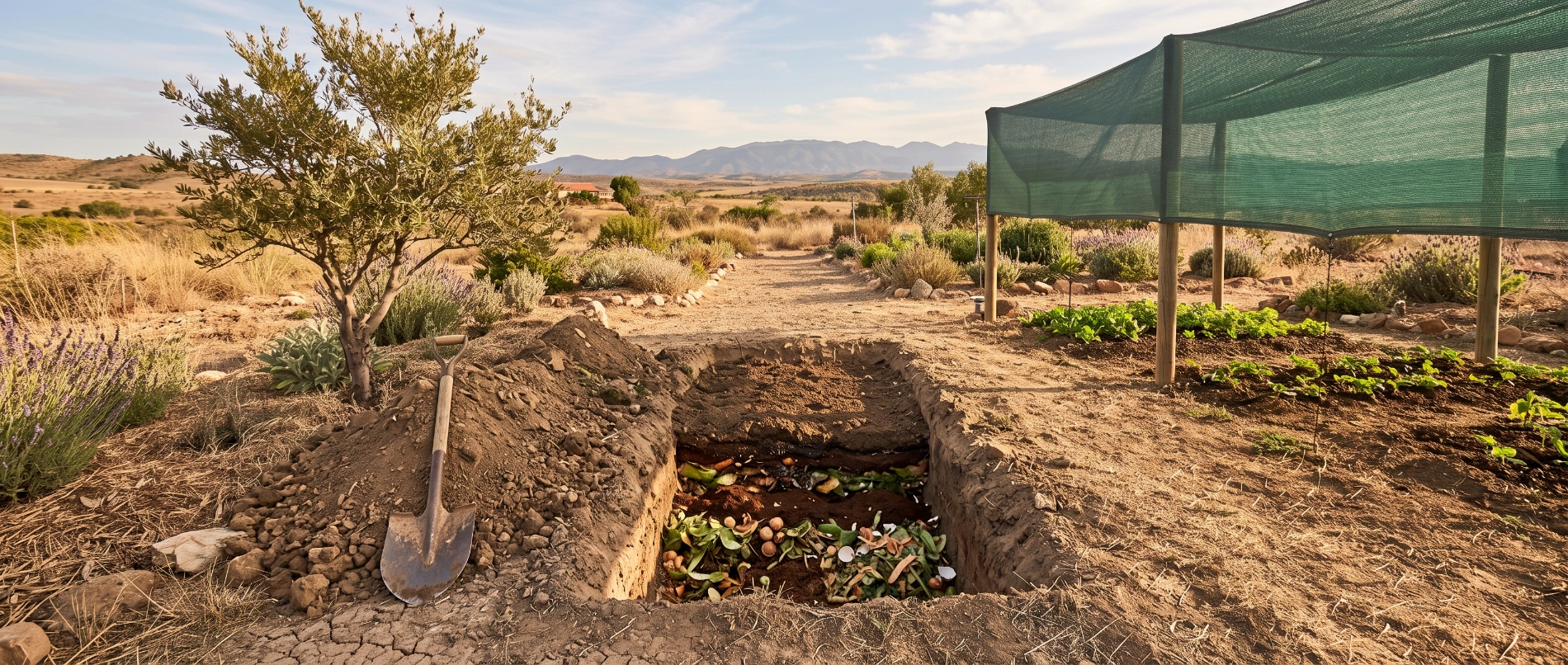
Soil is a remarkably good insulator. A trench or pit sits below the extremes of surface temperature, staying cooler through peak summer heat and more stable overall than anything exposed directly to sun and moving air. That same insulation works against the site's biggest threat: material below grade has dramatically less exposed surface area than an equivalent above-ground heap, which means far less water lost to evaporation, and what it does lose is largely trapped by the soil around it rather than carried off by wind.
This is exactly the same logic behind siting an above-ground system in shade and shelter, covered in Chapter 2 -- surface exposure is the enemy of moisture retention. Trenching simply takes that idea to its natural conclusion by removing most of the exposed surface altogether.
The Simple Single Trench
The most basic version needs no structure at all. Dig a trench roughly 30-45cm deep, and fill it with alternating layers of kitchen and garden waste and the soil you dug out, finishing with a soil or mulch cap on top. Left alone, it breaks down in place, worked by soil organisms as much as by the composting process itself. This is sometimes called trench composting, or simply "digging in", and it's about as low-effort as composting gets.
Because there's no separate finished heap to dig out and move, a trench feeds the exact spot it's dug in. Many gardeners deliberately dig a trench where they intend to plant the following season, so by the time seeds or seedlings go in, the material underneath has already broken down into the bed itself.
A Rotating Three-Trench System
A single trench works fine for occasional waste, but a household producing kitchen scraps continuously needs somewhere to put them while an existing trench is still breaking down. The fix is to run three trenches in rotation: dig the first and fill it gradually over several weeks as scraps come in, then cover it and dig a second trench alongside it to keep filling. By the time the third trench is dug and filling, the first is usually finished, so you come back around, dig it out or plant straight into it, and start the cycle again.
This gives continuous kitchen waste disposal with no need for a dedicated bin at all, and it naturally distributes finished compost across several planting spots over a season rather than concentrating it in one place.
Pit Composting for Larger Batches
When there's more material to deal with at once -- a garden clear-out, a large batch of crop residue, or manure and bedding cleared from an animal pen -- a pit gives the same below-ground advantages at a bigger scale. Dig a wider, deeper pit and build it up in layers much as you would an above-ground heap, alternating carbon-rich and nitrogen-rich material (see Chapter 4), then cover the top with boards, matting, or a thick mulch layer to control evaporation and keep animals out.
A pit takes longer to fill and finish than a single trench, but it handles far more volume in one go, and the same soil insulation and reduced surface exposure apply just as much at this larger scale.
Frequently Asked Questions
Why is below-ground composting better than a heap in an arid climate?
Soil is an excellent insulator against both heat extremes and moisture loss. A trench or pit has far less surface area exposed to sun and wind than an above-ground heap of the same volume, and the surrounding earth keeps it cooler in peak heat and slows evaporation dramatically. It's also one of the oldest and simplest composting methods there is, used across dryland farming traditions worldwide long before above-ground bays existed.
How deep should a compost trench be?
Roughly 30-45cm deep is enough for a simple single trench. Fill it with alternating layers of kitchen and garden waste and soil, then cover the top with a final layer of soil or mulch. Left to break down in place, this is sometimes called trench composting or simply digging in, and it needs no turning at all.
What's a rotating three-trench system?
It's a simple way to keep disposing of kitchen waste continuously without waiting for one trench to finish. Dig the first trench and fill it gradually over several weeks, cover it once full, then dig a second trench nearby and start filling that one. By the time the third trench is full and covered, the first is usually finished and ready to plant into, so you come back around to dig it out or plant straight into it and start the cycle again.