
Most composting advice assumes water is the one thing you don't have to think about. In an arid or semi-arid climate that assumption breaks completely, and it changes where you put your system and how you build it. The priorities here genuinely invert from a wet climate: instead of chasing sun and airflow, you're chasing shade and shelter.
Choosing a Shaded, Sheltered Site
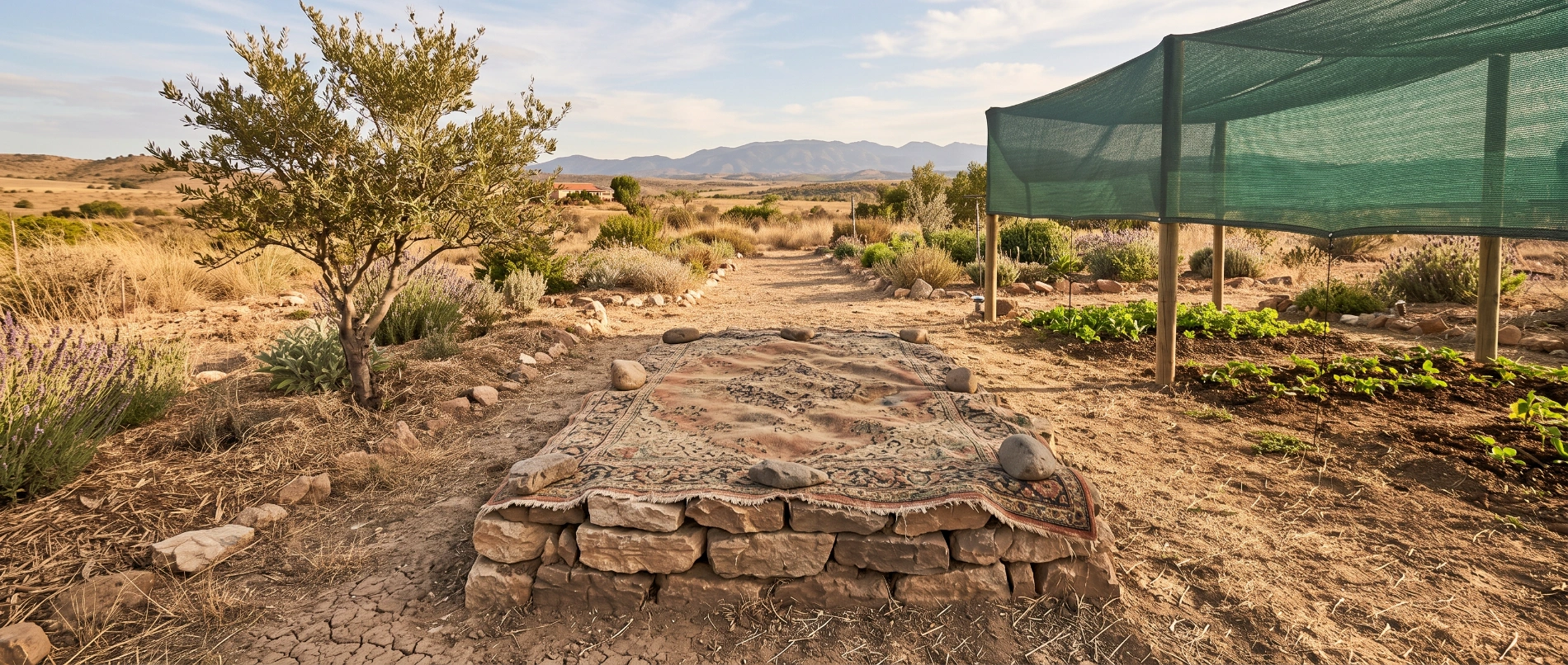
Shade first, not sun
A heap here already gets plenty of heat from ambient temperature and its own microbial activity, so a spot in full afternoon sun does very little useful heating and a great deal of unwanted drying. The best sites face east, catching cooler morning sun and falling into shade through the hottest part of the day, and the single best site of all is under the canopy of a tree, which cuts both direct sun and wind in one move.
Wind shelter matters more than most people expect
Moving air strips moisture from any exposed surface continuously, and it does this even on a day that doesn't feel especially hot. A heap in an open, windy spot can dry out faster than a hotter but sheltered one. Tuck the system behind a wall, a hedge, a fence line, or into a sheltered courtyard corner wherever possible, and treat a dedicated windbreak as a genuine investment rather than an afterthought.
Stay close to your water source
A heap in this climate needs regular, if modest, attention with water, and a system sited far from a tap or storage tank simply won't get that attention as reliably as one a few steps away. Put convenience to water ahead of convenience to the kitchen door if you have to choose between the two.
Build Smaller, Denser, or Partly Sunken
A large, open above-ground bay is a good shape for a cool, wet climate, where the goal is maximum airflow and surface exposure. Here that same shape is a liability: exposed surface area is exactly where moisture escapes, so a big open structure loses water faster than the same volume of material built more compactly.
A smaller, denser heap holds moisture better simply through geometry -- less surface relative to volume. Better still is a structure built partly or fully below grade, since the surrounding soil insulates it against both heat extremes and evaporation, much like the trench and pit methods covered in Chapter 3. Where an above-ground structure is more practical, keep it modest in scale rather than building the largest bay you can manage.
Local, low-cost materials work well and keep the system in keeping with the resources actually on hand: adobe or mud-brick surrounds, stacked stone, or a simple wood-and-wire frame. None of these need to be elaborate -- their job is to hold the material together and give you something to fix a cover to.
A Lid or Cover Is Not Optional
Whatever the site and structure, a cover over the top of the heap is one of the single most effective things you can do to cut evaporation, often making a bigger difference than shade or wind shelter alone. An old offcut of carpet, a sheet of shade cloth, a board or piece of plywood, or a thick layer of straw or mulch all work -- the goal is simply to stop the surface being directly exposed to sun and moving air.
A covered heap needs watering far less often than an uncovered one of the same size, and it's a far smaller job to lift a cover and check moisture than to rebuild a heap that's dried out completely. Combine cover with the shade and mulch techniques in Chapter 11 for the fullest evaporation control this climate allows.
Frequently Asked Questions
Should a compost heap go in sun or shade in a hot, dry climate?
Shade, ideally. This is the opposite of the usual advice for cooler climates, where sun helps a heap heat up. In an arid or semi-arid climate the heap already gets plenty of heat from ambient temperature and its own microbial activity, so full sun mostly just accelerates evaporation and can push internal temperatures past the point where the organisms doing the composting start dying off. An east-facing site that catches cooler morning sun and is shaded through the hot afternoon, ideally under the canopy of a tree, is close to ideal.
Does wind really matter that much for a compost heap?
Yes, often more than heat alone. Moving air continuously strips moisture from any exposed surface, and a compost heap is mostly exposed surface. A heap sited in a windy, open spot can dry out faster than an equally hot but sheltered one, which is why a windbreak, a wall, a hedge, or simply tucking the system into a sheltered corner of the garden, is worth as much attention as shade.
Why build smaller or partly sunken structures instead of a large open bay?
Exposed surface area is where a heap loses moisture, so a large open bay with lots of surface exposed to sun and wind is genuinely the wrong shape for this climate, however well it works elsewhere. A smaller, denser heap, or one built partly below grade so the surrounding soil insulates and shelters it, has far less surface to lose water from relative to its volume. Combined with a solid cover it needs only occasional watering rather than constant attention.