
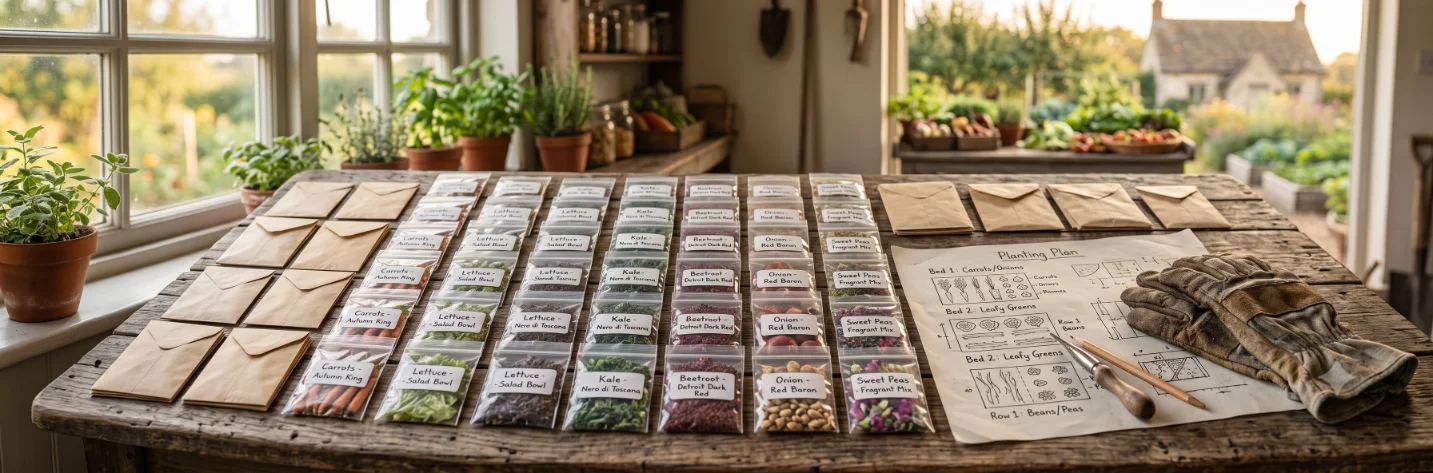
Seed-saving guides are full of terms that don't come up anywhere else in gardening -- isolation distance, roguing, vernalization. This page collects them in one place, in plain English, so you can look one up without leaving the crop guide you're reading. Every term below links back to the crop pages where it actually matters.
33 terms
Annual
A plant that completes its entire life cycle -- germination, growth, flowering, and seed set -- within a single growing season, then dies. Most vegetables on this site are annuals (beans, peas, tomatoes, lettuce), which is why they're the simplest to save seed from: no overwintering or vernalization needed. Contrast with Biennial. Some crops are grown as an annual in one climate and a true perennial in another -- see Malabar Spinach and Pigeon Pea.
Bagging
Covering an individual flower or flower cluster with a fine mesh, paper, or fabric bag before it opens, to physically block pollinators from reaching it. Used to keep a flower isolated until you hand-pollinate it yourself, then re-bagged afterwards so no other pollen reaches it while the fruit sets. Common on squash, brassicas, and other insect-pollinated crops in small gardens where distance isolation isn't practical. See Summer Squash for the technique in practice.
Biennial
A plant that completes its life cycle over two growing seasons: it grows leaves and stores energy (often in a root or bulb) in year one, then needs a cold period before it will flower and set seed in year two. Carrots, onions, beets, and most brassicas are biennial, which is why saving their seed takes an extra year compared with annual crops like beans or tomatoes. See Brassica and Carrot.
Cleistogamous
A flower that pollinates itself before it even opens, making cross-pollination with another plant essentially impossible. Oats, barley and wheat are all cleistogamous, which is why several varieties can be grown side by side with almost no isolation needed -- see Oats, Barley and Wheat.
Cross-Pollination
When pollen from one plant fertilises the flower of a genetically different plant -- a different variety, or another plant of the same variety. The resulting seed carries traits from both parents, which is exactly what you don't want if you're trying to keep a variety "true to type." The whole point of isolation distance, bagging, and hand-pollination is preventing unwanted cross-pollination.
Cultivar
Short for "cultivated variety" -- a plant selected and maintained by growers for particular traits (flavour, size, colour, disease resistance) and given its own name, e.g. 'Brandywine' tomato or 'Czar' runner bean. Cultivars within the same species can cross with each other; that's the crossing risk seed savers are managing.
Curing
Letting a harvested crop sit in a warm, dry place for one to several weeks before long-term storage, so the skin hardens and any minor wounds seal over. Winter squash and butternut are typically cured before storage; skipping this step shortens how long the fruit will keep. See Winter Squash and Butternut.
Dioecious
A species where individual plants are either entirely male or entirely female -- you need both a male and a female plant nearby to get seed at all. Uncommon among common vegetables (asparagus and spinach are two examples) but worth knowing when it applies, since it changes how many plants you need to grow for seed.
F1 Hybrid
The first-generation offspring of two different, deliberately chosen parent lines, bred to combine specific traits. F1 seed is consistent and often vigorous, but seed saved from an F1 plant ("F2") will not come true -- it splits back out into a wide, unpredictable mix of traits from the original parent lines. If a packet is labelled "F1" or "Hybrid," don't expect saved seed to match the parent plant. Look for "open-pollinated" instead if you plan to save seed.
Feral / Volunteer
A "volunteer" is a plant that grows on its own from seed you didn't intentionally plant -- often from compost, or from a fruit left to rot in the garden. "Feral" describes a population of a crop species growing wild, outside cultivation (wild cabbage on coastal cliffs, for example). Both are a hidden crossing risk: they flower and release pollen just like anything you planted deliberately, and gardeners often forget to check for them.
Fermentation
Letting scooped-out seeds and pulp sit in water for a few days until it forms a light mould on top. This mimics what happens naturally when a fruit rots on the ground, and it does two jobs: it strips off the gel coating that inhibits germination, and it kills off many seed-borne diseases. Standard practice for tomato and cucumber seed; not needed for dry-seeded crops like beans or peas.
Genetic Diversity
The range of genetic variation within a population of plants. A genetically diverse seed population adapts better to pests, disease, and changing conditions over generations. It's the reason seed-saving guides recommend saving seed from many plants (see Population Size) rather than just one or two -- a narrow gene pool becomes fragile over time.
Hand-Pollination
Manually transferring pollen from a male flower to a female flower (or between flowers on self-fertile plants) yourself, instead of leaving it to insects or wind. Usually paired with bagging to keep the flower isolated before and after. The standard technique for guaranteeing pure seed on squash, corn, and brassicas without needing hundreds of metres of isolation distance.
Heirloom
An open-pollinated variety that has been grown and passed down, seed to seed, for many generations (usually 50+ years) without crossbreeding, often within a family or community. All heirlooms are open-pollinated, but not all open-pollinated varieties are old enough to be called heirlooms.
Inbreeding Depression
A decline in vigour, yield, or fertility that can show up after several generations of saving seed from too few plants, especially in naturally outcrossing species like corn or brassicas. It's the practical reason behind minimum population size recommendations -- self-pollinating crops like beans and tomatoes are far more tolerant of small populations than wind- or insect-pollinated ones.
Isolation Distance
The minimum distance recommended between two flowering varieties of the same species to prevent cross-pollination, whether by wind or insect. It varies hugely by crop and pollinator: self-pollinating crops like peas need only a few metres, while wind-pollinated corn or insect-pollinated brassicas may need hundreds of metres to a kilometre. Every crop page on this site lists specific isolation distances -- check the Seed-Saving Helper for your crop.
Monoecious
A species where each individual plant produces separate male and female flowers on the same plant, rather than one flower with both parts. Squash and corn are classic examples -- you can usually spot the difference by looking for a tiny embryonic fruit behind female squash flowers, absent on male ones. Because pollen still has to move from a male flower to a female flower, cross-pollination between varieties remains a real risk.
Open-Pollinated (OP)
A variety that is pollinated naturally (by insects, wind, or self-pollination) and, when grown in isolation from other varieties of the same species, produces seed that comes true to type -- offspring that closely resemble the parent plant. This is the opposite of an F1 hybrid, and it's the seed type worth saving if you want next year's crop to match this year's.
Outcrossing
The tendency of a species to be fertilised by pollen from a different plant rather than its own. A "high outcrossing" crop -- corn, brassicas, carrots -- crosses readily and needs serious isolation. A "low outcrossing" or mostly self-pollinating crop -- beans, peas, lettuce, tomatoes -- rarely crosses and needs very little isolation between varieties.
Perfect Flower
A flower containing both male (pollen-producing) and female (seed-producing) parts in the same structure, able to pollinate itself without help from another flower or plant. Beans, peas, lettuce, and tomatoes all have perfect flowers, which is a big part of why they're such easy, low-risk crops for seed saving.
Population Size
The number of individual plants you save seed from. Saving from just one or two plants of an outcrossing species risks inbreeding depression over successive generations. Self-pollinating crops (beans, peas, tomatoes) tolerate small populations well; outcrossing crops (corn, brassicas, carrots, beets) generally need seed saved from a minimum of 20-80 plants to stay healthy long-term.
Protogynous
A flowering pattern where the female part of a flower or head becomes receptive before the male part sheds pollen on that same flower or head -- which favours cross-pollination over self-pollination, since a flower's own pollen usually isn't ready in time to fertilise it. Pearl millet is protogynous, one reason it needs more isolation than most other small grains.
Roguing
Pulling out and destroying "off-type" plants -- ones that don't match the variety's expected traits -- before they flower and have a chance to pollinate your good plants or contribute seed. Routine practice in any seed-saving patch, and especially important the year after you notice unexpected crossing, to stop off-types compounding in future generations.
Self-Incompatible
A plant that cannot pollinate itself at all, even though its flowers have both male and female parts -- pollen from a genetically different plant of the same variety is required. Radish and tomatillo are both self-incompatible, which is why they need several plants -- not just one -- flowering together to set any seed at all.
Selfing / Self-Pollination
A flower pollinating itself, or a plant pollinating another flower on the same plant, without pollen arriving from a different plant. Crops with high rates of self-pollination (beans, peas, lettuce, tomatoes) are the easiest and lowest-risk for home seed saving because there's very little opportunity for unwanted crossing, even between varieties grown close together.
Species vs Variety
Plants only cross with others of the same species (roughly), not just the same common name. This trips people up most with squash -- zucchini, butternut, and true winter squash are three different Cucurbita species and won't cross with each other, while a zucchini and an acorn squash are the same species and will. A "variety" or cultivar is a subgroup within one species. See Summer Squash for a full worked example.
Stratification
Exposing seed to a period of cold, moist conditions before sowing to break dormancy and trigger germination -- common for some perennial and tree seed. Distinct from vernalization, which is a cold period the living plant needs before it will flower, not something done to dry seed.
True to Type
Seedlings that closely match the traits of the parent plant -- the size, colour, flavour, and habit you expected. This is the goal of everything else on this glossary: isolation, bagging, hand-pollination, and roguing all exist to keep your saved seed true to type instead of drifting into an unpredictable mix.
Umbellifer / Umbel
A flat or dome-shaped flower head made up of many small flowers radiating from a central point, like an open umbrella -- the umbel is what gives the carrot family (Apiaceae) its old common name, umbellifers. Carrot, parsnip, celeriac and the Apiaceae herbs (alexanders, lovage) all flower this way.
Vegetative Propagation
Growing a new plant from a piece of the parent plant itself -- a tuber, a rooted cutting, a bulb offset, a divided crown -- rather than from seed produced by pollination. Because the new plant is a genetic clone of the parent, cross-pollination, isolation distance, and every other seed-saving concern simply don't apply. Potato, sweet potato, cassava, shallot, rhubarb, Jerusalem artichoke, and globe artichoke are all normally propagated this way. See the Vegetative Propagation guide for the specific techniques.
Vernalization
A required period of cold temperatures that triggers a biennial plant to switch from growing leaves/roots to flowering. Without enough cold exposure over winter, plants like carrots, onions, and brassicas simply won't flower or set seed the following year -- which is why overwintering (in the ground in mild zones, or lifted and stored in cold ones) is a required step, not an optional one, for biennial seed saving.
Viability
Whether a seed is still alive and capable of germinating. Viability declines over time, at a rate that depends on the crop and storage conditions -- onion seed may drop off within 2 years, while some beans and squash stay viable for 5+. Cool, dark, and dry storage extends viability significantly. A simple viability test: sow 10 seeds on damp paper towel and count how many sprout within the crop's normal germination window.
Wind-Pollination
Pollen carried between flowers by air currents rather than insects. Corn, beets, spinach, and grains like wheat all rely on wind for pollination -- it travels much further than insect-carried pollen, which is why wind-pollinated crops often need larger isolation distances than insect-pollinated ones. See Corn for the most extreme example on this site.