
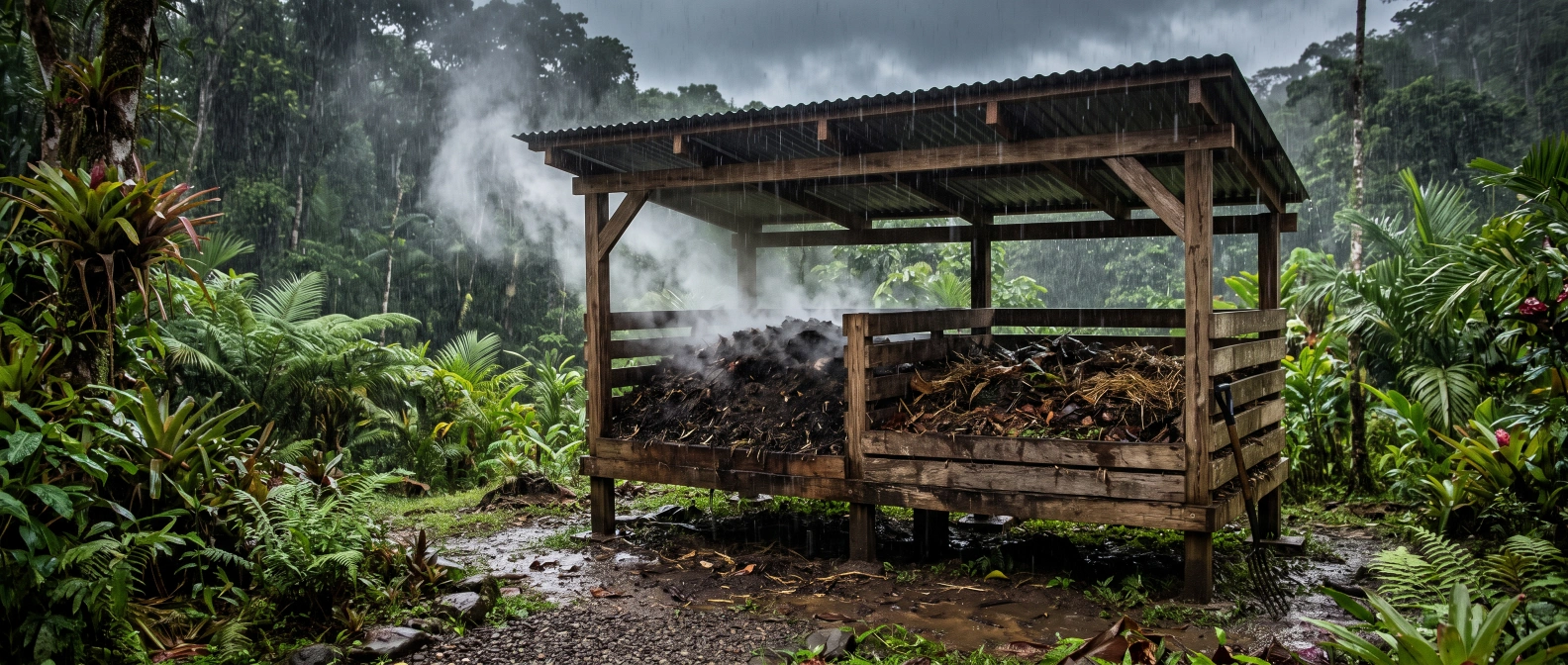
A tropical or humid climate -- the hot, wet lowlands near the equator, from Southeast Asia and the Amazon and Congo basins to coastal West Africa, the Caribbean and the Pacific islands -- gives composting more raw speed than almost anywhere else on earth, but also its most relentless adversary: rain. The golden rule here: keep the rain off, keep the heap off the ground, and treat every nutrient your compost produces as something that will wash away the moment you stop protecting it.
The Challenges
- Torrential, frequent rain can waterlog an uncovered heap within hours, pushing it anaerobic and washing dissolved nutrients straight out of it.
- Scarce dry carbon material is a genuine problem despite abundant plant growth -- almost everything here is soft and fast-rotting rather than dry and woody.
- High disease and pest pressure means humanure and manure handling demand real caution, even though heat alone speeds up pathogen die-off.
- Heavily leached native soils are common across much of the humid tropics, having already lost much of their natural fertility to the same rain a compost heap has to be protected from.
The Advantages
- Extremely fast decomposition once drainage is under control -- a well-managed heap can finish in a fraction of the time a cool climate needs.
- Abundant nitrogen-rich green material from fast, near-continuous plant growth, a resource most other climates in this guide struggle to find enough of.
- Fast pathogen die-off in sustained heat, once a heap is properly built and protected from the waterlogging that would otherwise undermine it.
- Genuinely abundant tropical plant waste -- banana pseudostems, coconut husk and coir, plantain trimmings -- provide a free, locally universal compost input.
19 Chapters, In Order
Each builds on the last, but every chapter also stands alone if you're looking for something specific.
Frequently Asked Questions
What's the single biggest composting challenge in a tropical or humid climate?
Torrential rain. A heap left uncovered can be waterlogged within a single downpour, turning anaerobic and losing dissolved nutrients to leaching almost as fast as they're produced. Almost every technique in this section, from raised covered systems to mulch cover, exists to keep rain out and nutrients in.
What real advantages does this climate have for composting?
Genuinely several. Heat and moisture together drive extremely fast decomposition once drainage is under control, often finishing a batch in a fraction of the time a cool climate needs. Plant growth is so fast and abundant that nitrogen-rich green material, the resource most climates struggle to find enough of, is rarely in short supply here.
Why is dry carbon material described as scarce in a climate with so much plant growth?
Because almost everything growing here is soft, moist and fast-decomposing rather than dry and woody. Straw, dead leaves and dry crop stalks, the easy brown material a temperate or arid garden has in abundance, simply don't accumulate the same way in a climate where plant matter rots down before it ever dries out. Finding genuine carbon, dried banana leaves, coconut husk, cardboard, becomes a deliberate task rather than something lying around.