
No-dig gardening matters in every climate, but here the case for it is stronger and more urgent than almost anywhere else. It isn't primarily about protecting soil biology, though that matters too -- it's about water, and how much of it undisturbed ground keeps compared to soil that's been turned over.
A Water-Saving Case, Not Just a Soil-Biology One
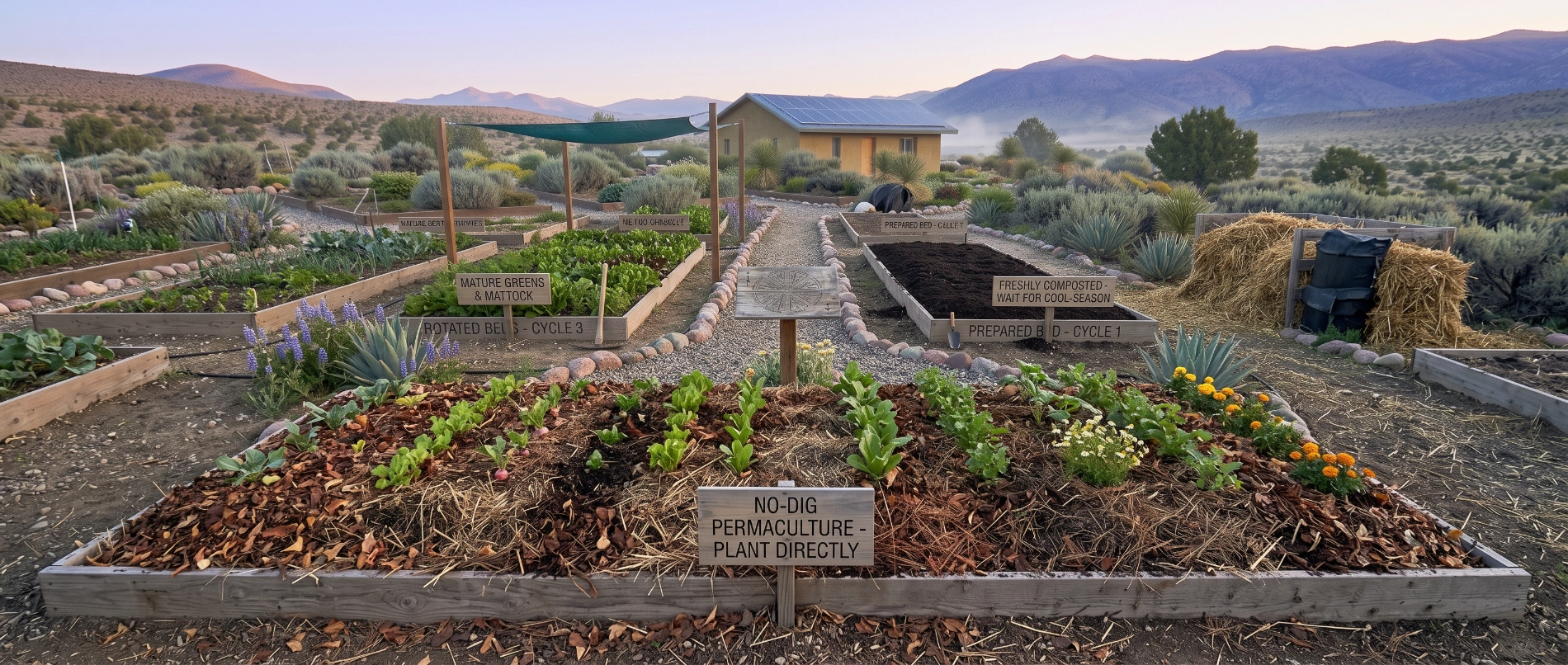
Digging or turning soil exposes moist subsoil directly to sun and air, which accelerates evaporation dramatically compared to ground that's simply left alone. It also breaks up the soil structure, the network of pores and aggregates, that helps water infiltrate when it does arrive and then stay held in the ground rather than running off or evaporating straight back out. An undisturbed, mulched no-dig bed loses far less moisture than bare dug soil, and needs less frequent irrigation as a direct, measurable result. This is why no-dig belongs alongside trench composting and shade cover as one of the foundational moisture-retention practices this whole guide is built around (see Chapter 3).
The Method
Lay a thick layer of compost and mulch directly onto the soil surface, often over cardboard or similar material to suppress existing weeds without digging them out. Plant straight into that surface layer rather than digging beds and turning the soil beneath, which stays undisturbed indefinitely. Over time the surface layer settles, feeds the soil beneath it, and gets topped up again, but the ground itself is never turned.
Stretching Scarce Compost with Mulch
No-dig is genuinely compost-intensive, a trade-off that's a live tension even in a wetter climate and an even sharper one here, given how hard-won every batch of finished compost is. The way through is to treat compost as one layer of a broader mulch system rather than the only ingredient in it. Chop-and-drop material from drought-tolerant green manures (see Chapter 12) and any locally available dry plant matter, straw, prunings, spent crop stalks, can make up the bulk of the covering, with finished compost layered in to do the concentrated fertility work that mulch alone can't. That combination lets a limited compost supply go much further than it would spread on its own.
Frequently Asked Questions
Why does no-dig matter more in an arid climate than elsewhere?
Because undisturbed soil retains moisture far better than soil that's been dug or turned. Digging exposes moist subsoil to air, which accelerates evaporation, and it breaks up the soil structure that would otherwise help water infiltrate and stay put. In a climate where every drop of water is precious, that difference between dug and undisturbed ground is a genuinely large one, not a marginal gain.
How does a no-dig bed actually work?
A thick layer of compost and mulch goes straight onto the soil surface, often over a layer of cardboard or similar material to suppress weeds without digging, and crops are planted directly into that surface layer rather than into dug and turned ground beneath it. The soil underneath is never disturbed, so its structure and moisture stay intact season after season.
No-dig needs a lot of compost -- how do I manage that when compost is scarce here?
Lean on mulch to stretch what compost you do have, rather than treating compost as the only ingredient in the surface layer. Chop-and-drop green manure material and any locally available dry plant matter can make up the bulk of the mulch, with finished compost used as one layer within that system rather than the whole thing, so the compost-intensive nature of no-dig doesn't outpace what a hard-won supply can realistically provide.