
In a cool, wet climate, winter is the dormant, difficult season for composting. Here, that's inverted: peak summer is usually the hard period, and the cooler months, often the main growing season in this climate, are actually the more favourable window for active composting.
Peak Summer: The Difficult Season
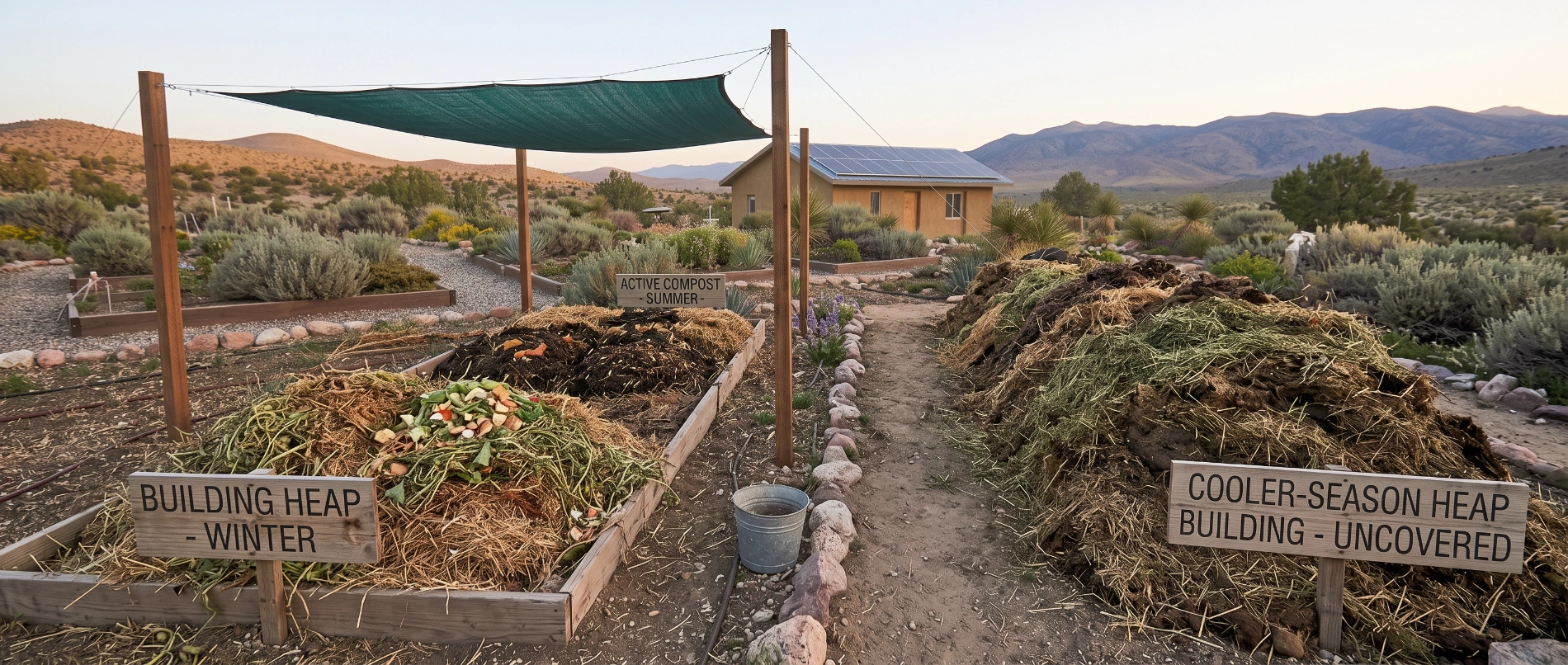
Peak summer brings two threats at once: a heap can overheat past the point where its microbes can survive (see Chapter 1), and extreme evaporation demands can strip it of moisture faster than almost any other time of year (see Chapter 11). Managing through this season means treating both risks as active, ongoing work rather than a set-and-forget heap.
- Shade becomes essential, not optional. An unshaded heap in peak summer sun risks both overheating and rapid drying at once.
- Watering needs to happen more frequently to keep pace with the higher evaporation demand, even while following the deep-soak technique rather than light frequent splashes.
- Consider smaller, more heavily shaded heaps rather than one large exposed pile, since a smaller heap is easier to keep evenly moist and shaded through the worst of the heat.
- Lean on below-ground methods. Trench and pit composting comes into its own in summer, since surrounding soil buffers both heat and moisture loss far better than anything sitting above ground.
The Cool/Mild Season: The Productive Window
The cooler months are usually the most active, productive composting window of the year here. Temperatures are moderate rather than extreme, any seasonal rain the zone receives falls mostly in this period, and there's typically more fresh plant material available to feed the heap from whatever is being harvested during the main growing season (see the rotation calendar in Chapter 17). This is the season to build new heaps, run them harder, and expect the fastest turnaround from raw material to finished compost.
Two Seasons, Not Four
Unlike a temperate climate's fixed four seasons, many arid and semi-arid regions really only offer two practical windows for composting purposes, and exact calendar dates vary enormously by region rather than following one shared pattern worldwide. Think in terms of a difficult hot/dry season and a more workable cool/mild season, with some semi-arid transitional zones getting a brief rainy season somewhere between the two. Plan heap-building and heavier maintenance work around the cool/mild window, and treat the hot/dry season as a period of careful maintenance rather than expansion.
Frequently Asked Questions
Is summer or winter the hardest season for composting in an arid climate?
Summer, which is the reverse of a cool, wet climate where winter is the difficult season. Peak summer brings the double threat of a heap overheating past the point of usefulness and extreme evaporation demands stripping it of moisture, while the cooler months here are usually the more favourable window for active, productive composting.
How should I manage a compost heap through peak summer heat?
Shade becomes essential rather than optional, watering needs to happen more frequently to keep pace with evaporation, and it's often worth running smaller, more heavily shaded heaps rather than one large exposed one that's harder to keep evenly moist. Below-ground trench and pit methods come into their own here, since the surrounding soil buffers both the heat and the moisture loss that above-ground heaps suffer most in this season.
Do arid and semi-arid regions really only have two composting seasons?
Broadly, yes, and that's a genuinely useful simplification even though exact calendars vary enormously by region. Rather than four fixed seasons, most arid and semi-arid zones really offer two practical windows for composting purposes: a difficult hot/dry season and a more workable cool/mild season, sometimes with a brief rainy season in between in semi-arid transitional zones.