
A working reference of everything covered so far, gathered in one place: what to use, what to be cautious with, and what to keep out of the heap entirely. Every material here is something genuinely available in a dry climate, not a list borrowed from a wetter one.
Good Carbon Inputs
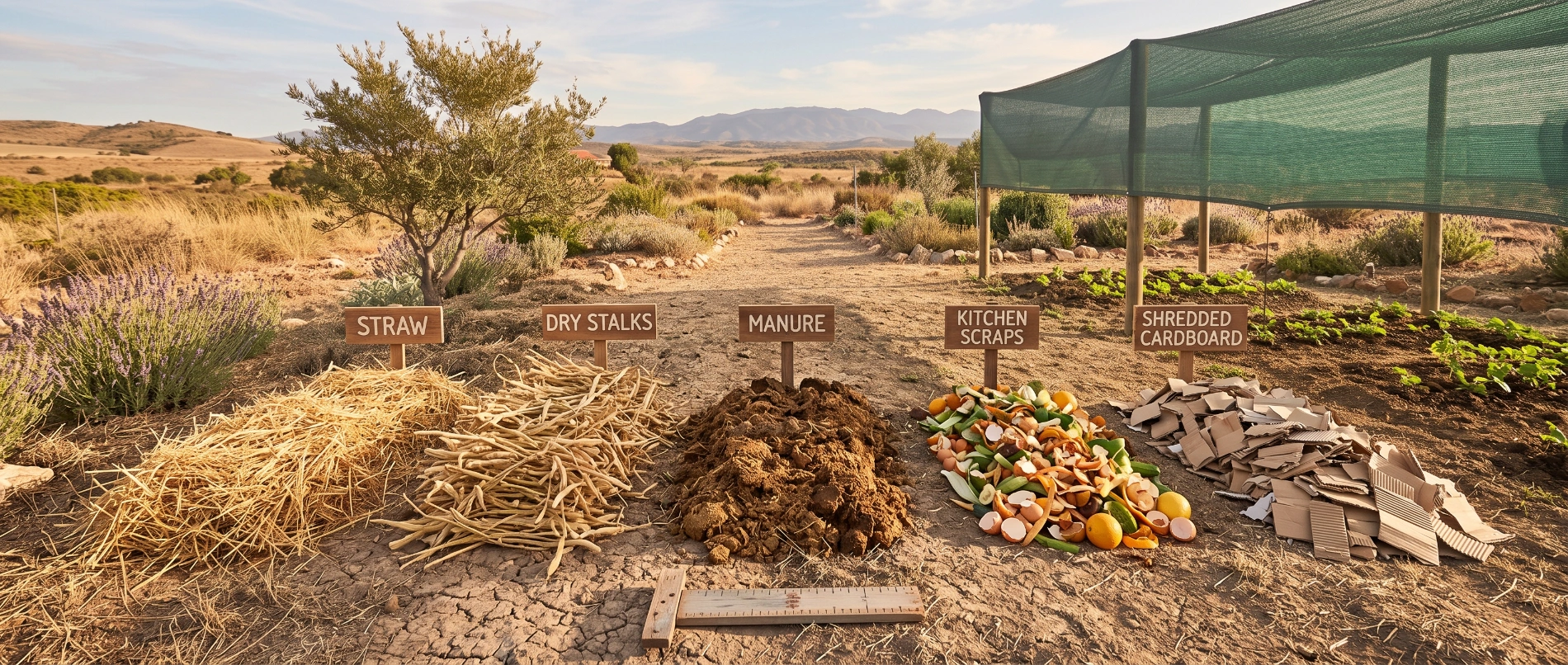
- Dry crop residue and stalks -- abundant after any harvest, chop or crush for faster breakdown.
- Straw -- the default dry brown in this climate, easy to source and easy to layer.
- Cardboard -- plain, uncoated cardboard only; shred or soak it to speed decomposition (see the caution below on glossy cardboard).
- Dry leaves and brush -- good bulk carbon wherever trees or scrub are locally available.
- Woody prunings -- very slow to break down whole, so shred first and mix thin through the heap.
- Dried grass -- once cured brown, a useful carbon source distinct from fresh green grass clippings.
Good Nitrogen Inputs
- Manure -- the backbone nitrogen source across dryland composting; see Chapter 6 for handling and application.
- Kitchen scraps -- genuinely precious in this climate; save every scrap for the heap rather than letting any go to waste.
- Urine -- a concentrated, always-available activator; see Chapter 8 for dilution and use.
- Fresh-pulled weeds -- pull before they set seed, both for nitrogen value and to avoid reintroducing weed seed later.
- Legume trimmings -- green manure cuttings from nitrogen-fixing cover crops are a rare reliable source of fresh green material here.
Materials to Avoid
Not everything belongs in the heap. Some materials are genuine no-gos; others aren't harmful so much as very slow or risky in specific ways and worth handling with more care. Anything kept out of the heap should be piled separately for another use rather than treated as waste -- see Chapter 9 for turning woody and problem material into biochar instead.
| Tier | Material | Why |
|---|---|---|
| 1 -- Avoid entirely | Meat, fish, cooked food, dairy | Attracts pests -- rodents and ants are a real problem in dry climates too |
| 1 -- Avoid entirely | Diseased plant material | Can reinfect future crops once spread as compost |
| 1 -- Avoid entirely | Pet / dog faeces | Carries pathogens unsuited to a food-growing system |
| 1 -- Avoid entirely | Perennial weed roots and seeds | May survive a heap that doesn't reliably reach weed-killing temperatures, which is more likely here if a heap is moisture-limited |
| 1 -- Avoid entirely | Treated / glossy cardboard | Inks, coatings and laminates don't break down cleanly |
| 2 -- Use with caution | Very woody or thorny desert scrub (mesquite, acacia) | Extremely slow to break down -- shred thoroughly first |
| 2 -- Use with caution | Salt-heavy or irrigation-affected plant matter | Composting doesn't remove salts; keep out of compost meant for food beds |
Tier 1 items should be kept out of every heap. Tier 2 items can be composted with extra preparation or care, not avoided outright.
Frequently Asked Questions
What are the best carbon inputs in a dry climate?
Dry crop residue and stalks, straw, cardboard, dry leaves and brush, woody prunings and dried grass are all genuinely abundant here and make excellent carbon material. Chop or shred the woodier items where you can, since smaller pieces break down considerably faster than whole stalks or branches.
Why does treated or glossy cardboard need to be kept out of the heap?
Glossy, heavily printed or plastic-coated cardboard often contains inks, coatings or laminates that don't break down cleanly and can introduce contaminants into finished compost. Plain, uncoated cardboard is fine and genuinely useful; anything glossy or plastic-backed should be piled separately rather than added.
Can I compost salt-affected or irrigation-damaged plant material?
Avoid adding heavily salt-laden material, including plant matter from soil with a known salinity problem. Composting doesn't remove salts, it just carries them through into the finished product, and dryland or heavily irrigated soils already carry more salinity risk than most. Pile this material separately rather than working it into a heap you intend to use on food-growing beds.