
A temperate maritime climate -- the kind found across Britain, Ireland, coastal northwest Europe, parts of New Zealand, and the Pacific Northwest -- presents a specific set of challenges and opportunities for the composter. Understanding these properly, not just as a list of tips but as the actual biology behind them, is the foundation everything else in this guide builds on.
The Challenges
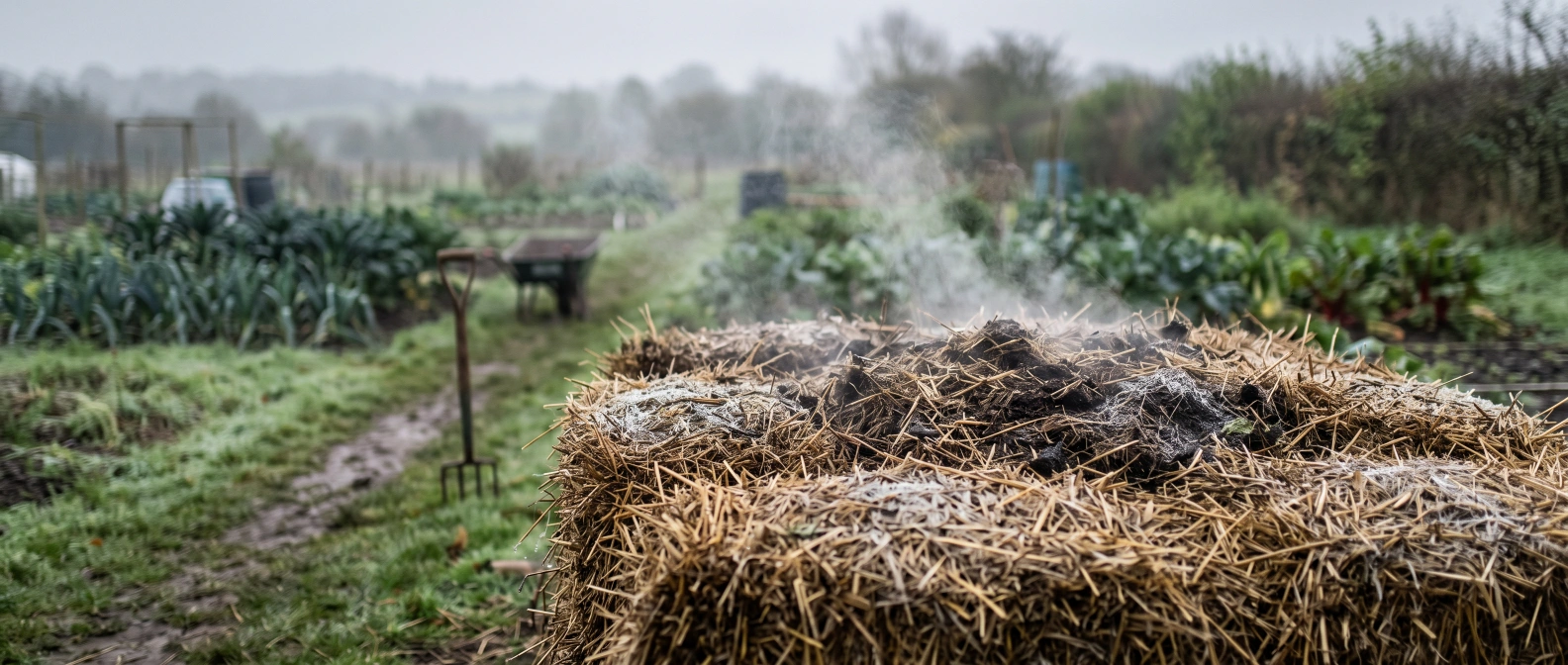
Cool temperatures slow microbial activity
This is the central challenge compared to composting in a warm climate. Sustained temperatures of 55-65°C are what kill most plant pathogens and weed seeds in a heap, and reaching that range depends on a large, active population of heat-generating bacteria working fast enough to outpace heat loss. In a cool climate, both halves of that equation work against you: the ambient temperature starting point is lower, and heat escapes the heap faster than it would somewhere warm. This is why heap mass, insulation and patience run through almost every chapter in this guide -- they're the direct compensation for this one fact.
High rainfall and humidity drive anaerobic decomposition
Composting is fundamentally an aerobic process -- the beneficial bacteria that break material down quickly and without bad smells need oxygen throughout the heap, held in the air pockets between particles. Persistent rain saturates those pockets with water instead of air, pushing the heap toward anaerobic decomposition: slower, smellier, and dominated by a different microbial community that doesn't reach the same temperatures or produce the same quality of finished compost. Moisture management, above almost everything else, is the practical skill this climate demands.
Variable seasons mean fluctuating heap activity
A heap that's working hard in July can be nearly dormant by January, and management needs to flex with it -- turning frequently in summer, barely at all in deep winter, with different inputs favoured at different times of year. Chapter 13 covers this season by season.
Slower decomposition overall means longer processing times
Everything simply takes longer here than it would in a hot climate. This matters for ordinary garden compost, but it matters most when handling humanure safely (Chapter 7) -- where the lack of reliable tropical heat is precisely why this guide sets a genuinely conservative two-year processing minimum rather than the shorter cycles sometimes quoted for warmer regions.
The Advantages
- Abundant carbon materials -- bracken, straw, rushes, autumn leaves and abundant coastal seaweed all provide excellent bulking material, and are genuinely free for the collecting across most of this zone.
- Large, active earthworm populations thrive in cool, moist soils -- and worms are among the most powerful composting organisms available (see Chapter 10, Vermicomposting).
- Year-round moisture means heaps rarely dry out completely, unlike in continental climates where summer heat can stall a heap just as effectively as winter cold does elsewhere.
- Coastal access to seaweed -- one of the most mineral-rich compost inputs on earth, containing 60+ trace elements often depleted from ordinary agricultural soils -- is a genuinely unique advantage of maritime locations (see Chapter 6).
Frequently Asked Questions
Why is 55-65°C heat so important in composting?
Sustained temperatures in that range are what kill most plant pathogens and weed seeds, so a heap that reaches and holds them produces compost safe to use on any crop. Below that range, decomposition still happens, but it's driven by a cooler, slower community of organisms that doesn't reliably kill everything a hot heap would -- which is exactly why this guide leans so heavily on heap mass, insulation and time to compensate.
Why does rain cause a heap to go anaerobic?
Composting needs oxygen -- the beneficial bacteria that break material down quickly and without bad smells are aerobic, meaning they need air pockets throughout the heap to function. Waterlogging fills those pockets with water instead of air, and the community that takes over in those airless conditions works far slower and produces the sulphurous, ammonia-like smells of a heap gone wrong. In a high-rainfall climate, keeping the heap covered is what prevents this.
Does a temperate maritime climate actually have any advantages for composting?
Genuinely, yes, and they matter as much as the challenges. Abundant carbon material (bracken, straw, rushes, autumn leaves), large active earthworm populations that thrive in cool moist soil, year-round moisture that stops heaps drying out the way they can in a continental climate, and -- for anyone near the coast -- free access to seaweed, one of the most mineral-rich compost inputs available anywhere.