
Where you site your compost system, and what you build it from, matters more in a temperate maritime climate than almost anywhere else. Every choice here is really a choice about heat retention and rain management -- the two forces this climate throws at a heap hardest. Get the site and the structure right and the biology described in Chapter 1 has a fighting chance; get them wrong and you're compensating for a bad start for the rest of the heap's life.
Choosing Your Site
South or southwest facing
This orientation captures maximum solar gain through the year. A south-facing wall positioned behind the heap does real work too -- it reflects and radiates warmth back into the heap, adding meaningful extra heat through the coldest months, essentially for free.
Sheltered from prevailing wind
Wind accelerates heat loss from the surface of a heap the same way it does from your own skin on a cold day. A hedge, fence or wall positioned to windward makes a genuinely noticeable difference to how much heat a heap holds onto through winter.
Partial shade in summer
A site under a deciduous tree gives you the best of both seasons -- summer shade that stops the heap drying out, and, once the leaves fall, winter sun reaching it exactly when the solar gain matters most. It's about as close to an ideal microclimate as this climate offers.
Level ground with good drainage
The base of the heap must never sit in standing water, or the bottom layer will go anaerobic regardless of how well the rest is managed. If your site drains poorly, raise the heap's base on pallets or a layer of brushwood.
Convenient access
You'll be using this system constantly -- adding material, turning it, checking on it. A location that's awkward to reach gets neglected, and a neglected heap in this climate goes downhill fast. Somewhere near the kitchen and near the vegetable plot is genuinely ideal.
Construction Materials
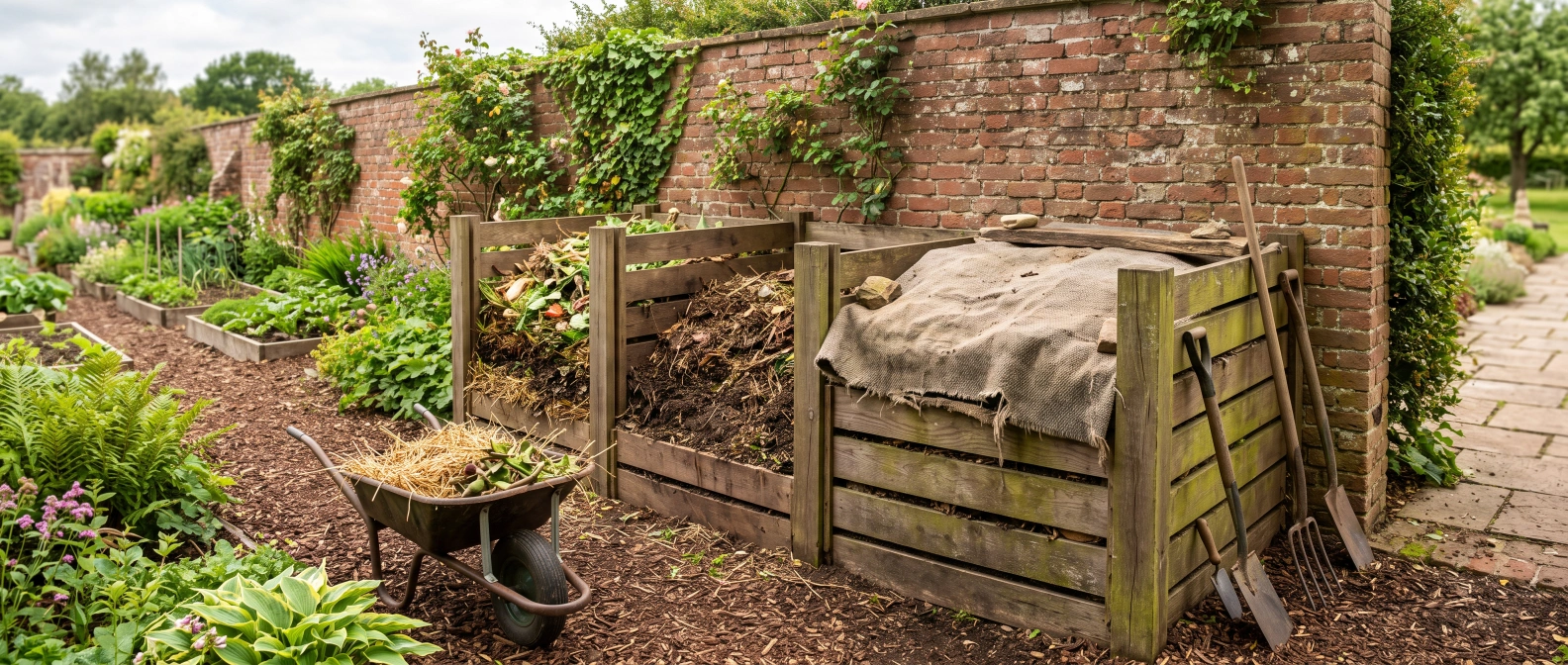
In order of effectiveness for temperate maritime conditions:
- Thick wooden planks or railway sleepers -- the best heat retention available. Build three-sided bays with removable front boards, which make turning and harvesting far easier.
- Straw bales -- excellent insulation, cheap, and easy to reconfigure. Replace them after 2-3 seasons once they begin to break down.
- Wattle panels -- traditional and genuinely effective. Hazel, willow or any flexible wood woven between stakes; drape old carpet or hessian sacking over them in winter for extra insulation.
- Stone walls -- excellent heat retention through thermal mass, absorbing warmth by day and releasing it back overnight. Traditional in upland areas for good reason.
- Wire mesh lined with cardboard -- the minimum viable option. Upgrade its insulation by packing straw against the outside through winter.
Covering the Heap
In a maritime climate, covering the heap is not optional -- it's essential. An uncovered heap left through persistent rain becomes waterlogged and goes anaerobic within weeks. Good options:
- Old carpet (wool or natural fibre) -- the traditional solution; insulates and sheds rain well.
- Hessian sacking, slightly weighted at the edges so it stays put in wind.
- A sheet of wood or corrugated iron, propped at an angle to shed rain.
- Thatched straw laid over the top, traditional farmhouse style.
Frequently Asked Questions
Why does a compost heap need a minimum size of one cubic metre?
Below roughly one cubic metre (about 1m x 1m x 1m), a heap simply doesn't hold enough mass to retain the heat its own microbial activity generates -- it loses heat to the surrounding air faster than it can produce it, especially through a cool maritime winter. Larger heaps have proportionally less surface area exposed to the cold relative to their volume, so they run hotter and compost far more effectively. In this climate, bigger is genuinely better.
Is covering the heap really necessary?
Yes -- in a maritime climate it isn't optional. Persistent rain will waterlogge an uncovered heap within weeks, filling the air pockets the aerobic bacteria depend on and pushing the whole heap anaerobic: slower, smellier, and far less effective. Old carpet, hessian sacking, a propped sheet of wood or corrugated iron, or a layer of thatched straw all work -- the point is simply to shed rain while still letting some air reach the heap.
What's the single best construction material for a maritime climate?
Thick wooden planks or railway sleepers give the best heat retention and let you build proper three-sided bays with removable front boards for easy turning and harvesting, which is why they top the list. But stone walls run them close on heat retention through sheer thermal mass, and straw bales are an excellent, cheap alternative if timber isn't available -- the right choice depends more on what you have access to than on any one material being essential.