
The two-chamber alternating system is the most effective low-technology approach for a temperate maritime climate. It solves a tension that trips up a lot of first-time composters: fresh material needs to go in continuously, but safe, finished compost needs uninterrupted resting time to get there. Trying to do both in one heap means you never quite get either right.
Chamber A -- Active Filling
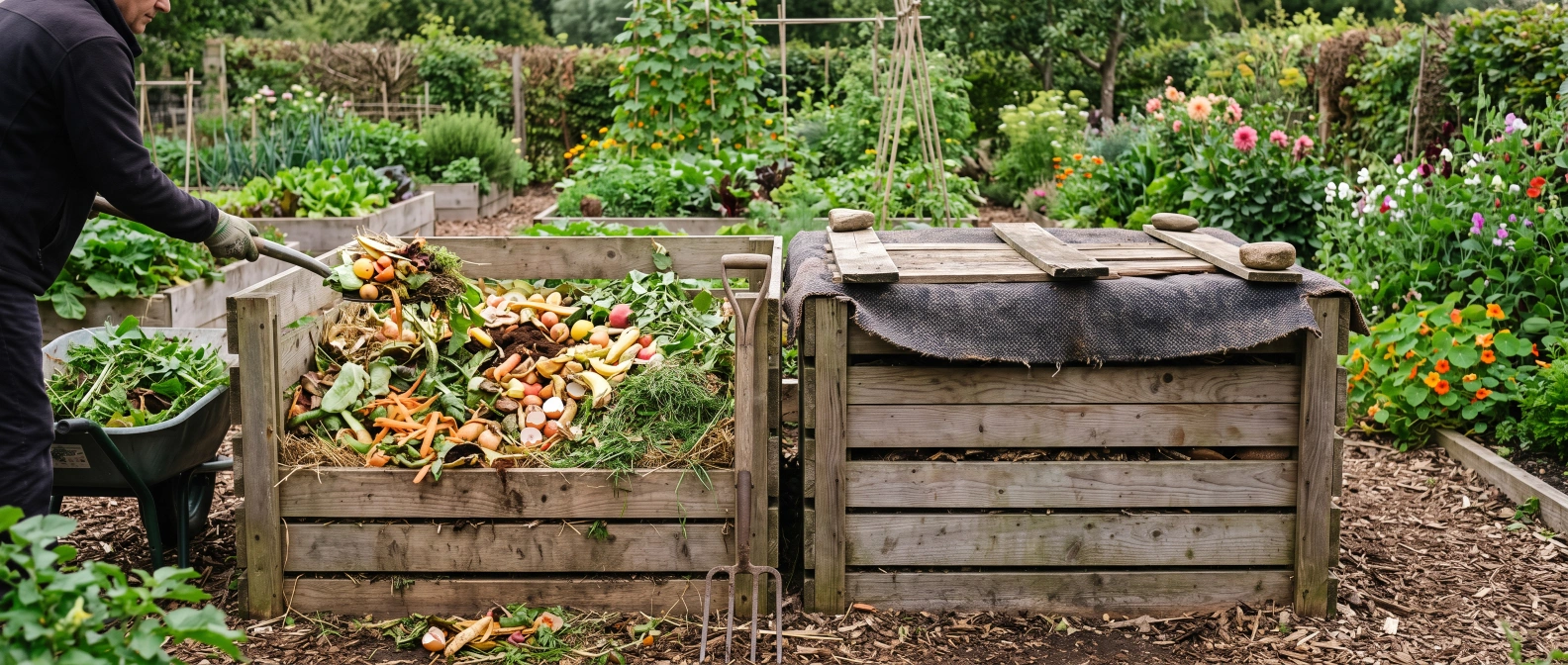
- Receives all fresh inputs continuously over 6-12 months.
- Layered carefully with carbon and nitrogen materials in rotation (see Chapter 4).
- Turned every 4-6 weeks in summer, less often in winter.
- Kept covered at all times; moisture checked regularly.
Chamber B -- Resting & Finishing
- Receives no new material -- critical for pathogen safety and even decomposition throughout.
- Turned 2-3 times across the season to introduce oxygen.
- Monitored for temperature and moisture.
- After 12 months resting, the finished compost is harvested and applied.
The Three-Chamber System
If space allows, a third chamber adds significant flexibility -- one chamber actively filling, one in mid-rest, one finished and ready to use. This is the traditional farmyard midden approach scaled to garden size, and it gives you a continuous supply of finished compost year-round rather than the staged rhythm of the two-chamber cycle above.
Frequently Asked Questions
How long does the two-chamber cycle take from start to finish?
Chamber A fills for 6-12 months as you add fresh material continuously, then everything transfers to Chamber B to rest for a further 12 months before harvest. End to end that's roughly 18 months to 2 years from the first material going in to that same batch coming out as finished compost -- but because you begin refilling Chamber A the moment you empty it into Chamber B, you're never actually waiting; there's always a batch at some stage of the cycle.
Why can't I just keep adding to one heap continuously?
Because fresh material and finished compost need opposite things. Fresh inputs need continuous topping up, but safe, evenly finished compost needs an uninterrupted resting period with no new material disturbing the process or introducing fresh pathogens partway through. A single heap that's constantly topped up never gets that uninterrupted rest, so you end up with a mix of raw and finished material throughout, and no reliable way to know when any given part is actually ready to use.
Is a third chamber worth building?
If you have the space, yes. A third chamber means one heap is always actively filling, one is mid-rest, and one is finished and ready to use -- essentially the traditional farmyard midden approach scaled down to garden size. It gives you a continuous, year-round supply of finished compost rather than the two-chamber system's more staged rhythm, at the cost of needing roughly 50% more space.