
Composting is fundamentally the management of microbial communities. Those communities need carbon for energy and structure, and nitrogen for protein synthesis. The ratio between the two is what determines whether your heap heats up properly, goes slimy, dries out, or works exactly as it should.
The Target Ratio
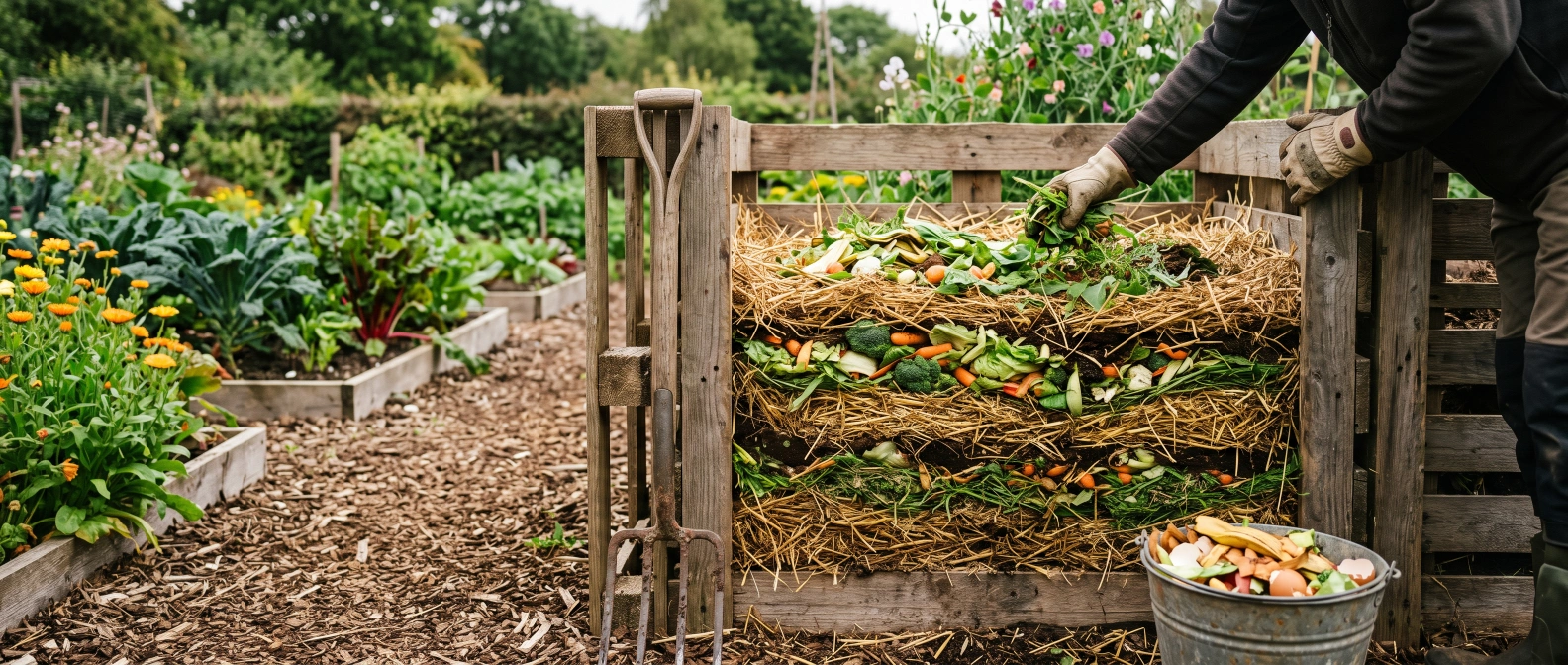
Aim for roughly 25-30 parts carbon to 1 part nitrogen by weight in your heap overall. In practice this means alternating layers of brown (carbon-rich) material and green (nitrogen-rich) material, with roughly twice the volume of browns to greens -- browns tend to be bulkier and lighter than greens, which is why the volume ratio looks different from the weight ratio.
Why This Ratio Actually Matters
Carbon and nitrogen aren't just abstract categories -- they map onto what the microbial community in your heap is genuinely doing with each material. Carbon is their energy source, burned for fuel and built into new cell structure. Nitrogen is what builds the proteins and enzymes those microbes need to actually grow and reproduce. Get the balance wrong in either direction and the population that does the decomposing can't function properly.
Too much carbon relative to nitrogen and the microbial population is starved of the protein-building blocks it needs to grow -- there's plenty of fuel but not enough workers, so decomposition crawls along far slower than it should, and a heap of pure straw or shredded cardboard can sit for a year with barely any visible change.
Too much nitrogen relative to carbon and the microbial population has more protein-rich material than it can use -- the surplus is released as ammonia gas (the sharp smell of an over-green heap), and nitrogen-rich material is often wet and dense besides, which compacts easily and squeezes out the air pockets aerobic decomposition depends on. That's why an all-grass-clippings heap so reliably turns into a slimy, smelly mat rather than compost.
Carbon (Brown) vs Nitrogen (Green) at a Glance
A representative spread of common materials, from the most carbon-heavy to the most nitrogen-heavy this climate offers. The full input list, with every material this guide covers and practical notes on using each one, is in the next chapter.
| Material | C:N Ratio | Category |
|---|---|---|
| Cardboard (plain) | ~400:1 | Carbon (brown) |
| Wheat / oat straw | ~80:1 | Carbon (brown) |
| Dried autumn leaves | ~60:1 | Carbon (brown) |
| Dried bracken fern | ~50:1 | Carbon (brown) |
| Fresh grass clippings | ~20:1 | Nitrogen (green) |
| Cow / horse manure | ~20:1 | Nitrogen (green) |
| Kitchen vegetable waste | ~15:1 | Nitrogen (green) |
| Nettles / comfrey leaves | ~10:1 | Nitrogen (green) |
| Chicken manure | ~7:1 | Nitrogen (green) |
| Human urine (diluted) | ~1:1 | Nitrogen activator |
Ratios are approximate -- real material varies with freshness, moisture content and exact species. Treat them as a guide to relative balance, not a figure to measure precisely.
Working Out Your Own Mix
You don't need to weigh anything to get this right in practice. Because browns are typically bulkier and lighter than greens, working by volume rather than weight naturally lands close to the right ratio -- roughly two buckets, barrowloads or armfuls of carbon material to every one of nitrogen material as you build up layers.
A practical rule of thumb: every time you add a bucket of kitchen scraps or fresh grass clippings, follow it with two buckets of straw, shredded cardboard or dried leaves. If you're adding something very nitrogen-dense -- fresh chicken manure in particular -- lean even further toward carbon to compensate, since its ratio is so far from balanced on its own.
Reading Your Heap
| Symptom | Cause | Fix |
|---|---|---|
| Slimy, cold, smells of ammonia | Too much nitrogen, too wet | Add more carbon material; turn to introduce air |
| Dry, straw-like, not decomposing | Too much carbon, too dry | Add nitrogen activator (nettles, urine, manure); water lightly |
| Hot and active in centre only | Good core but poor edges | Turn heap to move edges to centre |
| Smells of rotten eggs | Anaerobic, needs air | Turn immediately; add dry carbon material |
| Heats up then goes cold quickly | Not enough mass or insulation | Build bigger; insulate better; add activators |
Frequently Asked Questions
What's the ideal carbon-to-nitrogen ratio for a compost heap?
Aim for roughly 25-30 parts carbon to 1 part nitrogen by weight across the heap overall. In practice that means alternating layers of brown, carbon-rich material and green, nitrogen-rich material, with roughly twice the volume of browns to greens -- weight and volume aren't the same thing, and browns are typically lighter and bulkier, which is why the volume ratio looks different from the weight ratio.
Why does my heap smell of ammonia?
An ammonia smell, usually alongside a slimy, cold texture, means too much nitrogen and too much moisture relative to carbon -- the excess nitrogen is being released as ammonia gas rather than being used by the microbial community. Fix it by mixing in more carbon material such as straw, dried leaves or shredded cardboard, and turn the heap to introduce air at the same time.
Why does my heap heat up and then go cold again quickly?
This is usually a sign there isn't enough mass or insulation to hold onto the heat the initial burst of activity generates -- the heap gets a strong start but can't sustain it. The fix is to build the heap bigger (see Chapter 2 for the one-cubic-metre minimum), insulate it better, and add nitrogen-rich activators like nettles, comfrey or manure to restart and sustain the heating process.
Do I actually need to weigh my compost inputs to get the ratio right?
No -- working by volume rather than weight is genuinely accurate enough in practice, because browns are typically bulkier and lighter than greens. A rough rule of thumb of two buckets or barrowloads of carbon material to every one of nitrogen material, added as you go, naturally lands close to the target ratio without ever needing a scale.