
Chapter 4 covered the theory of the carbon-to-nitrogen ratio. This chapter is the practical reference -- every material commonly available across a temperate maritime climate, with its approximate C:N ratio, category, and any notes worth knowing before you add it to the heap.
Input Materials by C:N Ratio
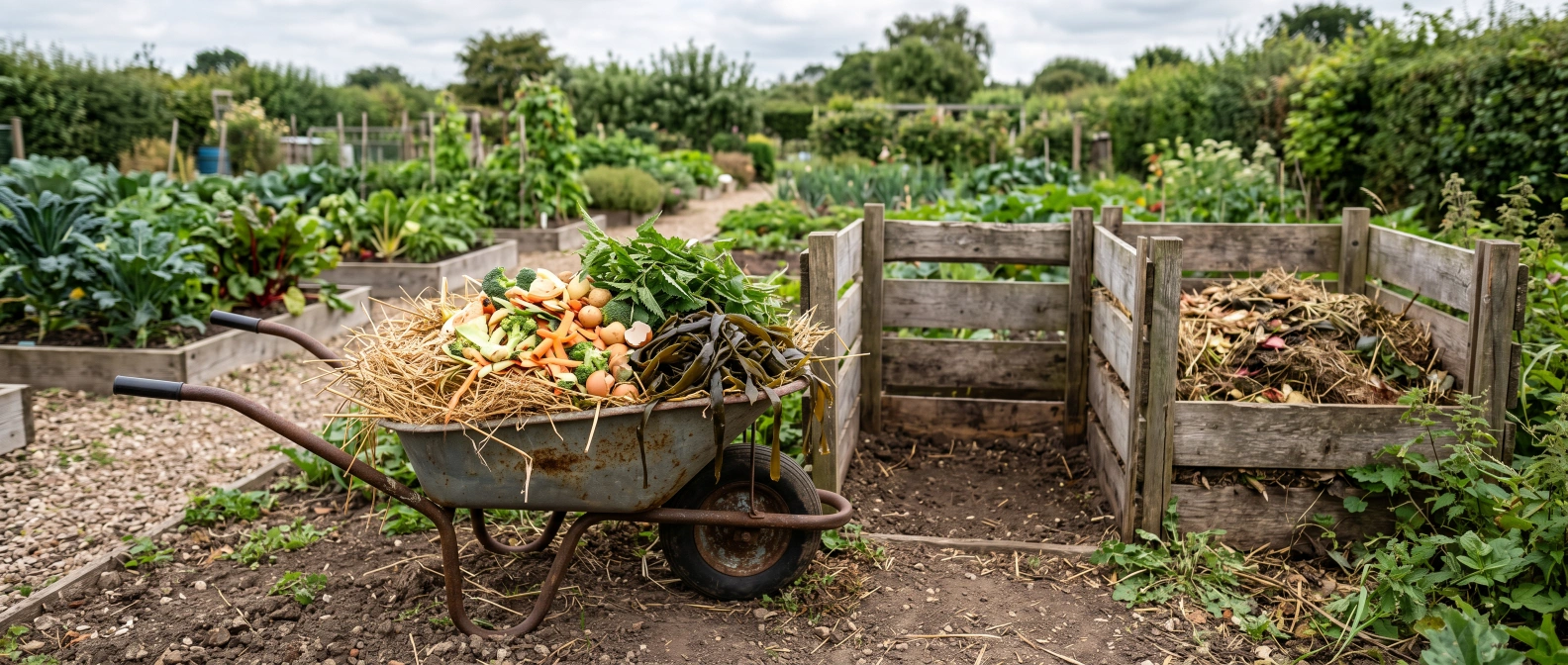
Every material worth adding to a temperate maritime heap, in one place.
| Material | C:N Ratio | Category | Notes |
|---|---|---|---|
| Dried bracken fern | ~50:1 | Carbon (brown) | Excellent bulking material; harvest late summer |
| Wheat / oat straw | ~80:1 | Carbon (brown) | Classic temperate standby; chop if possible |
| Dried autumn leaves | ~60:1 | Carbon (brown) | Mat if thick; mix or chop well |
| Wood ash | Variable | Mineral additive | Raises pH; adds potassium; use sparingly |
| Dried rushes / sedge | ~50:1 | Carbon (brown) | Coastal & wetland areas; slow to break down |
| Fresh grass clippings | ~20:1 | Nitrogen (green) | Mix in thin layers; avoid clumping |
| Kitchen vegetable waste | ~15:1 | Nitrogen (green) | Bury centrally to deter flies |
| Nettles | ~10:1 | Nitrogen (green) | Excellent activator; rich in iron & silica |
| Comfrey leaves | ~10:1 | Nitrogen (green) | Super-activator; makes superb liquid feed too |
| Seaweed (fresh) | ~19:1 | Nitrogen (green) | Rinse salt off first; adds 60+ trace minerals |
| Seaweed (dried) | ~50:1 | Carbon/mineral | Excellent slow-release mineral amendment |
| Human urine (diluted) | ~1:1 | Nitrogen activator | Dilute 10:1 with water; apply to heap freely |
| Humanure (composted) | ~10:1 | Nitrogen (green) | Only after full 2-year hot composting cycle |
| Cow / horse manure | ~20:1 | Nitrogen (green) | Best activator; adds vast microbial diversity |
| Chicken manure | ~7:1 | Nitrogen (green) | Very hot; use sparingly or pre-compost first |
| Coffee grounds | ~20:1 | Nitrogen (green) | Worms love them; good microbial food |
| Cardboard (plain) | ~400:1 | Carbon (brown) | Soak before use; remove tape/staples |
What Not to Add, at a Glance
Two genuinely different categories here. The first tier is a real no -- these cause active problems (vermin, disease, pathogens, poisoned soil or plants) and don't belong in a heap or leafmould pile at any quantity. The second tier isn't dangerous, just slow and best used sparingly rather than banned outright -- full detail on each is below.
Tier 1 -- Genuine No-Gos
| Material | Why |
|---|---|
| Meat, fish, cooked food, dairy | Attracts vermin; rots anaerobically |
| Diseased plant material | Spreads disease unless the heap sustains 60°C+ |
| Cat or dog faeces | Pathogens transferable to humans |
| Coal ash | Sulphur compounds harmful to soil biology |
| Glossy or treated cardboard | Inks and coatings may contain harmful compounds |
| Perennial weed roots (couch grass, bindweed, dock) | Survive an ordinary heap and spread; needs sealed-bag or drowning treatment instead |
| Ivy stems | Roots readily from cut fragments; same survive-and-resprout risk as perennial weed roots |
| Walnut leaves | Contains juglone, which actively poisons other plants |
Tier 2 -- Slow to Break Down, Use Sparingly
| Material | Why |
|---|---|
| Rhododendron, laurel, camellia | Thick, waxy leaves; very slow and mildly acidifying |
| Holly | Same leathery, waxy problem, plus spines that don't soften -- shred first |
| Pine and other conifer needles | Slow and acidic; fine in small amounts |
| Leylandii | Genuinely worse again -- resin-heavy, barely breaks down even in a hot heap |
| Eucalyptus leaves | Slow, plus mildly allelopathic oils; shred well, use sparingly |
- Meat, fish, cooked food, dairy -- attract vermin and create anaerobic pockets.
- Diseased plant material -- unless you can guarantee sustained temperatures above 60°C.
- Perennial weed roots (couch grass, bindweed, dock) -- survive all but the hottest heaps; compost separately in a sealed bag or drown in water for six weeks first.
- Ivy stems -- a genuinely different risk from most leaf material: ivy roots readily from cut fragments, so pieces left in an ordinary heap can survive and resprout wherever the finished compost ends up. Treat it the same way as perennial weed roots -- a sealed bag or a long soak in water first, not the ordinary heap.
- Rhododendron, laurel and camellia prunings -- their thick, waxy leaves are genuinely slow to break down even in an active heap, and can noticeably acidify the mix if added in quantity; shred well and use sparingly mixed with plenty of other material, or leave out of leafmould entirely (see Chapter 11).
- Holly -- the same leathery, waxy problem as rhododendron and laurel, with the added practical nuisance of spines that don't soften even as the leaf breaks down. Shred it well before adding, both to speed decomposition and to make it safe to handle once turned into the heap.
- Pine needles and other conifer clippings -- slow and acidic for the same reason; fine in small amounts mixed with plenty of other material, but don't rely on them as a bulk input.
- Leylandii -- genuinely a step worse than ordinary conifer prunings; its dense, resin-heavy clippings barely break down even in an active hot heap. Best kept out of home composting entirely -- pile it separately to rot down very slowly over years, or better, burn it for biochar (Chapter 9) so at least the carbon it contains ends up back in the soil rather than going to waste.
- Eucalyptus leaves -- slow to break down like other leathery evergreens, but its aromatic oils are also genuinely allelopathic, well documented to suppress germination of other plants. Shred well, use only in small amounts, and keep it out of anything destined for seed sowing.
- Glossy or treated cardboard -- inks and coatings may contain harmful compounds.
- Coal ash -- unlike wood ash, coal ash contains sulphur compounds harmful to soil biology.
- Cat or dog faeces -- may carry pathogens transferable to humans; not suitable for garden composting without specialist high-temperature systems.
Frequently Asked Questions
What's a good carbon material if I don't have access to bracken or straw?
Dried autumn leaves are an excellent and near-universal alternative -- around 60:1 carbon to nitrogen, abundant across this whole climate zone from deciduous trees, and free for the raking. They do mat down if piled thick, so mix them through the heap or chop them roughly rather than adding them in one solid layer. Plain cardboard is another reliable standby, though at around 400:1 it needs soaking first and should only be used in modest amounts alongside other browns.
Why can't I compost meat or dairy scraps?
Meat, fish, cooked food and dairy attract vermin and create anaerobic, foul-smelling pockets within the heap that are very difficult to fix once established. Ordinary garden composting, even in a well-built two-chamber system, doesn't reliably reach the sustained high temperatures needed to break these materials down safely, so they're best avoided entirely rather than risked.
Can I use coal ash instead of wood ash?
No. Wood ash is a useful mineral additive in moderation, raising pH and adding potassium, but coal ash is a different substance entirely -- it contains sulphur compounds that are harmful to soil biology and should never go on the compost heap or directly onto growing beds.