
Biochar is charcoal produced specifically for incorporation into soil, made by pyrolysis: burning woody material with restricted oxygen, then quenching it with water to stop the burn at the charcoal stage rather than letting it turn to ash. The result is stable, porous carbon that persists in soil for centuries. In this climate, it's a genuine long-term answer to a problem almost every boreal grower faces, soil that started out working against them.
Why Biochar Matters Here -- Correcting Naturally Poor Podzols
Boreal soils are typically podzols, formed under coniferous forest over long periods, where slow-decomposing needle litter builds up on the surface faster than it breaks down. The result, as covered in Chapter 1, is soil that's naturally acidic, nutrient-poor and often thin, biologically sparse compared to soils that formed under other conditions.
Biochar's stable, porous structure helps correct this over time. It improves nutrient retention by holding minerals and compounds in its microscopic pore structure rather than letting them wash straight through thin, acidic ground, and that same pore structure creates habitat for soil bacteria and fungi in ground that would otherwise offer them very little to work with.
- Nutrient retention -- holds nutrients in place against the leaching that naturally acidic, thin soil is prone to.
- Permanent structure -- doesn't break down like compost, so every addition is a lasting improvement rather than something that needs constant replenishing.
- Microbial habitat -- gives soil life a protected home in ground that's naturally biologically sparse.
- Long-term rebuilding -- connects directly to the wider soil-health project in Chapter 19.
Making Biochar From Abundant Woodlot Material
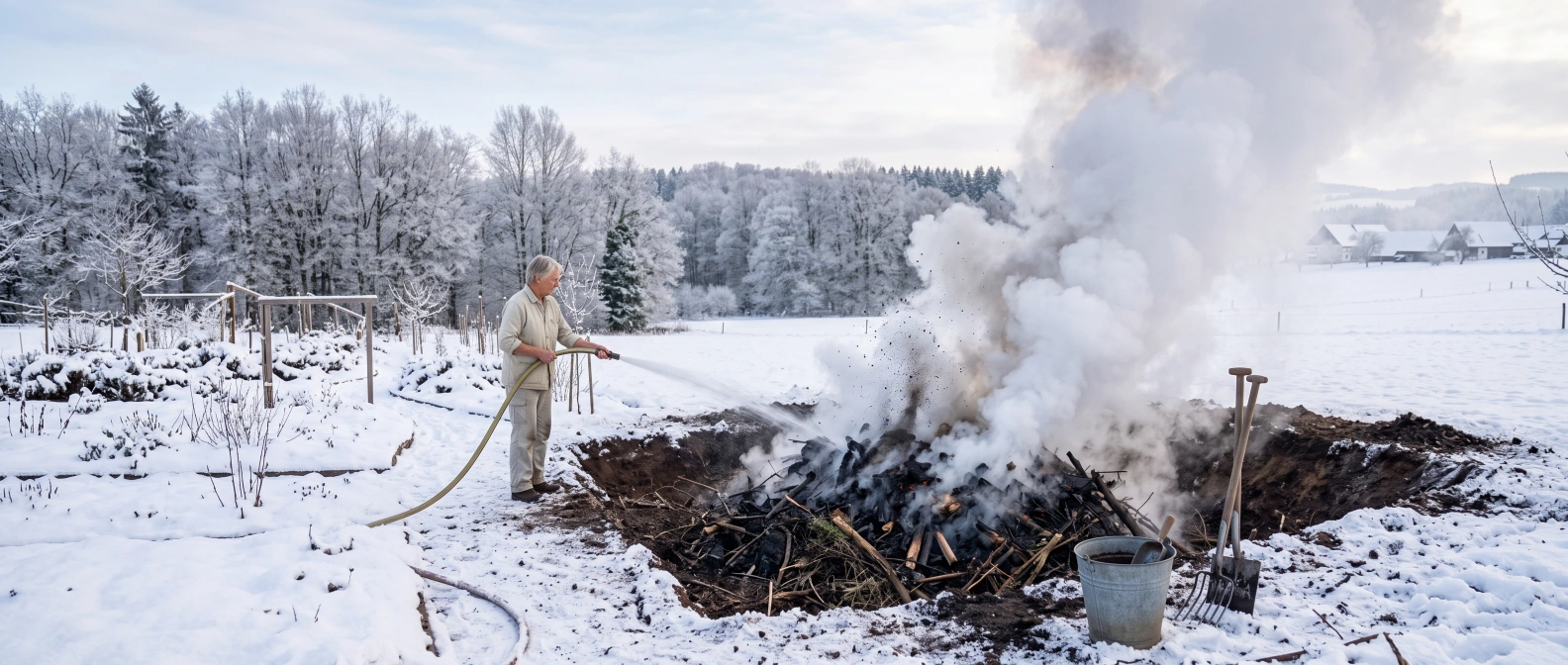
Feedstock is genuinely abundant in this climate, given how widespread wood-burning for heat already is. Offcuts, brush and thinnings from ordinary woodlot management provide a steady supply, especially material that's too woody or resinous to break down well in an ordinary compost heap, see Chapter 5 for what to route to the heap versus what's better converted to biochar instead.
Dig a shallow trench or pit and build a fire with the woody material, letting it burn down to glowing coals. Before the coals turn to grey ash, extinguish immediately by dousing thoroughly with water, quenching the burn at the charcoal stage. The result is a stable, porous black material, distinct from ordinary ash, ready to be charged before use.
Charging Biochar Before Use
Raw biochar can actually rob soil of nutrients initially, its empty pore structure draws nutrients in to fill itself rather than releasing anything useful, so it should never be applied raw and unamended.
- Soak in compost tea -- steep biochar in finished compost tea for several days to weeks before use.
- Soak in diluted urine -- the 1:10 dilution covered in Chapter 8 works well for charging biochar as well as feeding plants directly.
- Mix into finished compost -- combine biochar with finished compost at roughly one part biochar to four parts compost, leave several weeks before applying to soil.
Biochar Is Not Wood Ash -- Two Products, One Woodstove
Wood ash (Chapter 6) and biochar come from the same wood-burning necessity in this climate, and it's easy to conflate them, but they're different products used differently. Ash is a mineral-rich, alkaline, fine-particle input used in careful moderation, a thin sprinkling per layer. Biochar is a deliberately-made, inert, porous carbon structure used more generously as a long-term soil conditioner once charged. One is a seasoning, the other is closer to a permanent structural amendment.
Frequently Asked Questions
Why does biochar matter so much in a cool or boreal climate?
Boreal soils are typically podzols, naturally acidic, nutrient-poor and often thin, having formed under coniferous forest where slow-decomposing needle litter builds up faster than it breaks down. Biochar's stable, porous structure helps correct this over time, improving nutrient retention and giving soil biology a protected home in ground that's naturally quite biologically sparse to begin with.
Where does biochar feedstock come from in this climate?
It's genuinely abundant here, given how widespread wood-burning for heat already is. Offcuts, brush, and thinnings from ordinary woodlot management supply plenty of raw material, especially anything too woody or resinous to break down well in an ordinary compost heap.
Is biochar the same thing as wood ash?
No, even though both come from the same wood-burning necessity in this climate. Wood ash is a mineral-rich, alkaline, fine-particle input used in careful moderation. Biochar is a deliberately-made, inert, porous carbon structure used more generously as a long-term soil conditioner. They're easy to conflate but play genuinely different roles in the garden.