
Vermicomposting in this climate has one hard constraint everything else revolves around: composting worms die if they actually freeze. That single fact makes the whole approach here structurally different from a milder climate, where a bit of extra mulch or a sheltered corner is often enough to see a worm bin through winter. Here, the real answer isn't outdoor management at all, it's bringing the worms inside.
Why Outdoor Vermicomposting Doesn't Work Through Winter Here
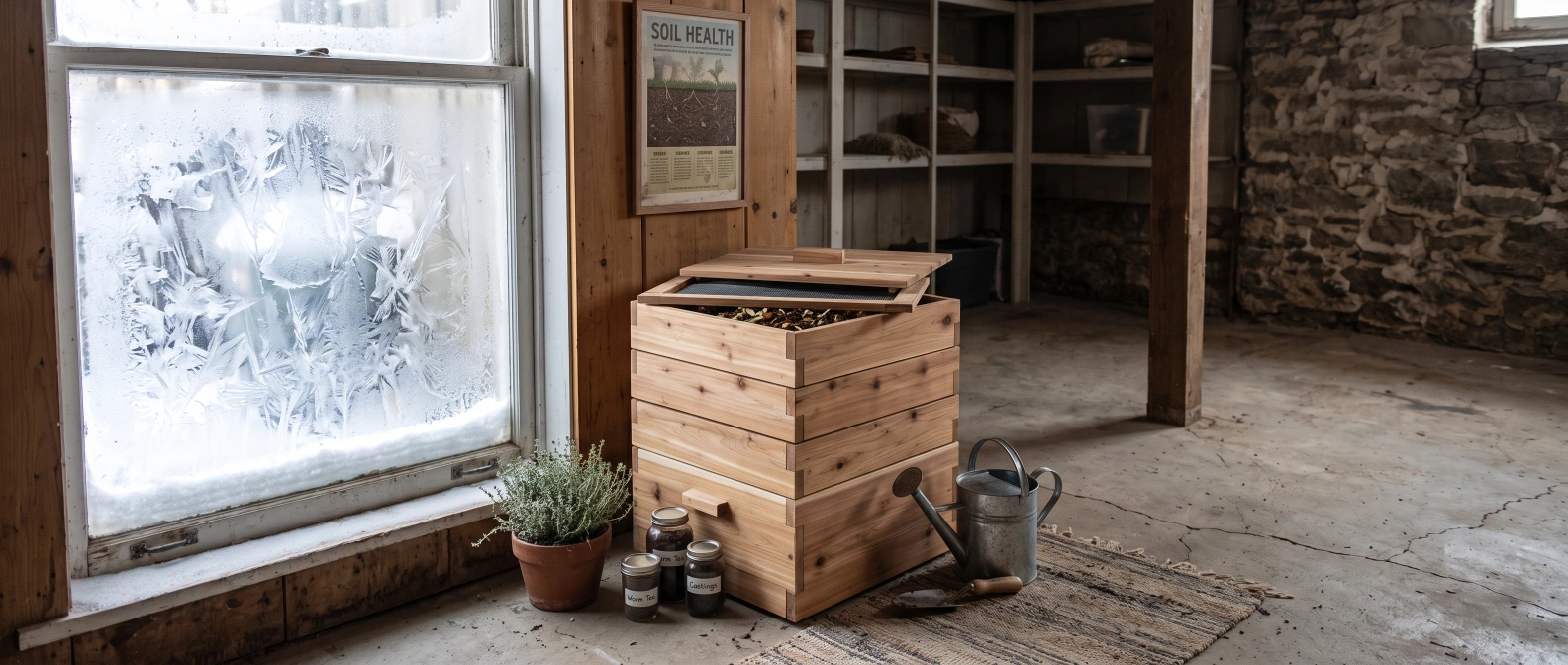
Red wigglers (Eisenia fetida) and other common composting worms are surface-dwelling species with no meaningful tolerance for actually freezing. In a milder climate, an outdoor worm bin can often be insulated and buried enough to keep its core temperature just above freezing through a mild winter. In a genuine boreal winter, months of hard, deep freeze (see Chapter 1) simply overwhelm that approach, no amount of outdoor insulation reliably keeps a bin's core above freezing for that long.
Trying to winterize an outdoor worm bin the way you would a regular compost heap, per Chapter 11, is a reasonable instinct, but it's not enough here. Insulation slows heat loss, it doesn't add heat, and a worm bin has far less thermal mass than a full-sized compost heap to begin with. The worms need a step beyond insulation: an actual move indoors.
The Solution: Bring the Bin Indoors
For the cold months, the bin needs to go somewhere that reliably stays above freezing. A basement or cellar is often ideal, cool and stable without being cold. An unheated but frost-free porch or entryway can work too, provided it genuinely never drops to zero. A garage that runs a little warmer than outside air may or may not be enough, check it through a cold snap before trusting it. And if none of those are available, a spot in a heated living space works fine, worms don't need warmth, just consistency above freezing and reasonably cool conditions, not a warm room by human standards.
This is genuinely one of the few advantages this climate offers a composter: a well-managed indoor worm bin can run productively right through the winter, producing finished castings while an outdoor heap sits dormant under snow. It's one of the only composting methods here without a hard seasonal shutdown, provided the move indoors happens in time.
Bedding and Moisture Indoors
The basics of bedding and moisture don't change once the bin is indoors: shredded paper or cardboard bedding, kept damp so a handful feels like a wrung-out sponge, not dripping and not dry. What does change is how stable conditions are. Indoors, the bin isn't exposed to wind, sun, sudden rain or the freeze-thaw swings an outdoor bin faces, so moisture and temperature stay far more consistent and controllable than anything achievable outside in this climate. Check the bedding every week or two rather than daily, an indoor bin drifts out of range much more slowly than an outdoor one ever could.
Using the Short Outdoor Season
None of this rules out outdoor worm composting altogether. Through the short, warm part of the year, a bin can move back outside to a shaded, sheltered spot, taking advantage of ambient warmth and free access to garden scraps without hauling everything indoors. Worms often process material faster outdoors in summer than they will indoors, given the extra warmth.
The catch is timing. The bin has to come back inside well before the first hard frost, not after it, since worms can be killed by a single unexpectedly early cold snap if the bin is left out too long. Track this transition against the seasonal calendar in Chapter 13 rather than waiting for the weather to force the decision.
Frequently Asked Questions
Can composting worms survive winter outdoors in a cool or boreal climate?
No, not through a genuine hard freeze. Red wigglers and other common composting worms will die if they actually freeze, and an outdoor bin in this climate offers nowhere near enough insulation on its own to prevent that through months of deep cold. The only reliable answer is moving the whole worm bin somewhere that stays above freezing for the winter, not trying to insulate it enough to survive outside.
Where should a worm bin go for the winter?
Anywhere that reliably stays above freezing and reasonably cool works: a basement, a cellar, an unheated but frost-free porch, a garage that never quite freezes, or a spot in a heated living space if nothing else is available. Worms don't need warmth, just consistency above freezing, so the coolest indoor spot that never actually drops to zero is usually the best choice.
Does vermicomposting have to shut down for winter the way an outdoor heap does?
No, and that's what makes it different from almost everything else in this guide. A well-managed indoor worm bin can keep working productively right through the winter when an outdoor heap genuinely can't, since it's no longer exposed to the freeze at all. Vermicomposting is one of the few composting methods in this climate without a hard seasonal shutdown, provided the bin actually gets moved indoors in time.