
Liquid feeds extend the value of your composting system, letting you apply nutrients quickly and directly rather than waiting for a slow-release solid amendment to break down in the soil. Several can be made alongside or straight from your compost system, each suited to a different job in the garden.
Five Liquid Feeds at a Glance
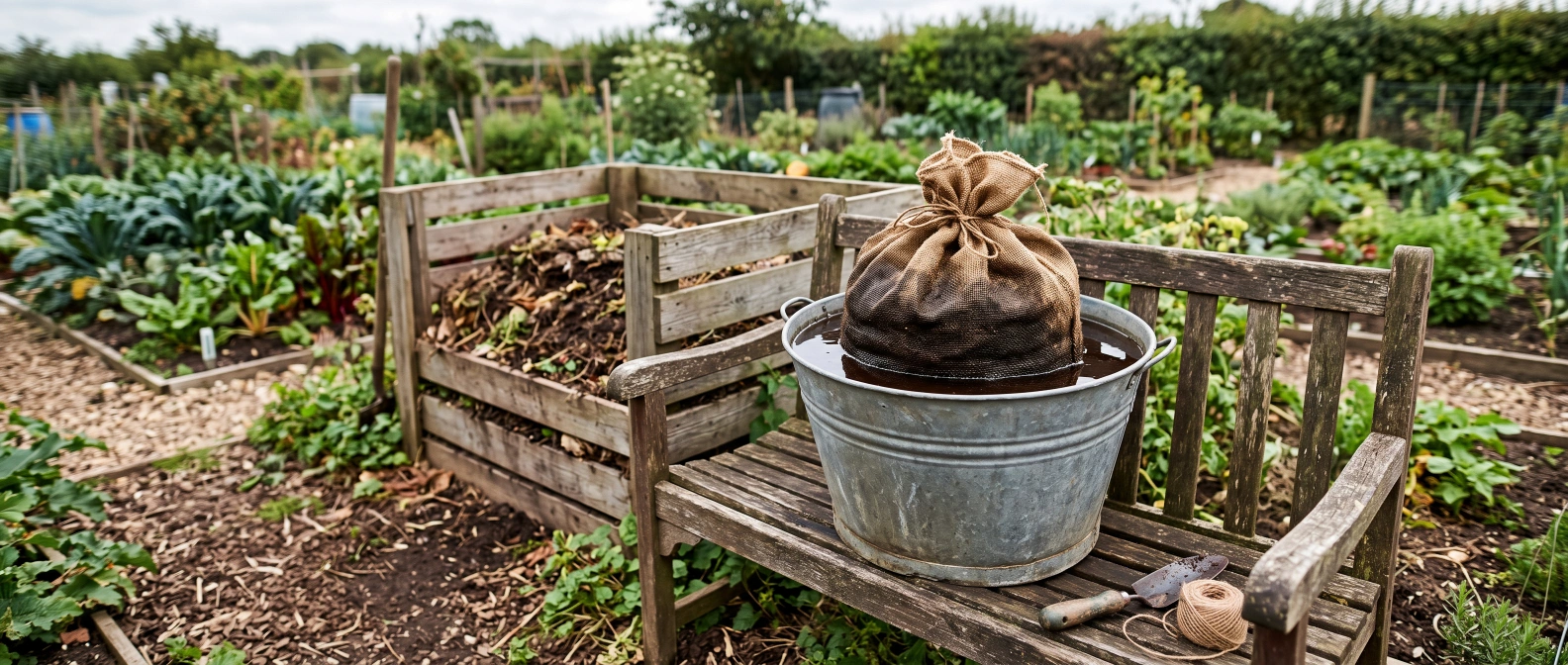
Five liquid feeds you can make alongside your heap, each suited to a different job.
| Feed | Method | Dilution | Best For |
|---|---|---|---|
| Compost Tea | Steep finished compost in a sack, 24-48 hours | To a pale straw colour | Gentle soil drench or foliar feed |
| Comfrey Liquid Feed | Steep packed leaves, 4-6 weeks | 15:1 | Fruiting crops -- tomatoes, squash, beans, peppers |
| Nettle Liquid Feed | Steep packed leaves, 4-6 weeks | 10:1 | Leafy crops; spring growth stimulant |
| Seaweed Liquid Feed | Steep in a barrel, 4-8 weeks | 10:1 | General tonic, foliar feed, trace elements |
| Diluted Urine | Dilute and apply fresh | 10:1 | Fast early-spring nitrogen boost |
Making Each Feed
Compost Tea
Fill a hessian sack or old pillowcase with finished compost. Steep it in a bucket of water for 24-48 hours, stirring occasionally. Apply the resulting liquid diluted to a pale straw colour, and use it within 24 hours of straining -- it doesn't keep. Excellent as a soil drench or a gentle foliar feed.
Comfrey Liquid Feed
Pack a container tightly with comfrey leaves. Cover it and let it steep for four to six weeks -- it will become extremely dark and strong-smelling as it matures. Dilute the concentrate 15:1 with water before applying. High in potassium, this is the best homemade feed for fruiting crops -- tomatoes, squash, beans, peppers.
Nettle Liquid Feed
Made the same way as comfrey, but with nettles. Produces a nitrogen-rich feed ideal for leafy crops and as a spring growth stimulant. Dilute 10:1. The smell is formidable -- steep it away from the house.
Seaweed Liquid Feed
Fill a barrel with fresh or dried seaweed. Cover with water and steep for four to eight weeks. Strain and dilute 10:1. Use as a general tonic, foliar feed, and mineral supplement -- particularly valuable for trace elements unavailable from any other garden source.
Diluted Urine
Dilute 10:1 and apply directly to the soil around plants during the growing season. Particularly effective as a fast nitrogen boost in early spring, when plants are making rapid growth but the soil is not yet warm enough for strong biological nitrogen release.
Frequently Asked Questions
How long does comfrey liquid feed take to make?
Four to six weeks. Pack a container tightly with comfrey leaves, cover it, and leave it to steep -- it will turn extremely dark and strong-smelling as it matures. Dilute the resulting concentrate 15:1 with water before applying. It's the best homemade feed available for fruiting crops like tomatoes, squash, beans and peppers, thanks to its high potassium content.
Why does nettle liquid feed smell so strong?
It's made the same way as comfrey liquid feed -- leaves packed into a container and steeped for four to six weeks -- but the breakdown produces a genuinely formidable smell, stronger than comfrey. Steep it away from the house. What you get in return is a nitrogen-rich feed, diluted 10:1, that's ideal for leafy crops and works well as a spring growth stimulant.
What's the difference between compost tea and a liquid feed like comfrey or nettle?
Compost tea is a short 24-48 hour steep of finished compost in water, diluted to a pale straw colour and used quickly as a gentle soil drench or foliar feed -- it's more a way of spreading finished compost's biology further than a concentrated feed. Comfrey and nettle liquid feeds are long steeps (four to six weeks) of fresh plant material, producing a strong, nutrient-dense concentrate that must be diluted heavily before use. Compost tea is gentle and general-purpose; comfrey and nettle feeds are targeted, potent, and matched to specific crop needs.