
Compost is most effective when its application is integrated with a planned crop rotation. Different vegetable families have different fertility needs, and matching compost application to those needs both maximises the value of your compost and reduces the risk of over-feeding crops that don't need it.
A Four-Bed Rotation Framework
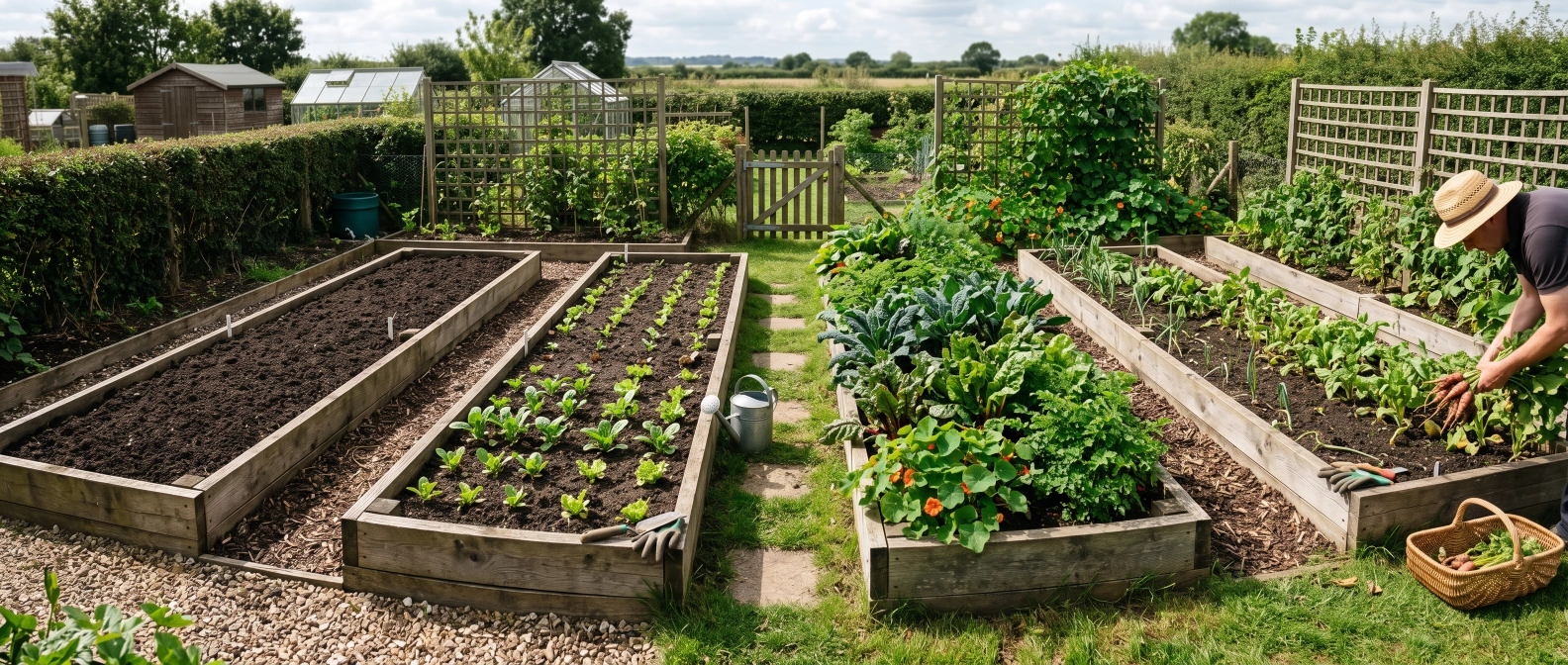
The classic four-bed rotation divides crops into groups that rotate around beds annually, breaking pest and disease cycles while managing fertility systematically. Each year, the crop groups move on: Bed A's crops move to what was Bed B, Bed B's to what was Bed C, and so on -- so the same ground never grows the same crop family, and therefore never carries the same pest and disease pressure, two years running.
| Bed / Year | Crop Group | Compost Application | Green Manure Option |
|---|---|---|---|
| Bed A -- Year 1 | Brassicas (cabbage, kale, broccoli, sprouts, turnip) | Heavy -- one barrowload per m² dug in the previous autumn | Previous year: red clover or winter tares cut and incorporated in spring |
| Bed B -- Year 1 | Legumes & roots (peas, beans, carrots, parsnips, beetroot) | Light for roots: well-rotted compost only, 6+ months old. Legumes: minimal | After harvest: mustard or phacelia as winter cover; chopped in spring |
| Bed C -- Year 1 | Alliums & salads (onions, leeks, garlic, lettuce, chard) | Moderate -- compost the previous autumn; wood ash added at planting | After harvest: grazing rye for winter weed suppression |
| Bed D -- Year 1 | Potatoes & cucurbits (squash, courgette) | Very heavy -- most demanding group; plant into rich compost directly | After potatoes: crimson clover or phacelia through late summer and autumn |
The Annual Compost Calendar
| Month | Compost System Task | Garden Application |
|---|---|---|
| January-February | Maintain insulation; add kitchen waste centrally; add urine | No application; plan the season's rotation and compost needs |
| March | Turn active heap; add first nettles and spring green waste | Apply finished compost to beds awaiting early planting |
| April | Add comfrey and grass clippings; check moisture; apply activators | Plant into compost-prepared beds; apply as planting hole fill |
| May-June | Peak activity -- turn monthly; harvest mature compost from resting bay | Top-dress growing crops; apply liquid feeds fortnightly |
| July-August | Collect and add seaweed; maintain moisture in dry periods | Continue liquid feeds; mulch beds to retain moisture |
| September | Begin insulating for winter; stockpile dry carbon materials | Apply compost to cleared beds; sow green manures |
| October | Add autumn leaves to leafmould cage; reduce turning frequency | Main annual compost application to all beds; no-dig top dressing |
| November-December | Full winter insulation; switch chambers if ready | Incorporate green manures; last applications before frost |
Frequently Asked Questions
Why rotate crops between beds each year?
Different vegetable families have different fertility needs and different pests and diseases that build up in the soil around them. Moving each crop group to a different bed every year means the same ground never grows the same family two years running, breaking pest and disease cycles before they establish, while also letting compost application be matched systematically to what each group actually needs rather than applied evenly and wastefully everywhere.
When is the main annual compost application in this climate?
October, once beds are cleared for the season. This is when the bulk of finished compost goes onto the ground, alongside sowing green manures and no-dig top dressing, so it has all winter to be incorporated by soil biology before spring planting. Smaller applications happen through the rest of the year -- liquid feeds in summer, planting-hole fill in spring -- but October is the big one.
How much compost do potatoes and squash need compared to legumes?
Potatoes and cucurbits like squash and courgette are the most demanding group in the rotation and are planted directly into very heavy compost application. Legumes need very little by comparison -- peas and beans fix their own nitrogen and are only lightly fed, while the root crops sharing their bed (carrots, parsnips, beetroot) do better on well-rotted compost that's at least six months old rather than anything freshly applied.