
The no-dig method, developed and popularised by Charles Dowding among others, represents the most compost-intensive but also most soil-preserving approach to vegetable growing. It works exceptionally well in a temperate maritime climate.
The Principle
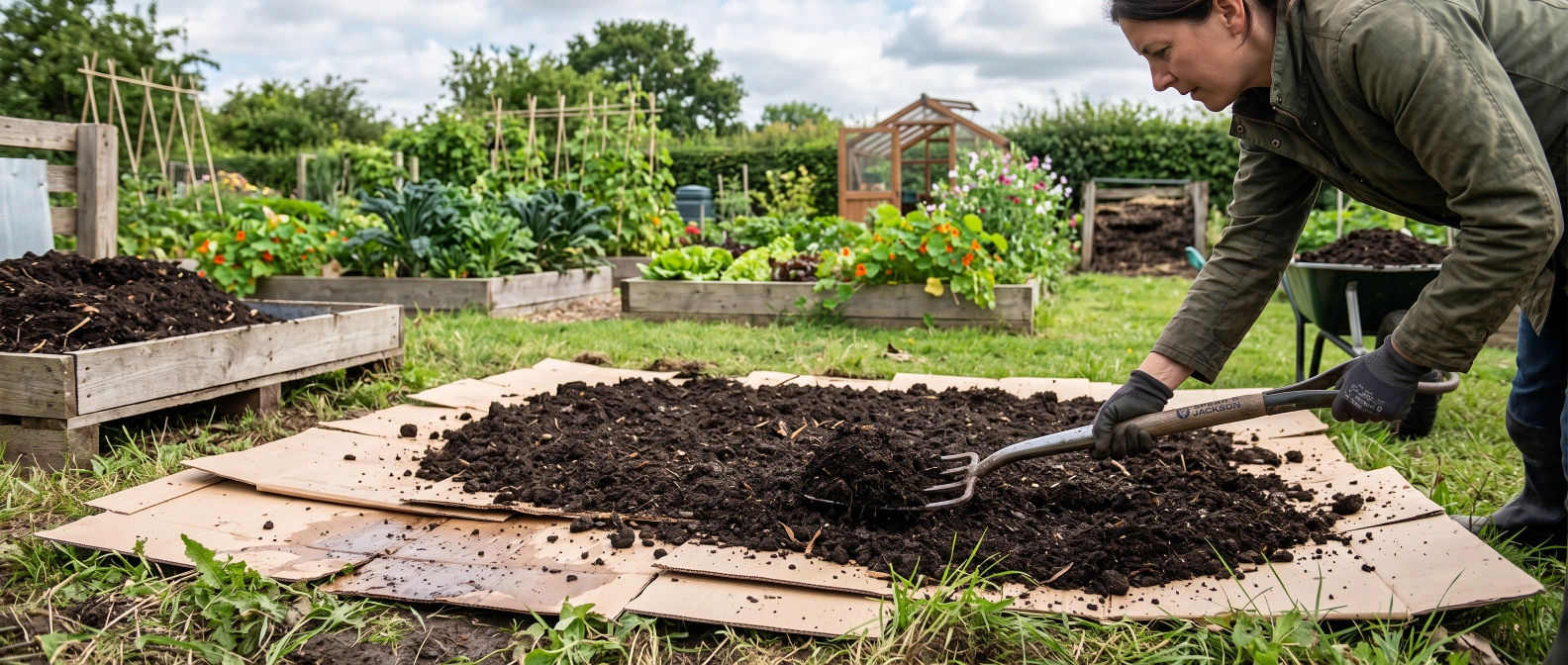
Rather than digging compost into the soil, you apply it as a thick surface layer and allow soil biology -- primarily earthworms and fungal networks -- to incorporate it naturally. This preserves soil structure, fungal networks, and the stratified layers of soil biology that digging disrupts.
Quick Start: Starting a No-Dig Bed
- Lay cardboard directly over grass or weeds -- no need to remove them first.
- Overlap the cardboard generously to prevent regrowth through the joins.
- Apply a minimum 10-15cm layer of compost directly over the cardboard.
- Plant or sow directly into the compost layer.
- Let the underlying vegetation die back and decompose, feeding the soil from below.
Annual Maintenance
Each autumn, apply a fresh 5cm layer of compost across all beds. No digging, no turning of the soil. After three to five years on this system, the soil beneath becomes extraordinarily rich, well-structured, and biologically active.
Frequently Asked Questions
Do I need to remove grass or weeds before starting a no-dig bed?
No. Lay cardboard directly over the grass or weeds, overlapping it generously so nothing regrows through the joins, then apply a minimum 10-15cm layer of compost straight on top. The vegetation underneath dies off and decomposes in place, feeding the soil from below rather than being dug out and wasted.
How much compost does the no-dig method actually require?
A genuinely significant volume -- a minimum 10-15cm layer to start a new bed, plus a fresh 5cm layer across all beds every autumn after that. This is the most compost-intensive method in this guide, which is exactly why the two- or three-chamber system described in Chapter 3 is sized specifically to meet demand at this scale.
How long before a no-dig bed's soil becomes genuinely rich?
Three to five years of annual autumn top-dressing, with no digging or turning of the soil in between. After that, the soil beneath becomes extraordinarily rich, well-structured and biologically active, as earthworms and fungal networks incorporate each year's compost layer naturally and the soil's stratified biology is left undisturbed to build up.