
A working reference of what's genuinely available to build a heap with in a temperate continental climate, and what belongs nowhere near it. Nothing here relies on anything you can't gather, grow or produce yourself, in keeping with this guide's whole approach to self-sufficiency.
Good Carbon Inputs
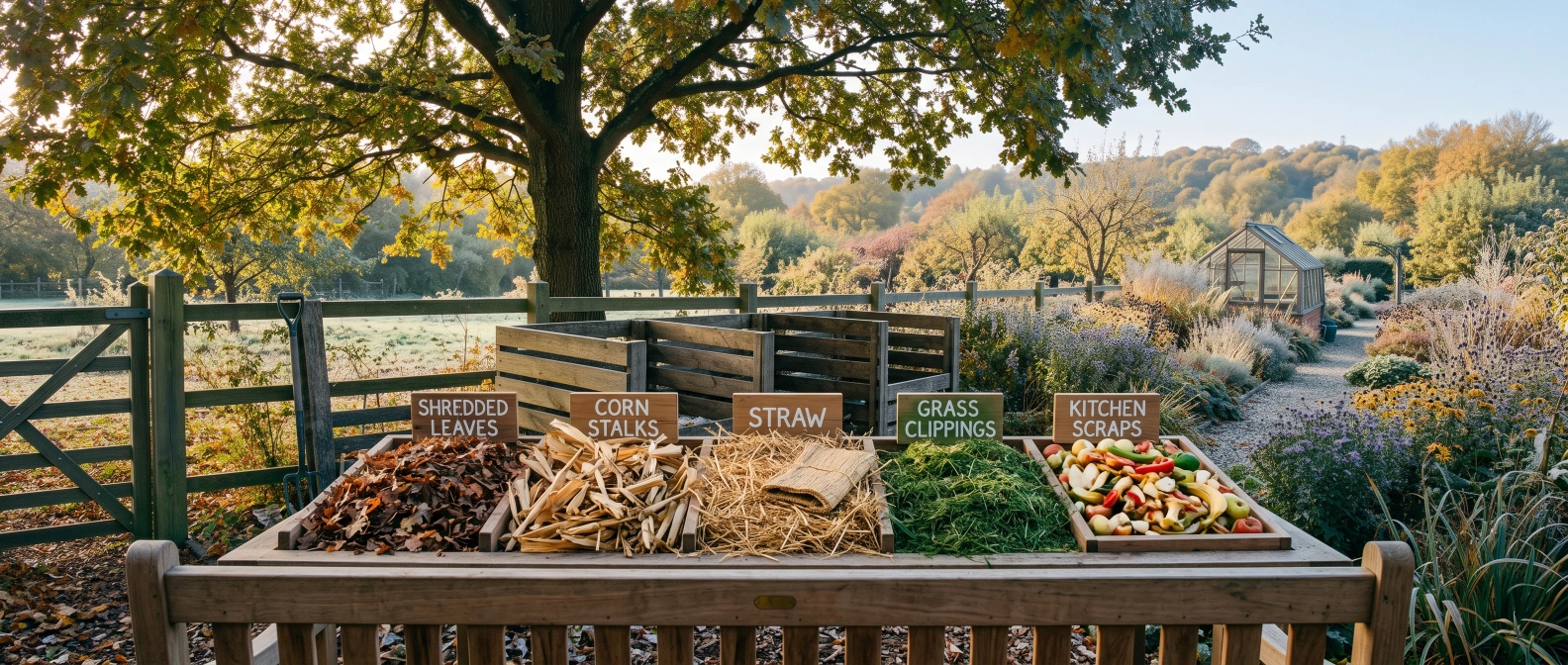
- Dried autumn leaves -- genuinely abundant in a short autumn window; one of the best free carbon sources in this guide (see Chapter 11).
- Corn stalks and other crop stubble -- genuinely tough and slow whole. Shred first (see Chapter 6).
- Straw -- excellent bulk carbon wherever grain is grown locally, and useful as a mulch material too.
- Cardboard -- shred before use and keep it dry until then; a reliable brown to bridge the gap between one autumn's leaf-fall and the next.
- Dried garden waste -- spent stems and dried plant material left over at season's end, a useful supplementary brown.
Good Nitrogen Inputs
- Fresh kitchen scraps -- available year-round, a reliable nitrogen source in every season.
- Grass clippings and garden waste -- genuinely abundant right through the long growing season; use fresh rather than letting it mat down into an airless layer.
- Legume cover crop trimmings -- cut before the hard freeze for a genuinely strong nitrogen boost (see Chapter 12).
- Manure, where available -- a genuinely valuable local resource if livestock are kept; strength varies with the animal and any bedding mixed in.
- Urine -- a concentrated, genuinely free source of nitrogen year-round, independent of the seasonal flush; always dilute before use (see Chapter 8).
Materials to Avoid
Not everything that could theoretically go into a heap should. Some materials are genuine no-gos, others are fine in small amounts but cause real problems if overdone. If something needs to be kept out of a heap, pile it separately or, where appropriate, refer to biochar production (Chapter 9) as an alternative use, rather than treating it as waste with nowhere to go.
| Material | Tier | Why |
|---|---|---|
| Meat, fish, cooked food, dairy | 1 -- avoid entirely | Attracts wildlife looking for food, a real concern in rural continental settings (raccoons, deer, and similar depending on region) |
| Diseased plant material | 1 -- avoid entirely | A heap here may not reliably reach temperatures high enough to kill pathogens, especially once a winter freeze interrupts the heating cycle |
| Pet or dog faeces | 1 -- avoid entirely | Can carry pathogens harmful to humans; keep well away from food-bound compost |
| Perennial weed roots and seeds | 1 -- avoid entirely | May survive a heap that doesn't reliably heat right through a genuine winter freeze-interrupted cycle |
| Black walnut leaves and hulls | 2 -- use with caution | Contain juglone, a genuine allelopathic compound that can inhibit other plants' growth; compost separately and let it mature fully first |
| Large quantities of unshredded corn stalks or tough crop residue | 2 -- use with caution | Genuinely slow to break down whole; chop or shred first |
Tier 1 materials should stay out of the heap entirely. Tier 2 materials are genuinely useful inputs, but only when handled with the extra care noted above.
Frequently Asked Questions
Can I compost black walnut leaves and hulls?
With genuine caution. Black walnut is a widespread tree across much of this climate zone, especially the US Midwest and Northeast, and its leaves and hulls contain juglone, a real allelopathic compound that can inhibit the growth of other plants. Composting fully does break juglone down over time, but it's safest to compost black walnut material separately and let it mature thoroughly before using it anywhere near sensitive plants, rather than mixing fresh material straight into a general-purpose heap.
Do corn stalks and crop stubble need any preparation before composting?
Yes, genuinely. Large quantities of unshredded corn stalks or other tough crop residue are slow to break down whole, and can sit largely unchanged in a heap for a long stretch. Chop or shred them first, whether with a dedicated shredder or simply cutting them into short lengths by hand, and they become a genuinely excellent bulk carbon source instead of a heap-clogging obstacle.
What should never go in a temperate continental compost heap?
Meat, fish, cooked food and dairy top the list, attracting wildlife looking for food, a real concern in rural continental settings from raccoons to deer depending on region. Diseased plant material, pet or dog faeces, and perennial weed roots or seeds should also stay out, since a heap that doesn't reliably heat right through a winter freeze-interrupted cycle may not kill off what's inside them.