
Green manures build soil fertility by growing them, then returning what they've built straight back into the ground. This climate's genuine hard winter freeze (see Chapter 1) actually opens up a real choice most milder climates don't offer: a cover crop that dies outright at the first hard freeze and mulches itself, or one that survives the winter and keeps growing.
The Core Principle
Legume green manures fix nitrogen through root nodules, drawing it straight from the air into a form plants can use. Non-legumes build organic matter and improve soil structure simply through the sheer volume of roots they put down, loosening compacted ground and feeding soil life as those roots die back. Either way, the crop is grown specifically to be cut and returned to the soil, dug in or left as a surface mulch, rather than harvested for food, closing the loop between what the plant took from the soil and what it gives back (see Chapter 4).
Winter-Killed: Oats
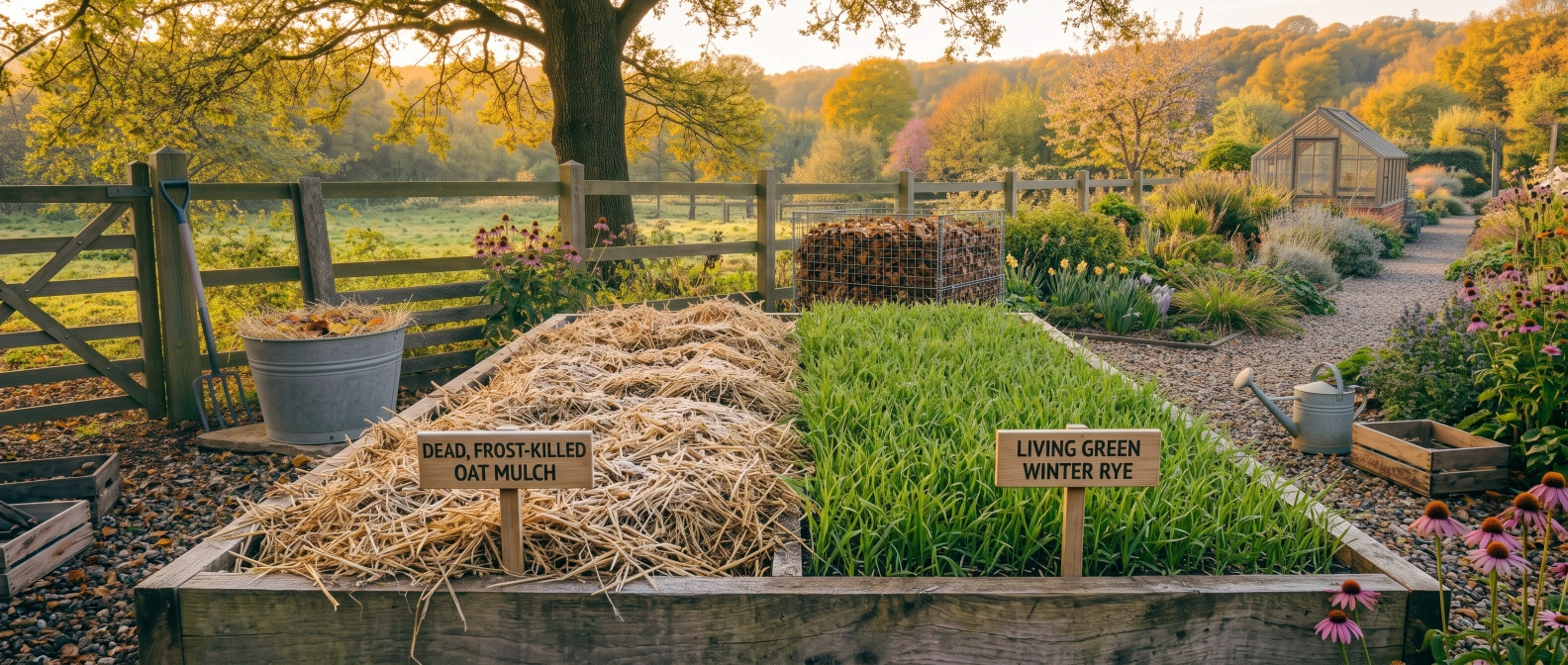
Oats are the classic winter-killed cover crop here. Sown in late summer or early autumn, they grow through the remaining mild weather and are then reliably killed outright by the first genuine hard freeze, a freeze this climate can be counted on to deliver. The dead plants collapse into a protective mulch layer that sits on the surface all winter, shielding the soil, and breaks down by spring largely on its own. It's a genuinely low-effort technique, no cutting, no digging in, no management through winter at all, and one that specifically depends on this climate's reliably hard freeze to work as cleanly as it does.
Overwintering: Winter Rye
Winter rye, similar to the approach used in a boreal climate, can be sown later in the season and will survive under snow cover, resuming growth as soon as spring conditions allow. This suits a grower who wants a crop that's still alive and actively building fertility come spring, rather than an already-dead mulch, though it does mean the crop needs to be cut before the bed is ready for planting, unlike oats' self-mulching finish.
Fast Summer Fill-In: Buckwheat
Buckwheat is a fast-growing summer cover crop, useful for filling a short gap in the rotation during this climate's long growing season. It's frost-tender and won't survive winter itself, but that's not the point, it's a quick fertility-building or weed-suppressing fill-in between food crops, sown and cut within a single season rather than carried through to the freeze. See Chapter 17 for fitting it into a rotation.
Frequently Asked Questions
What is a green manure and why bother growing one?
A green manure, or cover crop, is grown specifically to build soil fertility and structure rather than to be harvested and eaten. Legume green manures fix nitrogen through root nodules, while others build organic matter and improve soil structure simply through their root systems. Once grown, the crop is cut and either dug in or left on the surface as a mulch to break down, returning what it built straight back into the soil.
What's the advantage of a winter-killed cover crop like oats in this climate?
Oats, sown in late summer or early autumn, grow through the remaining mild weather and are then reliably killed outright by the first hard freeze. The dead plants collapse into a protective mulch layer that sits on the surface all winter and breaks down by spring on its own, without needing to be cut or managed. It's a genuinely low-effort technique that specifically depends on this climate's reliably hard freeze to work.
Should I choose a winter-killed crop or an overwintering one like winter rye?
It depends what's wanted in spring. A winter-killed crop like oats leaves an already-dead mulch ready to plant straight into with no extra work. Winter rye survives under snow cover and resumes growth in spring, offering a living crop still actively building fertility, but it needs to be cut before the bed can be planted. Both are genuine, valid choices this climate's hard freeze makes possible, the difference is simply what condition the grower wants the bed in come spring.