
A temperate continental climate -- the inland regions of the US Midwest and Northeast, much of Central and Eastern Europe, and similar continental-interior zones worldwide -- gets a genuine four-season year, with a far wider swing between summer and winter than a milder maritime climate ever sees. Understanding this properly, not just as a list of tips but as the actual seasonal rhythm behind it, is the foundation everything else in this guide builds on.
The Challenges
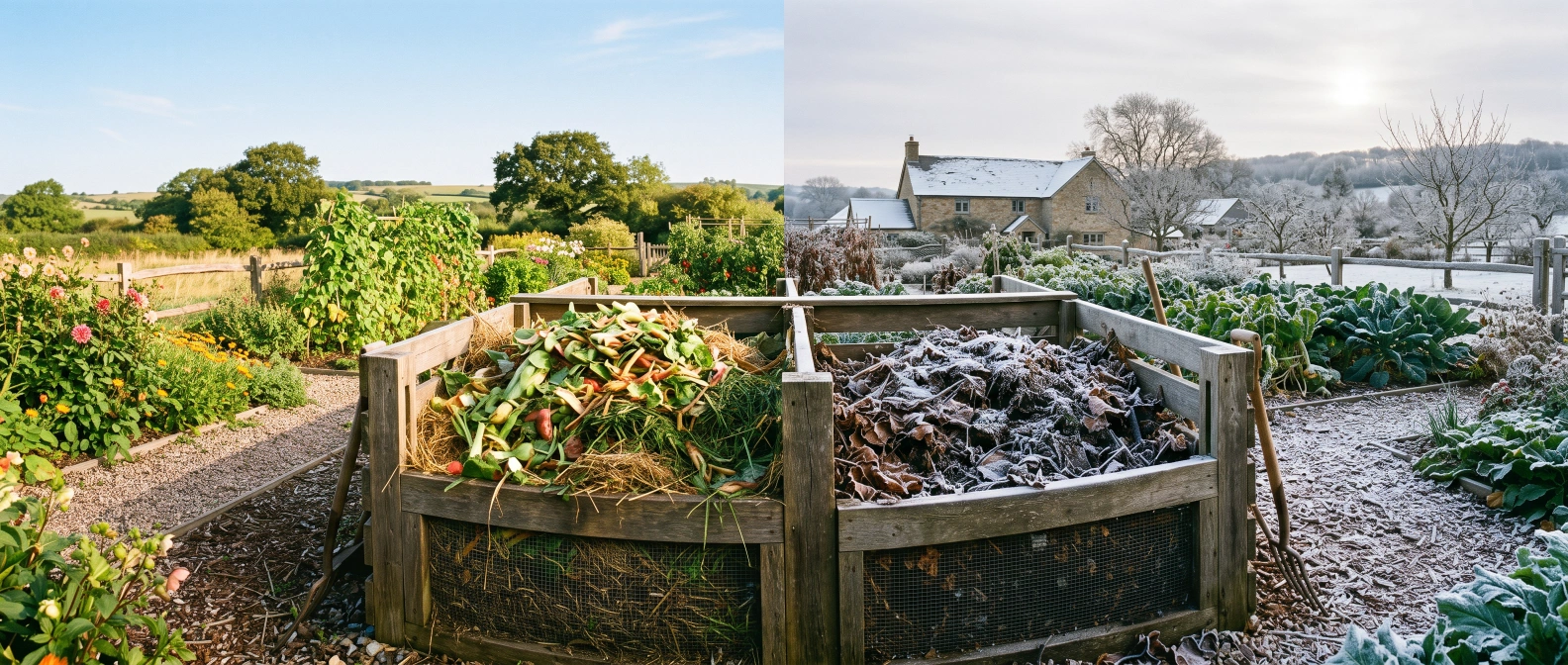
A genuinely wide seasonal temperature swing demands a flexible system
This is the central challenge, and it's fundamentally different from a single-extreme climate. A heap here has to survive real summer heat, sometimes well above 30°C, and a real hard winter freeze, sometimes well below freezing for months, within the same year. A system built only to handle one extreme, insulated purely for cold, or ventilated purely for heat, fails at the other end of the year. This is why building for both, not just one, runs through this guide (see Chapter 2).
Hard winter freeze stops microbial activity for a real stretch
Composting bacteria need liquid water and a minimum working temperature, and a genuinely frozen heap sits largely dormant for as long as that freeze holds, typically a few months depending on exact location. This is less extreme than a true boreal winter, which can last most of the year, but it's real enough that expecting a heap to keep working straight through it is unrealistic, and planning around a genuine seasonal pause matters (see Chapter 13).
Summer heat and thunderstorm rain can swing a heap both ways
Unlike a Mediterranean climate's dry summer, this zone often gets its heaviest rainfall as summer thunderstorms, arriving in sudden, intense bursts rather than steady drizzle. A heap can dry out fast in the heat between storms, then be briefly waterlogged by a downpour, swinging between two failure modes within the same week rather than settling into one predictable pattern.
Spring thaw brings its own mess
A heap that went into winter frozen doesn't simply switch back on when temperatures rise. Meltwater can saturate material that's still too cold to process it properly, and a genuine period of mud and slow restart is normal before full activity resumes, similar in kind to a boreal spring thaw, though typically shorter and less dramatic.
The Advantages
- A long, genuinely hot growing season drives strong plant growth and gives an active heap real sustained warmth to work with, well beyond a short boreal summer.
- Dramatic deciduous autumn leaf-fall provides one of the most abundant, genuinely free carbon sources of any climate in this guide (see Chapter 11).
- Huge volumes of crop stubble and residue from inland grain farming, a resource most coastal climates simply don't produce in the same quantity (see Chapter 6).
- Often naturally excellent soil -- deep, fertile prairie soils across much of this zone give composting here a genuinely strong starting point compared to many other climates in this guide.
Frequently Asked Questions
How is a temperate continental climate different from a temperate maritime one?
Mainly in the size of the seasonal swing. A maritime climate is buffered by the sea, staying fairly mild and damp year-round without extremes in either direction. A continental climate, further from that moderating ocean influence, swings much further each year: genuinely hot summers, sometimes well above 30°C, and a genuinely hard winter freeze, sometimes well below freezing for months at a stretch. The underlying composting methods are often similar, but the range each one has to cope with is far wider here.
Does the ground actually freeze solid here, and does that stop composting completely?
Yes, for a real stretch of the year, typically a few months depending on exact location. Composting bacteria need liquid water and a minimum working temperature, so a heap that's genuinely frozen through sits largely dormant during that stretch, similar in principle to a boreal winter, though usually for a shorter period and with a proper productive growing season either side of it rather than a boreal climate's very brief summer window.
Does a temperate continental climate actually have any advantages for composting?
Genuinely, yes, and they matter as much as the challenges. A long, hot, often thunderstorm-wet growing season drives strong plant growth and gives an active heap real sustained warmth to work with. Dramatic deciduous autumn leaf-fall provides one of the most abundant, genuinely free carbon sources of any climate in this guide, and inland grain-farming regions produce huge volumes of crop stubble and residue most coastal climates simply don't have.