
Coastal composting guides lean heavily on seaweed as a free, abundant input. This zone doesn't have that option, and doesn't need it. The inland regions this guide covers, the US Midwest, Ukraine and Central and Eastern Europe's wheat belts, and similar continental grain-belt farming regions worldwide, are among the most productive grain-growing areas on earth, and what they produce in genuinely enormous volume every year is crop stubble and residue. If you're not near grain farmland yourself, the same principle still applies to whatever crop or garden residue is locally dominant at the end of your own growing season.
Corn Stalks & Grain Straw -- The Big-Volume Carbon Inputs
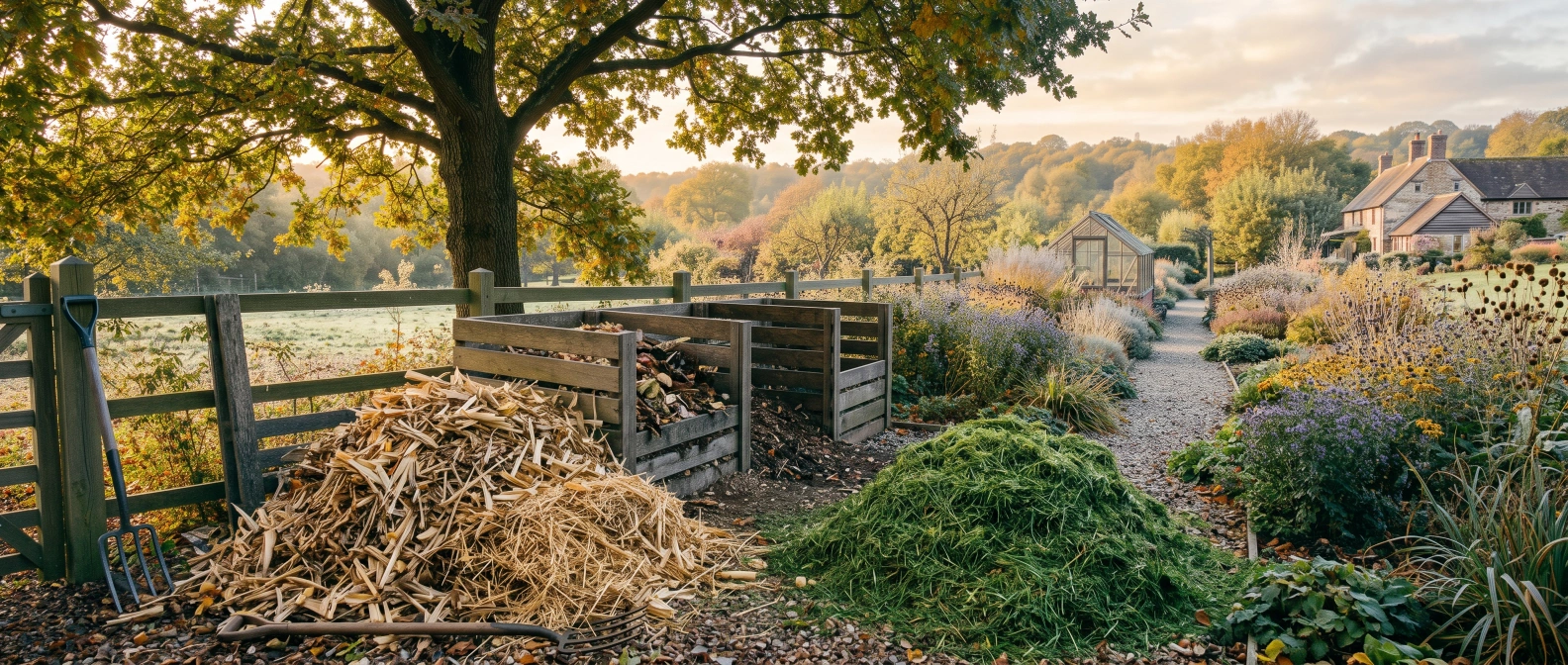
Corn stalks are a huge-volume byproduct wherever maize is grown in this zone. They're tough and fibrous, genuinely high in carbon, and left whole they're genuinely slow to break down, sometimes taking a very long time to process in an ordinary heap. Chopping or shredding matters a great deal here: mowing over stalks left standing, running them through a shredder, or simply cutting them into shorter lengths before adding them to the heap exposes far more surface area and dramatically speeds the whole process.
Wheat and other grain straw works on the same principle. It's abundant right after harvest, a classic reliable brown, carbon-rich material, and like corn stalks it breaks down far faster once it's chopped or shredded rather than left as long whole strands or intact bales. See Chapter 4 for how these fit into the wider carbon-to-nitrogen balance.
Soybean Residue & Other Crop-Specific Byproducts
Depending on the regional cropping pattern, soybean residue and other crop-specific byproducts left after harvest generally behave the same way: carbon-rich material that's slow to break down whole. Treat these the same way as corn stalks and straw, chop or shred before composting, and use them as the reliable brown backbone of a heap through the harvest season.
Garden & Lawn Residue -- What's Left After the Growing Season
Beyond field-scale crops, the same "what's left after the growing season" category covers grass clippings and spent vegetable plants cleared at the end of the year. These are worth distinguishing clearly from the harvest residues above, though: grass clippings specifically lean nitrogen-rich rather than carbon-rich, behaving more like a green input than a brown one, while spent vegetable plants sit somewhere in between depending how woody or soft they are.
- Corn stalks, grain straw, soybean residue -- carbon-rich, slow to break down whole, chop or shred first.
- Grass clippings -- nitrogen-rich, breaks down fast, balance against browns rather than piling thick and wet.
- Spent vegetable plants -- variable, generally fine added as-is, chop anything woody or thick-stemmed.
Mulch and Biochar Feedstock -- Not Everything Needs to Go on the Heap
Crop residue doesn't have to be composted to be useful. Chopped straw or stalks make effective mulch spread directly over beds, suppressing weeds and moderating soil temperature through both summer heat and the freeze-thaw cycling of early winter. Where volumes are genuinely large, or the material is simply too tough or woody to be worth the effort of composting, it's often more practical to route it toward biochar production instead, see Chapter 9, which turns exactly this kind of slow-to-break-down material into a permanent, stable soil amendment rather than something the compost heap has to labour through.
Frequently Asked Questions
Why does this guide cover crop stubble here instead of seaweed like the coastal climates do?
Because this zone is defined by inland grain-belt farmland rather than coastal access. The US Midwest, Ukraine, and Central and Eastern Europe's wheat belts, and similar continental farming regions worldwide, are among the most productive grain-growing areas on earth, but seaweed simply isn't accessible the way it is in a coastal climate. Crop stubble and garden residue is the real, genuinely dominant free input here instead, and it's abundant in a way most coastal climates never see.
Why does chopping or shredding tough residue like corn stalks matter so much?
Because whole cornstalks or straw bales are genuinely slow to break down. They're tough, fibrous and high in carbon, and left whole they can sit in a heap for a very long time without processing properly. Mowing over them, running them through a shredder, or simply chopping them by hand before adding them to the heap dramatically speeds breakdown by exposing far more surface area to the microbes doing the work.
Are grass clippings the same category as crop stubble?
No, and it's worth distinguishing them clearly. Corn stalks, grain straw and soybean residue are carbon-rich brown material, genuinely slow to break down whole. Grass clippings, though they're also garden residue left over at the end of the growing season, lean nitrogen-rich rather than carbon-rich, and behave more like a green input. Both matter here, but they play different roles in the carbon-to-nitrogen balance.