
This climate follows the most conventional rotation calendar of any zone in this guide: spring planting, summer growing, autumn harvest, and a real winter fallow, rather than the inverted-season calendars a Mediterranean or arid climate needs. The table below shows one practical cycle across a small number of beds; adapt bed numbers to whatever space you're working with.
A Simple Rotation Across the Four Seasons
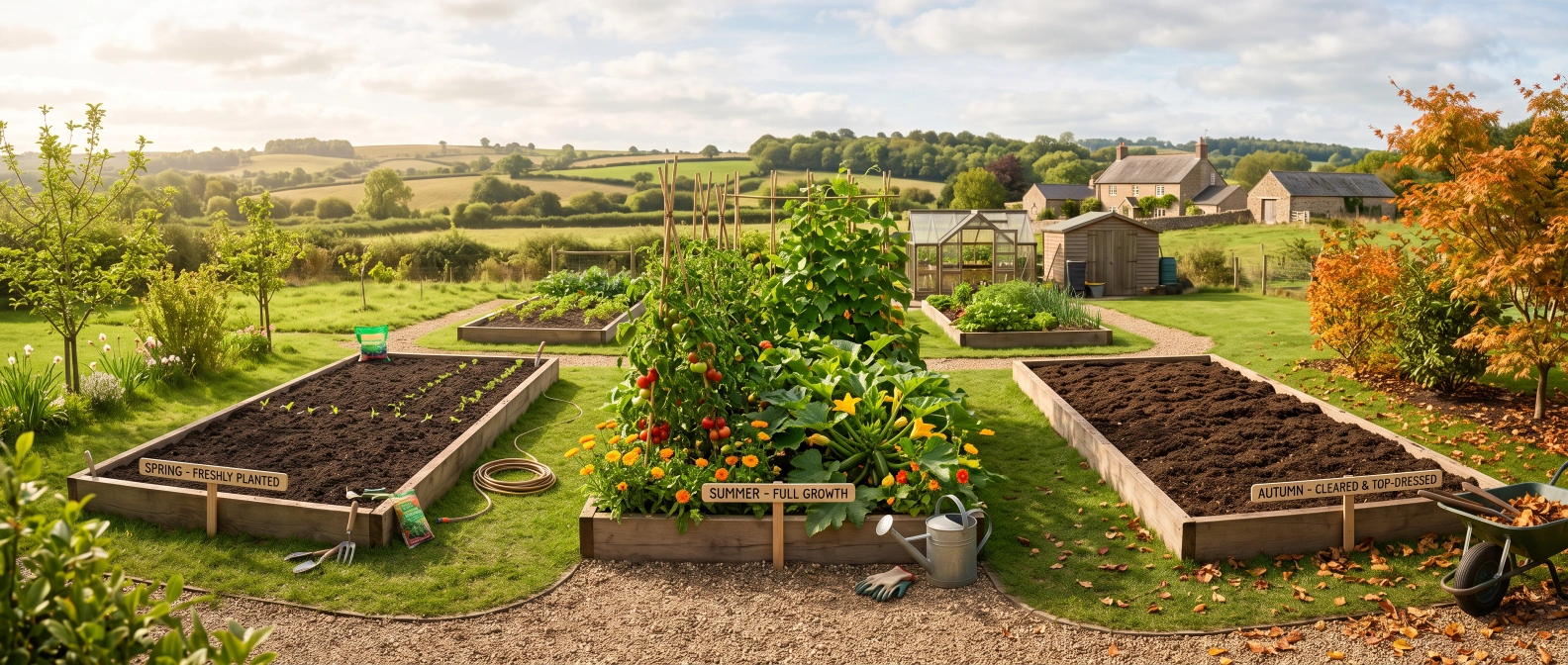
Rotating beds through spring planting, summer growth, autumn harvest, and winter fallow keeps soil fertility and the compost supply itself in balance year to year.
| Bed / Stage | Timing | Compost Action |
|---|---|---|
| Bed A -- Spring planting | As soon as the ground is workable after thaw | Work finished compost in ahead of sowing |
| Bed B -- Summer growing | Full growing season, watch for hot-spell drying | Mulch to hold moisture; hold compost for autumn |
| Bed C -- Autumn harvest | After harvest, ahead of the first hard frost | Top-dress and sow a cover crop, or rest under compost |
| Bed D -- Winter fallow | Through the hard freeze | No action; let the resting chamber finish undisturbed |
Autumn: Winter-Kill or Overwinter
After harvest, choose between a winter-killed cover crop that dies back on its own and leaves residue on the surface, or an overwintering cover crop that resumes growth the following spring (see Chapter 12). Either way, working finished compost into the bed beforehand, or top-dressing it as the cover crop goes in, means it's ready and incorporated well before spring planting begins.
Fitting the Two-Chamber Rhythm
This calendar lines up naturally with the two-chamber system's own yearly cycle (see Chapter 3) and the seasonal management approach covered in Chapter 13: one chamber fills through spring and summer while the other rests and finishes, ready to hand over right around the autumn harvest window.
Frequently Asked Questions
Why does this calendar follow such a classic spring-to-autumn pattern?
Because this climate genuinely has a textbook four-season year, spring planting, summer growing, autumn harvest, and a real winter fallow, unlike the inverted-season calendars a Mediterranean or arid climate needs. It's the most conventional rotation calendar of any zone in this guide.
When should compost go onto the beds in this rotation?
Mainly at two points: in spring as beds are prepared for planting, and in autumn after harvest as beds are either top-dressed and put to rest or planted with a cover crop. Both line up with the two application windows covered in the harvesting chapter, and both fit naturally with the two-chamber system's own yearly rhythm.
What happens to the beds over winter?
A genuine winter fallow. Beds either sit under a winter-killed cover crop that dies back on its own and leaves residue on the surface, or under an overwintering cover crop that resumes growth in spring, both choices covered in the green manures chapter. Either way the ground rests through the hard freeze rather than being worked.