
Composting worms turn kitchen scraps into some of the richest fertility a garden can get, and in most climates in this guide they're a genuinely easy win. At real altitude, honesty is more useful than enthusiasm: the same daily freeze-thaw cycle that makes a compost heap difficult (see Chapter 11) is directly lethal to worms, and that changes how this chapter has to be written.
Why Outdoor Worms Are a Poor Fit Here
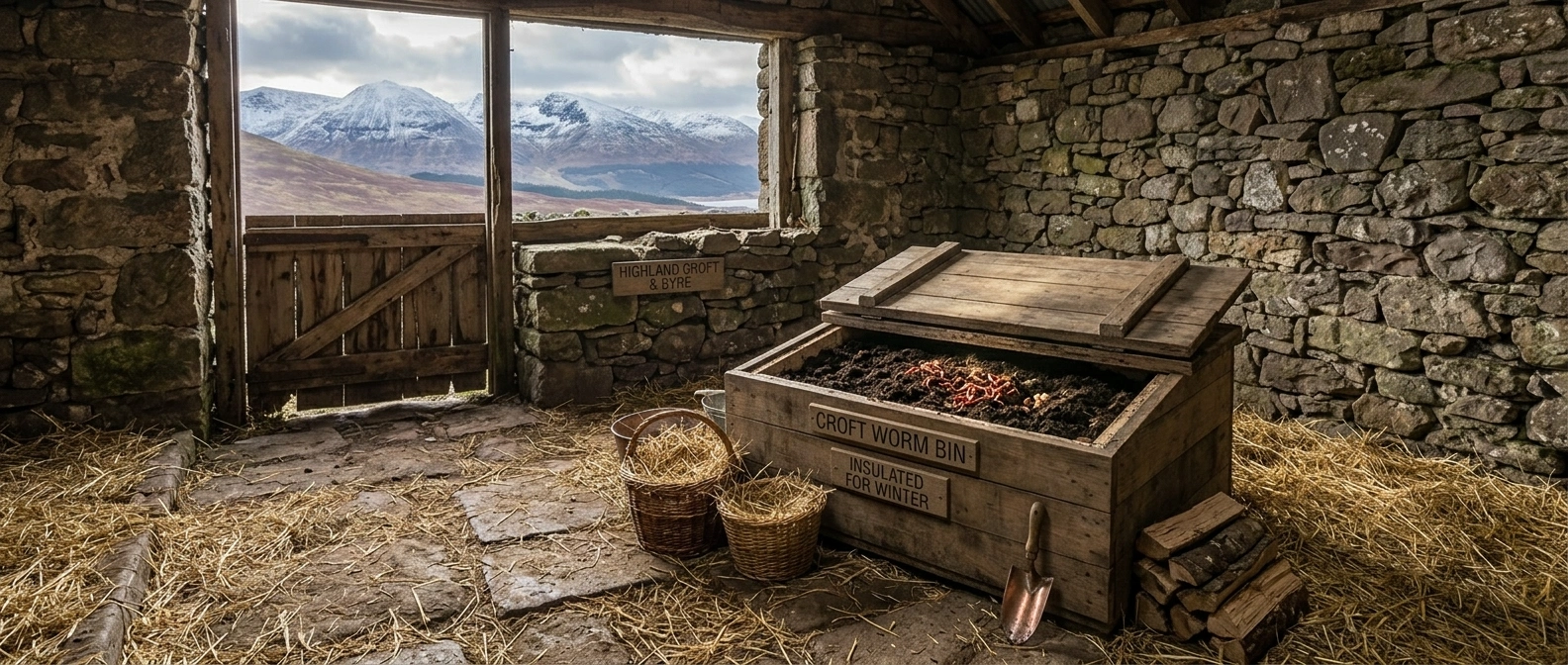
Frozen bedding kills worms outright
Red wigglers and brandling worms (Eisenia fetida), the species almost every home vermicomposting setup relies on, cannot survive their bedding actually freezing solid around them. A heap can recover from a hard overnight freeze and simply restart the next day, which is genuinely frustrating but not fatal. A worm bin cannot recover the same way: worms that freeze die, full stop, and there's no next-day restart for the population lost.
A "safe" outdoor window may not exist
In a boreal climate, a short but genuine frost-free summer stretch gives an outdoor bin a real window of safety, even if it has to come back indoors for winter (see how that zone's guide handles the same seasonal move). At real altitude, that assumption doesn't hold: a clear night at elevation can drop below freezing even in the height of the growing season, regardless of how warm the afternoon was. There often simply isn't a reliable frost-free stretch long enough to trust an outdoor bin through, which is a harder problem than Cool or Boreal climates face with their worms.
An honest recommendation
Given this, vermicomposting may genuinely be one of the less practical techniques covered anywhere in this guide for this particular climate. A reader without a truly reliable, protected indoor space year-round has every reason to focus effort instead on the other composting methods covered elsewhere in this guide, which don't depend on keeping a living population alive through repeated freezing.
If You Do Attempt It: Permanent Protection, Not Seasonal
Where a reliable protected space genuinely exists, worms here need to live indoors, or in a properly insulated structure, essentially all year round rather than being moved seasonally. That means a shed with real insulation, an insulated box kept in a consistently sheltered spot, or the bin genuinely brought inside living space, using the same sheltering logic covered for structures generally in Chapter 3, applied here to worm housing specifically.
- Bedding moisture -- keep it like a wrung-out sponge, damp throughout but never waterlogged, exactly as in any other climate.
- Protection from both extremes -- freezing is the dominant risk here, but a bin kept indoors or in a small enclosed space can also overheat in direct sun, so site it out of strong light too.
- Only cautious, brief outdoor testing -- if the most reliably mild stretch of the short season genuinely arrives, a very brief, closely watched trial outdoors may be reasonable, but bring the bin straight back in at the first sign of an overnight temperature drop.
- Treat any outdoor placement as provisional -- never as the bin's normal home, the way it might be in a gentler climate.
Frequently Asked Questions
Can composting worms survive outdoors at high altitude?
Not reliably, and often not at all. Composting worms like red wigglers freeze and die if their bedding actually freezes around them, and at real altitude a night below freezing can happen even in the height of the growing season. An outdoor bin left exposed through a normal alpine night risks exactly that, which makes casual outdoor vermicomposting a genuinely poor fit for this climate compared to almost anywhere else in this guide.
Is vermicomposting worth attempting in this climate at all?
Only with a genuinely reliable protected space, ideally indoors or in a properly insulated shed, essentially year-round rather than moved in for winter alone. Without that kind of space, vermicomposting may honestly be one of the less practical techniques in this guide for this particular climate, and effort may be better spent on the other composting methods covered elsewhere, which don't depend on keeping a living population alive through repeated freezing.
How is alpine vermicomposting different from a boreal or cool climate?
Boreal climates get a genuine, if short, frost-free summer stretch where a bin can sit outdoors in relative safety. Alpine nights can drop below freezing even at the height of summer, so there often isn't an equivalent safe window at all. That's why alpine worm housing leans toward permanent indoor protection rather than the seasonal indoor-to-outdoor movement that works further from the equator at lower elevation.