
Every other zone in this guide builds a system around insulation, moisture control, or convenient turning. Here, the single most important structural decision is breaking the wind, and the terrain itself, steep, rocky, naturally terraced, offers a genuine answer drawn from an ancient mountain building tradition rather than anything invented for this guide. This is the core structural chapter for a highland or alpine climate.
Wind, Not Just Cold, Is the Primary Enemy
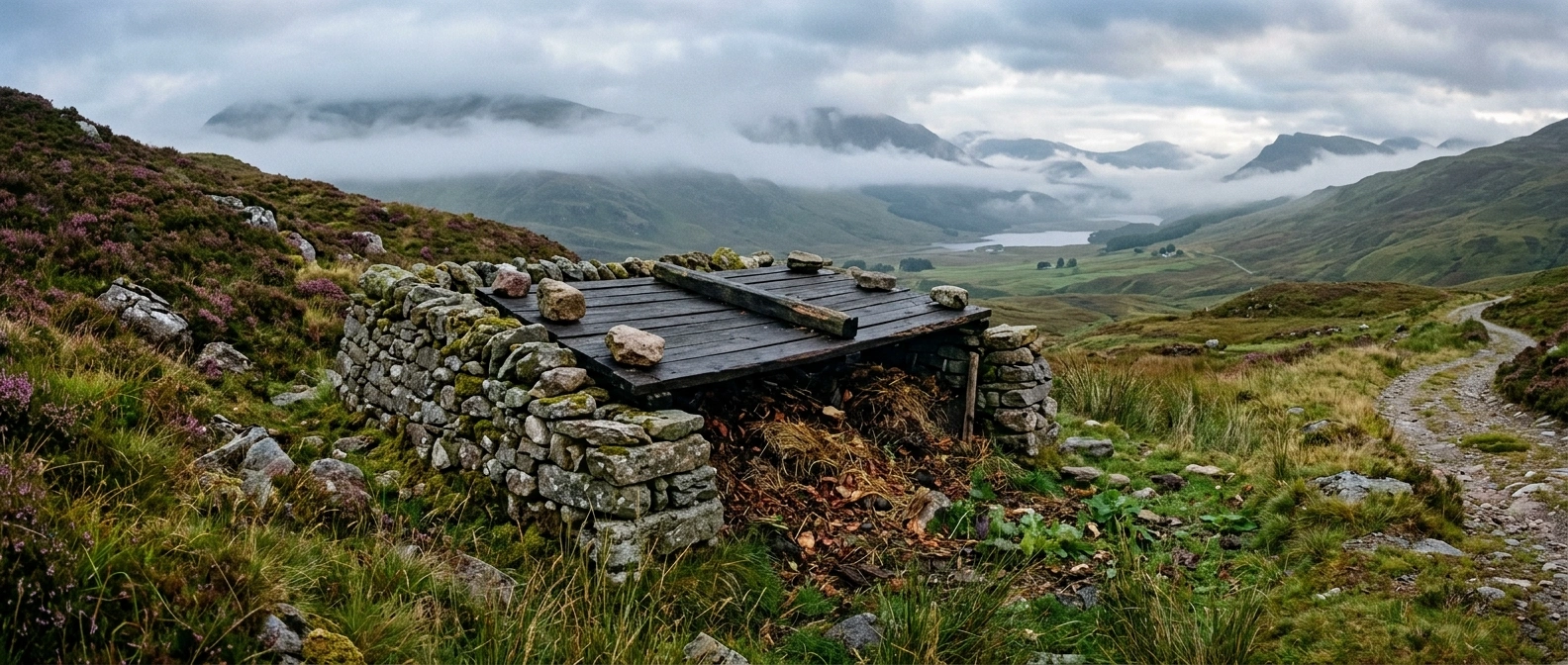
It's tempting to think of a mountain compost system as needing "extra insulation" the way a cold-winter climate would. That's only half the picture. Constant wind strips heat and moisture from an exposed heap far more aggressively than the same low temperature would in still air, which means a structure's main job here is breaking the wind, not simply wrapping the heap in extra insulating bulk.
A well-insulated but wind-exposed heap will still underperform a modestly insulated, genuinely wind-broken one. That single fact drives every design choice in this chapter, and it's why Chapter 2 already put wind shelter ahead of sun exposure when choosing a site in the first place.
Terraced, Dry-Stone Construction
Dry-stone walling, stacked stone laid without mortar, is a genuine, ancient mountain farming tradition found worldwide, from Alpine terracing to Andean agricultural terraces built up mountainsides over centuries. The same technique that has long turned steep, unfarmable slopes into productive terraced ground applies directly to building a wind-sheltering, thermally stable compost enclosure.
Thick stone walls do two jobs at once. They break the wind bodily, forcing it up and over or around the heap rather than through it, and they absorb daytime heat, releasing it slowly overnight to buffer the heap against the cold rather than letting it swing freely with the outside air. A stone-walled enclosure set into a terraced slope is, in effect, both the wind-break and the thermal mass in a single structure.
Building this way also solves the sloped-ground problem from Chapter 2 at the same time: a terrace cut and walled into a hillside gives a level working surface exactly where the natural ground doesn't provide one.
Partly-Sunken Siting for Thermal Buffering
Cutting a shelf into a slope, or building the base of the enclosure below the surrounding ground level, uses the earth itself as insulation and wind protection. This is similar in spirit to how an arid climate's sunken trenches use surrounding soil for evaporation control, but here the goal is thermal buffering and wind-breaking rather than moisture retention.
A partly-sunken base combined with stone walls above ground level gives a heap real protection on every side except the open top, which is exactly where the next consideration, a secure lid, matters most.
A Genuinely Secure, Weighted Lid
Given how strong mountain wind can be, anything not properly secured risks being blown open or carried away entirely. A light tarp weighed down with a couple of stones is not reliable here. The lid needs to be a genuinely robust, heavy cover, solid timber, a stone slab, or a securely fastened panel weighted or pinned down against gusts, treated with the same seriousness as the walls themselves rather than as an afterthought once the structure is otherwise finished.
Fully Enclosed vs Partially Open: The Real Trade-Off
A fully enclosed stone structure, walled on every side with only the secured lid as an opening, gives the best wind and thermal protection available in this climate, but it offers less direct control over airflow into the heap, which still needs some air exchange to stay aerobic.
A partially open, terraced design, with a windbreak wall built only on the prevailing-wind side and the heap otherwise more exposed to the sky, is more adaptable and easier to manage airflow in, but it demands genuine thought about exactly which direction that wall faces. Get the orientation wrong and the wall does nothing useful; get it right and a single well-placed wall can do most of the protective work of a full enclosure. Either approach is legitimate, the choice comes down to how much control over turning and airflow matters against how much protection the site genuinely needs.
Frequently Asked Questions
Why is wind treated as a bigger structural problem here than cold itself?
Because constant wind strips heat and moisture from an exposed heap far more aggressively than still cold air would on its own. Two sites at the same air temperature can behave completely differently, a sheltered heap holding warmth steadily while an exposed one nearby loses it continuously. A structure's main job at altitude is breaking the wind, not simply insulating against low temperature, which is why this chapter treats wind-breaking as the defining design goal.
Why use dry-stone terracing instead of a simpler bin design?
Dry-stone walling is a genuine, ancient mountain farming tradition worldwide, from Alpine terracing to Andean agricultural terraces, and the same technique applies directly to building a wind-sheltering, thermally stable compost enclosure. Thick stone walls absorb daytime heat and release it slowly overnight, buffering the heap against the cold, while also solving the wind-break and ground-levelling problems at the same time on genuinely sloped terrain.
Should a mountain compost enclosure be fully enclosed or partly open?
It depends on the trade-off you're prioritising. A fully enclosed stone structure gives the best wind and thermal protection but less control over airflow into the heap. A partially open, terraced design with a windbreak wall on the prevailing-wind side only is more adaptable and easier to manage airflow in, but it still needs genuine thought about which side that wall faces, since getting it wrong defeats the purpose entirely.