
The biology doesn't change with climate: microbes need carbon for energy and nitrogen for growth, and the target ratio is the same everywhere, roughly 25-30 parts carbon to 1 part nitrogen by weight. Too much carbon and a heap decomposes slowly, locking up nitrogen along the way. Too much nitrogen and it turns slimy, smelly and anaerobic. What's genuinely different in a highland or alpine climate is that neither ingredient is abundant, both are limited simply by how little grows at altitude.
Scarcity on Both Sides, Not Just One
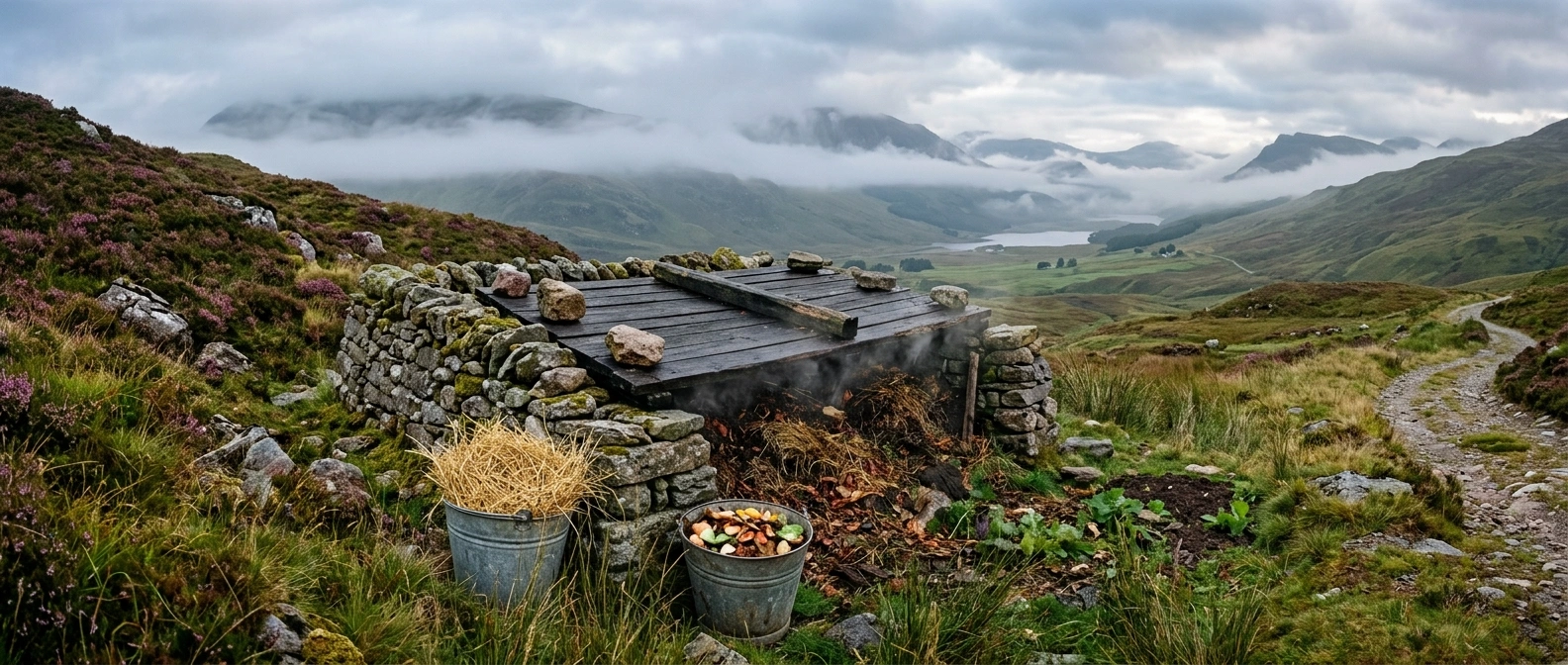
In an arid climate, it's nitrogen-rich material that stays chronically scarce. In a tropical climate, it's carbon that's hard to come by. A highland or alpine climate is genuinely closer in spirit to a boreal one, material overall is limited, than to either of those single-sided shortages, but the cause is different: it's altitude-limited vegetation, not a latitude-limited short season.
Thin, sparse vegetation, a short growing window, and often minimal woody material above the treeline mean there simply isn't as much overall plant growth here to draw either browns or greens from, regardless of how long the season runs each year. Both sides of the ratio are genuinely limited by the same underlying cause.
The real skill in this climate is treating every scrap of both material types as valuable rather than assuming abundance of either, and making the most of what a mountain pastoral system does reliably provide: meadow hay as a genuinely good carbon source, and livestock manure as a genuinely good nitrogen source (see Chapter 6).
Carbon vs Nitrogen at a Glance
A representative spread of materials genuinely available in a highland or alpine climate, from the most carbon-heavy to the most nitrogen-heavy. The full input list, with practical notes on using each one, is in the next chapter.
| Material | Type | Approx C:N Ratio | Notes |
|---|---|---|---|
| Cardboard (plain, kept dry) | C | ~350-400:1 | Shred first; a useful carbon source that doesn't depend on what grows locally |
| Any available scrub or woody prunings | C | ~100-500:1 | Minimal above the treeline, but worth keeping whatever is found; shred or chop first |
| Dried meadow hay | C | ~40-50:1 | The single most reliable carbon source here, a genuine mountain pastoral staple (see Chapter 6) |
| Dried alpine grasses and sedges | C | ~50-60:1 | Thin, sparse growth, but worth gathering and drying wherever it's found |
| Straw, where grown locally | C | ~50-80:1 | Not always available at altitude; use it if a lower valley farm supplies it |
| Livestock manure | N | ~15-25:1 | The single most reliable nitrogen source here (see Chapter 6) |
| Fresh-cut alpine grass, still green | N | ~15-20:1 | Cut and use promptly, before it dries out and shifts toward the carbon side |
| Fresh kitchen scraps | N | ~15:1 | Genuinely scarce given a small household's limited output; save every scrap |
| Legume trimmings, where grown | N | ~15-20:1 | A real nitrogen boost if any legume crop fits the short season |
| Urine | N | ~0.8-1:1 (concentrated) | A genuinely free, always-available nitrogen source independent of what grows; always dilute before use (see Chapter 8) |
Ratios are approximate -- real material varies with freshness, moisture content and exact species. Treat them as a guide to relative balance, not a figure to measure precisely.
Working By Volume, Not Weight
You don't need to weigh anything to get this right in practice. Browns are typically bulkier and lighter than fresh greens, so working by volume naturally lands close to the target ratio: roughly two buckets of carbon material to every one bucket of nitrogen material.
In this climate, because both types of material are genuinely limited by how little grows at altitude in a short season, the practical task is less about fine-tuning that 2:1 ratio in any single moment and more about not wasting any of either type at all. Dried meadow hay and manure are the most consistently available materials here, so treat them as the reliable backbone of both sides of the ratio (see Chapter 6), and top them up with whatever scraps of kitchen waste, dried grass or scrub come available, rather than holding out for a perfectly balanced mix that this climate may simply never offer in one go.
Troubleshooting: A Heap Too Small to Hold Heat
The most common failure mode here is a heap that's simply too small and too thin on material to hold any heat at all, given how little is available to build it with. Spreading a genuinely limited amount of material across too large or too exposed a structure leaves it unable to generate or retain any real warmth, and it never gets close to an active, heating state.
The fix is concentrating whatever material is available into the smallest heap that still meets a reasonable minimum size, following the structural guidance in Chapter 2 and Chapter 3, rather than building a larger structure and hoping to fill it gradually. A small, dense, well-sheltered heap built from concentrated material will outperform a larger, thinly filled one every time in this climate.
Frequently Asked Questions
Is carbon or nitrogen scarcer in a highland or alpine climate?
Both are genuinely limited here, which is different from most other climates in this guide, where usually only one side runs short. Altitude, not latitude, is the cause: thin, sparse vegetation, a short growing window, and often minimal woody material above the treeline mean there simply isn't as much overall plant growth to draw either browns or greens from, unlike a boreal climate where the constraint is a short season rather than thin vegetation itself.
How does this differ from a boreal climate's material shortage?
The underlying cause is different even though the effect looks similar. A boreal climate's shortage comes from a short season driven by high latitude, plenty grows, but only briefly. An alpine climate's shortage comes from altitude itself limiting how much grows at all, thin, sparse vegetation and minimal woody material above the treeline regardless of how long the season runs. The practical result is the same discipline either way: waste nothing.
What's the most common carbon-nitrogen mistake in this climate?
Building a heap that's simply too small and too thin on material to hold any heat at all, given how little is available to build it with. The fix is concentrating whatever material is available into the smallest heap that still meets a reasonable minimum size, rather than spreading too little material across too large or too exposed a structure, which never gets close to heating properly.
Do I need to weigh my compost inputs to get the ratio right?
No -- working by volume rather than weight is accurate enough in practice, because browns are typically bulkier and lighter than fresh greens. The rule of thumb is roughly two buckets of carbon material to every one bucket of nitrogen material. In this climate, because both material types are genuinely limited by how little grows at altitude in a short season, the practical task is less about fine-tuning that 2:1 ratio and more about not wasting any of either type, using dried meadow hay and manure as the reliable backbone of both sides.