
A working reference of what's genuinely available to build a heap with in a highland or alpine climate, and what belongs nowhere near it. Nothing here relies on anything you can't gather, grow or produce yourself, in keeping with this guide's whole approach to self-sufficiency.
Good Carbon Inputs
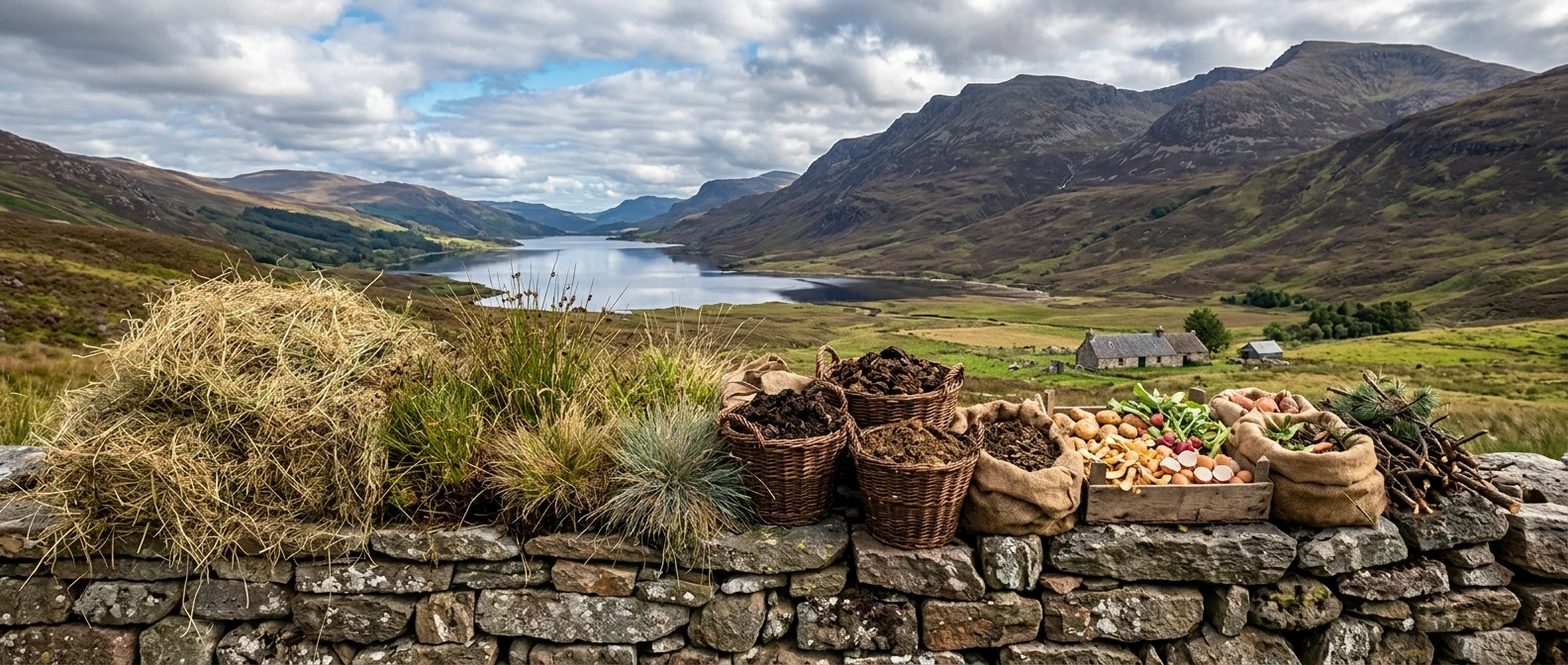
- Dried meadow hay -- the single most reliable carbon source here, a genuine mountain pastoral staple (see Chapter 6).
- Dried alpine grasses and sedges -- thin, sparse growth compared to lower elevations, but worth gathering and drying wherever it's found.
- Straw, where grown locally -- not always available at real altitude; a useful bulk carbon if a lower valley source supplies it.
- Cardboard -- shred before use and keep it dry until then; a reliable brown that doesn't depend on what grows locally.
- Any available scrub or woody prunings -- genuinely minimal above the treeline, but worth keeping and shredding whatever is found rather than discarding it.
Good Nitrogen Inputs
- Livestock manure -- the single most reliable nitrogen source here, and genuinely abundant across long-established mountain pastoral farming (see Chapter 6).
- Fresh kitchen scraps -- genuinely scarce given a small household's limited output at altitude, but worth saving every scrap of.
- Fresh-cut alpine grass, while still green -- cut and use promptly, before it dries out and shifts toward the carbon side of the ratio.
- Legume trimmings, where grown -- a real nitrogen boost if any legume crop fits inside the short growing season.
- Urine -- a genuinely free, always-available nitrogen source independent of what grows locally; always dilute before use (see Chapter 8).
Materials to Avoid
Not everything that could theoretically go into a heap should. Some materials are genuine no-gos, others are fine in small amounts but cause real problems if overdone. If something needs to be kept out of a heap, pile it separately or, where appropriate, refer to biochar production (Chapter 9) as an alternative use, rather than treating it as waste with nowhere to go.
| Material | Tier | Why |
|---|---|---|
| Meat, fish, cooked food, dairy | 1 -- avoid entirely | Attracts wildlife looking for food, a real concern where mountain predators and scavengers are part of the local ecology |
| Diseased plant material | 1 -- avoid entirely | A heap here may not reliably reach temperatures high enough to kill pathogens, given how limited and interrupted warmth is at altitude |
| Pet or dog faeces | 1 -- avoid entirely | Can carry pathogens harmful to humans; keep well away from food-bound compost |
| Perennial weed roots and seeds | 1 -- avoid entirely | May survive a heap that doesn't reliably heat given how limited and interrupted warmth is here |
| Conifer material near the treeline | 2 -- use with caution | Genuinely slow to break down and acidic, the same as in other climates; use sparingly mixed with faster material |
| Heavily lignified alpine scrub or dwarf shrub material | 2 -- use with caution | Genuinely slow to break down whole in a climate that already struggles to sustain heat; shred or chop first |
Tier 1 materials should stay out of the heap entirely. Tier 2 materials are genuinely useful inputs, but only when handled with the extra care noted above.
Frequently Asked Questions
What are the most reliable compost materials at high altitude?
Dried meadow hay for carbon and livestock manure for nitrogen, by a clear margin. Both come from long-established mountain pastoral farming traditions and are genuinely more consistently available here than anything else, since so little else grows reliably at altitude. Everything else on this list, dried alpine grasses, fresh kitchen scraps, urine and the rest, is worth gathering too, but these two are the backbone this climate's heap is built around.
Can conifer material be composted at altitude?
Only sparingly. Conifer material found at the higher, colder margins of the treeline is genuinely slow to break down and acidic, the same as conifer material in any other climate's guide, and that effect is only made worse by a heap that already struggles to sustain heat. Use it in small amounts mixed well with faster, more reliable material rather than as a primary carbon source.
What should never go in a highland or alpine compost heap?
Meat, fish, cooked food and dairy top the list, attracting wildlife looking for food, a real concern where mountain predators and scavengers are part of the local ecology. Diseased plant material, pet or dog faeces, and perennial weed roots or seeds should also stay out, since a heap that doesn't reliably heat given how limited and interrupted warmth is here may not kill off what's inside them.