
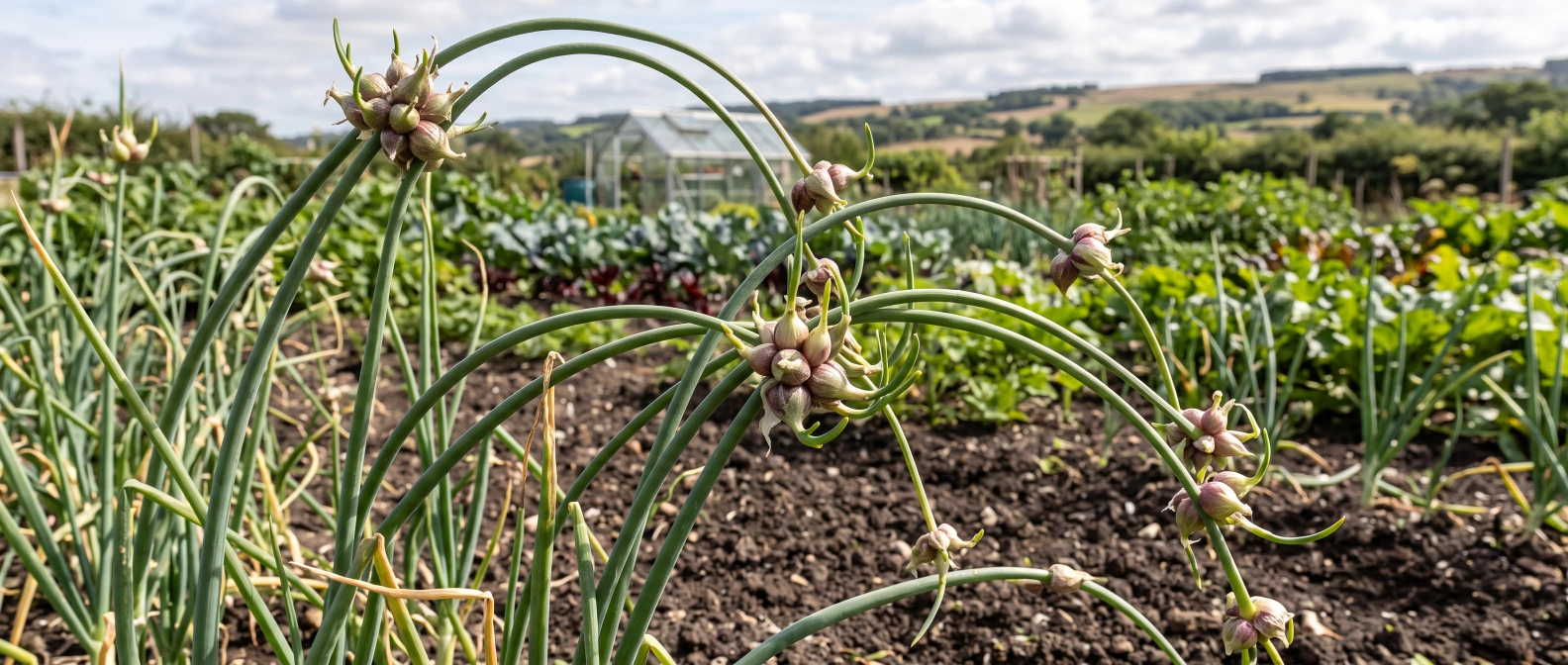
A genuine perennial, per the crop database's own description -- self-propagating and very hardy. Instead of flowers, each stem produces a cluster of small bulbils at its tip; as these grow heavy the stem bends over and roots them into the soil, so the clump literally walks across a bed year after year.
Water need
One of the toughest, most drought-tolerant alliums on this whole site -- unsurprising given "very hardy" is the crop database's own description.
Calories at a glance
400 kcal/kg -- broadly comparable to Welsh onion, grown as much for its year-round convenience as for calorie density (scale is log-based across all 55 core crops in the calculator).
Temperature Range by Month
Month on the bottom, temperature up the side. The pale green background is what the plant can survive at all -- fatal above or below it, labelled directly on the chart where that applies to your zone. The coral band is its ideal range, and only fades in during the months this zone would actually have the crop in the ground -- reusing the exact same calendar data as further down the page. The blue line is real monthly climate data (not a modelled estimate) for a representative rural/agricultural location in this zone -- a small farming town or agricultural research station rather than a major city, to avoid the warmer bias city weather stations have. For the actual verdict on how well this crop does in your zone, see the badge at the top of the page -- that's based on the site's own researched yield figures, not this chart.
Quick Start: Planting to Storage
- Plant bulbils in a permanent bed. Plant bulbils a few centimetres deep into a permanent bed, since the clump will remain in place and spread for years.
- Harvest green stems as needed. Pick green stems and young bulbs through the growing season, treating it much like a perennial spring onion.
- Let some stems produce top bulbils. Leave a portion of stems uncut so their top bulbil clusters develop fully for propagation.
- Let bent stems root new bulbils. Allow heavy bulbil clusters to bend the stem down and root into the soil, letting the clump spread naturally.
- Divide congested clumps every few years. Lift and divide an overcrowded clump every few years to keep it productive and to share plants elsewhere in the garden.
Planting & Harvesting Calendar
Pick your zone under "Temperature Range by Month" above and this updates too. As a genuine standing perennial, walking onion can be harvested across most of the year once established -- this shows when planting and picking are at their best in your zone.
Calories & Yield
Tropical gives the best yield here, and every zone stays viable outdoors -- a genuinely hardy crop across the board.
| Climate Zone | Yield per plant | Calories per plant | Viability |
|---|---|---|---|
| Tropical / Humid | 3.00 kg | 1,200 kcal | Viable -- best yield |
| Subtropical | 2.50 kg | 1,000 kcal | Viable |
| Mediterranean | 2.50 kg | 1,000 kcal | Viable |
| Temperate Maritime | 2.00 kg | 800 kcal | Viable |
| Temperate Continental | 2.00 kg | 800 kcal | Viable |
| Cool / Boreal | 1.50 kg | 600 kcal | Viable |
| Arid / Semi-Arid | 0.90 kg | 360 kcal | Challenging (60% yield) |
| Highland / Alpine | 0.90 kg | 360 kcal | Challenging (60% yield) |
Figures per established clump per year, from the site's own crop database. Arid and Alpine already reflect the 60% penalty applied to challenging zones.
A note on varieties: walking onion (Egyptian/tree onion) is mostly grown as a single undifferentiated type, propagated from bulbils rather than named seed varieties -- real named-cultivar diversity is genuinely thin.
Seed Saving -- Quick Guide
Walking onion is propagated by bulbils, not true seed -- it's a believed hybrid of onion and Welsh onion, largely sterile, so crossing risk barely applies. Every bulbil is a genetic clone of its parent.
SERVINGS, NOT DAILY CALORIES This works out plate-sized servings of walking onion from your bulbils during its fresh harvest window only, not your group's full daily calorie needs. For that, use the main calculator.
PERENNIAL, SELF-PROPAGATING Walking onion is a genuine perennial that spreads on its own bulbils once established, with no replanting needed. You need far less bulbil stock overall than an annual crop of the same scale -- the figures below are a single year's servings from an established, spreading clump.
Estimated for your selected zone above, using this site's own germination, loss and yield figures for walking onion -- a helping is roughly what you'd put on a plate as part of a meal with other veg. Treat it as a planning estimate, not a promise.
Storage & Preservation
Fresh green stems and bulbils keep for one to two weeks refrigerated, similar to spring onions.
Bulbils can also be pickled for longer-term storage, giving a genuinely practical way to preserve a heavy bulbil set.
Growing Walking Onion Without Bought Inputs
Genuinely one of the lowest-maintenance crops on this entire site -- "very hardy" per the crop database, and it spreads and replenishes itself without any intervention at all.
Few pests bother it seriously, in common with most alliums.
Simply letting the clump spread where there's room is the most practical, genuinely input-free way to expand your planting.
Frequently Asked Questions
Is walking onion related to onion and Welsh onion?
Yes, genuinely -- walking onion (Allium x proliferum) is widely believed to be a natural hybrid between onion (Allium cepa) and Welsh onion (Allium fistulosum), both grown elsewhere on this site's Alliums hub. In practice this rarely matters for seed saving, since walking onion almost never sets viable true seed and is propagated by bulbils instead.
Why is it called a walking onion?
Each stem produces a cluster of small bulbils at its tip instead of flowers. As these bulbils grow heavy, the stem bends over and they root where they touch the soil -- so the clump genuinely migrates, or "walks", across a bed year after year.
Do you need to replant walking onion every year?
No -- that's the point of it. The crop database is direct: perennial, self-propagating, very hardy. Once established, it keeps producing and spreading on its own bulbils without any replanting.