
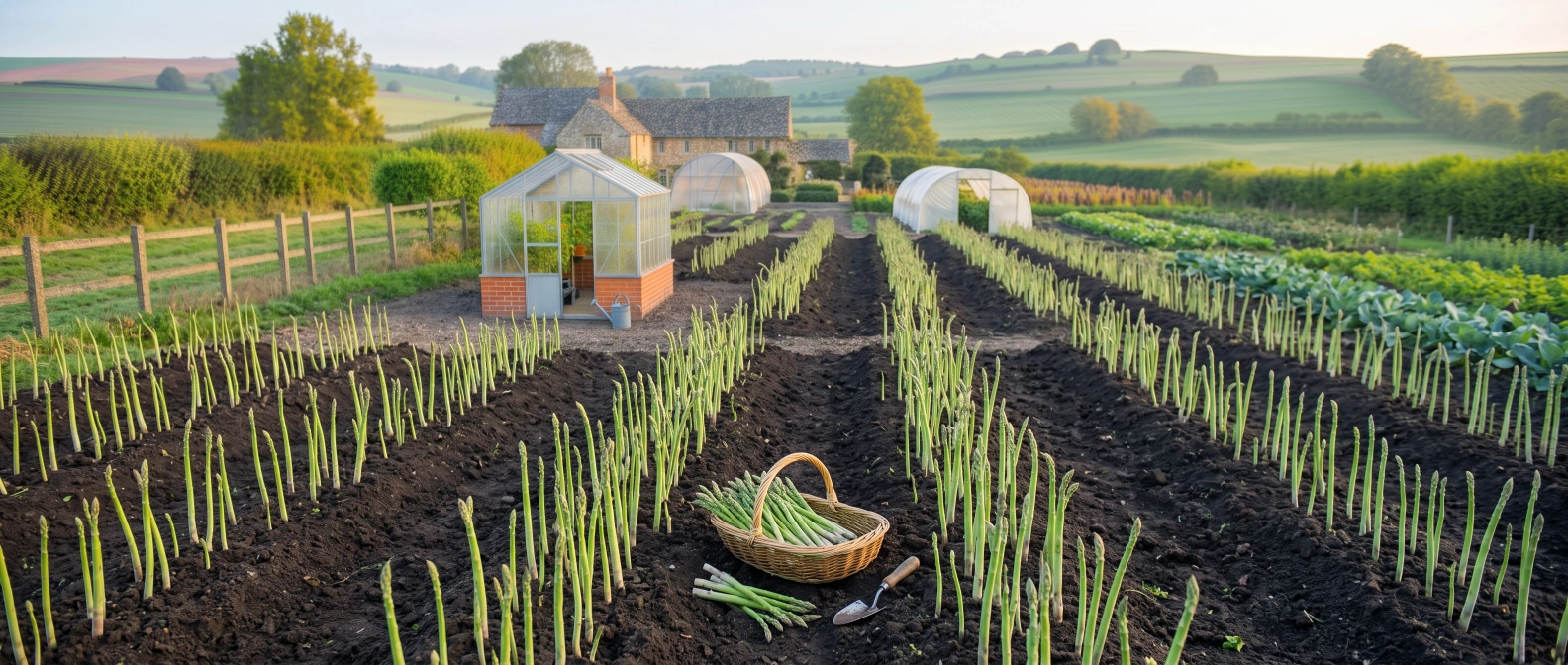
Asparagus is the longest-term investment on this whole site: plant crowns, wait three years before the first proper harvest, and then it keeps cropping for 20+ years -- per the crop database's own description. It's also genuinely dioecious, meaning individual plants are either male or female, which is why all-male hybrid varieties are so popular: no seed-bearing females competing for the crown's energy.
Water need
Genuinely drought-tolerant once established, thanks to deep, extensive roots built up over its long establishment period -- one advantage of a crop that's in the ground for decades.
Calories at a glance
200 kcal/kg -- grown for its distinctive early-spring flavour and as a long-term, low-effort perennial rather than for calories (scale is log-based across all 55 crops in the calculator).
Temperature Range by Month
Month on the bottom, temperature up the side. The pale green background is what the plant can survive at all -- fatal above or below it, labelled directly on the chart where that applies to your zone. The coral band is its ideal range, and only fades in during the months this zone would actually have spears being harvested -- reusing the exact same calendar data as further down the page. The blue line is real monthly climate data (not a modelled estimate) for a representative rural/agricultural location in this zone -- a small farming town or agricultural research station rather than a major city, to avoid the warmer bias city weather stations have. For the actual verdict on how well this crop does in your zone, see the badge at the top of the page -- that's based on the site's own researched yield figures, not this chart.
Quick Start: Planting to Storage
- Plant crowns, not seed. Plant dormant crowns in early spring into a well-prepared, weed-free bed -- this is the single biggest head start over growing from seed.
- Let the bed establish for three years. Resist cutting any spears for the first two years, and take only a light harvest in year three -- the crown needs that time to build the root reserves that support decades of future cropping.
- Harvest spears at full cropping age. From year four onward, cut spears regularly through the harvest window while they're young and tender, then stop cutting to let the plant put energy back into the crown for next year.
- Let ferns grow on after harvest. Once the harvest window ends, stop cutting and let the feathery ferns grow through summer and autumn -- this is how the crown recharges for next year's spears.
- Cut back ferns and mulch in autumn. Once ferns die back and yellow, cut them to the ground and mulch the bed -- this protects the crown over winter and feeds next year's growth.
Planting & Harvesting Calendar
Pick your zone under "Temperature Range by Month" above and this updates too. This shows the planting window for new crowns and the annual harvest window for an already-established bed -- not the three-year wait before that first harvest, which applies everywhere regardless of zone.
Calories & Yield
These figures are per plant, per year, once a bed is fully established and past its three-year wait. Subtropical, Mediterranean, Maritime and Continental zones share the best yield here.
| Climate Zone | Yield per plant | Calories per plant | Viability |
|---|---|---|---|
| Tropical / Humid | 0.20 kg | 40 kcal | Viable |
| Subtropical | 0.30 kg | 60 kcal | Viable -- best yield |
| Mediterranean | 0.30 kg | 60 kcal | Viable -- best yield |
| Temperate Maritime | 0.30 kg | 60 kcal | Viable -- best yield |
| Temperate Continental | 0.30 kg | 60 kcal | Viable -- best yield |
| Cool / Boreal | 0.20 kg | 40 kcal | Viable |
| Arid / Semi-Arid | 0.06 kg | 12 kcal | Challenging (60% yield) |
| Highland / Alpine | 0.15 kg | 30 kcal | Viable |
Figures per established plant per year, from the site's own crop database. Arid's yield already reflects the 60% penalty applied to challenging zones -- 0.10kg raw becomes 0.06kg actual.
Varieties Worth Knowing
Asparagus varieties mainly differ in colour and vigour. All the varieties below are open-pollinated (OP), meaning seed saved from them breeds true and is worth keeping under this site's seed-saving approach; none are F1 hybrids.
Seed Saving -- Quick Guide
Asparagus is dioecious -- individual plants are entirely male or entirely female -- so a reliable seed crop needs both sexes flowering together, not just isolation from other varieties.
SERVINGS, NOT DAILY CALORIES This works out plate-sized servings of asparagus from your crowns during its fresh harvest window only, not your group's full daily calorie needs. For that, use the main calculator.
3-YEAR ESTABLISHMENT Asparagus takes three years before the first proper harvest -- the figures below show what a mature, established bed produces each year, not what you'll get in year one. Resist cutting spears for the first two years and take only a light harvest in year three, or you'll weaken the crown for the 20+ years of cropping it should otherwise give you.
Estimated for your selected zone above, using this site's own germination, loss and yield figures for asparagus -- a helping is roughly what you'd put on a plate as part of a meal with other veg. Treat it as a planning estimate, not a promise.
Storage & Preservation
Fresh asparagus spears don't store long -- they're best cut and eaten or preserved within days, unlike most of the storage-focused crops elsewhere on this site.
For longer-term preservation, blanching and freezing is the most practical route for a self-sufficiency setting, keeping spears usable for months without specialist equipment.
Growing Asparagus Without Bought Inputs
Once established, asparagus is genuinely low-maintenance -- its main ongoing need is keeping the bed weed-free, since young spears compete poorly with weeds for light and nutrients.
Asparagus beetle is the main pest to watch for, targeting both spears and the summer ferns.
Hand-picking beetles and larvae off plants, and a thick mulch to suppress weeds, are simple, genuinely effective input-free measures.
Frequently Asked Questions
Why does asparagus take three years before the first harvest?
Because the crop database is direct about it: plant crowns, not seed, and it takes three years before the first harvest -- that time lets the crown build up enough root reserves to support cutting spears without weakening the plant. It's a genuine long-term investment, but one that's then productive for 20+ years.
Is asparagus really a plant-once crop?
Yes -- once established from crowns and given its three-year establishment period, an asparagus bed keeps producing for 20+ years, making it one of the longest-lived crops this site models.
Does asparagus have separate male and female plants?
Yes -- asparagus is genuinely dioecious, meaning individual plants are either male or female, not both. Female plants put energy into producing seed berries, which is why modern all-male hybrid varieties are popular: without seed production competing for the crown's energy, they tend to give heavier spear yields.
How is new asparagus normally propagated?
From crowns rather than seed, exactly as the crop database specifies -- buying or dividing established crowns gives a much faster start than growing from seed, which adds a full extra year before the standard three-year establishment period even begins.