
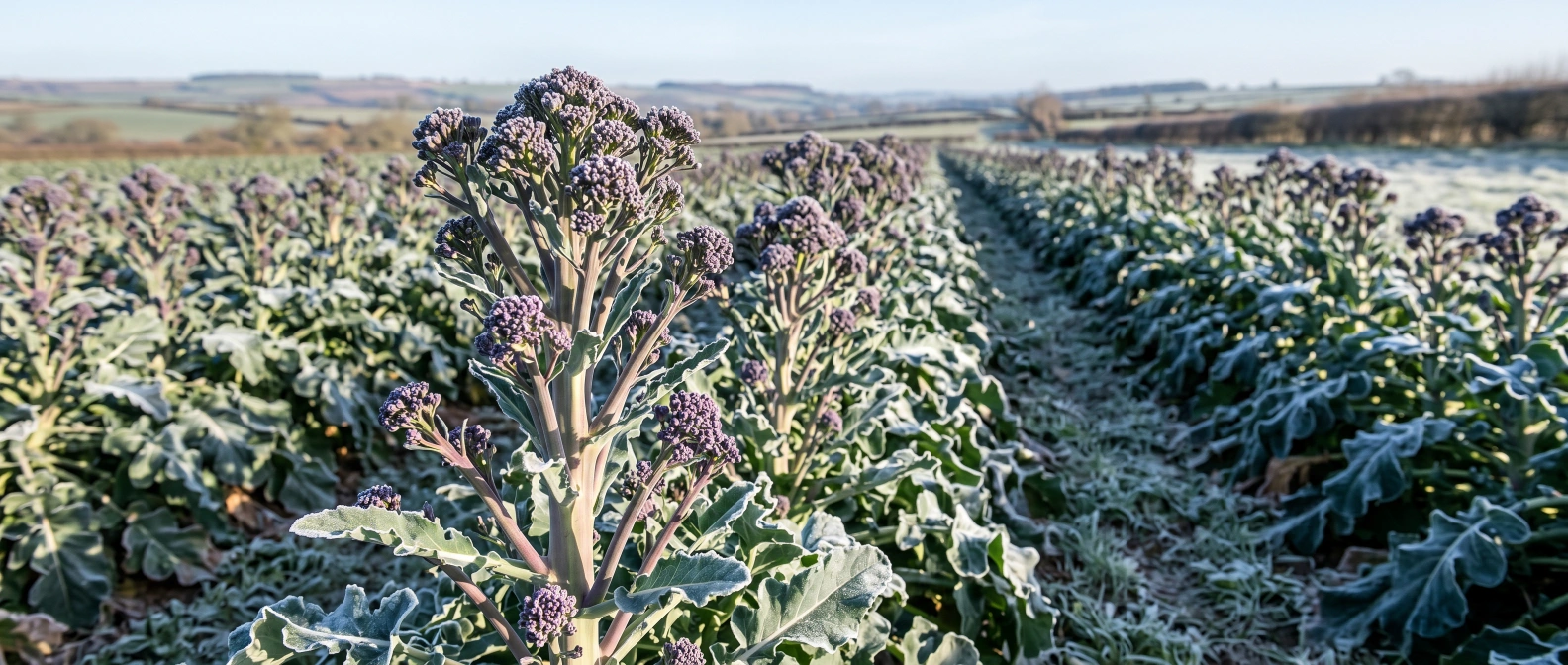
A genuine overwintering brassica, per the crop database's own description: sow in summer, harvest late winter into spring. That timing makes it an excellent hungry gap crop -- ready exactly when stored autumn crops are running low and new spring sowings aren't there yet. It needs a specific kind of climate to work: mild enough to survive winter outdoors, but with enough real cold to trigger proper spear formation.
Water need
Wants consistent moisture through its long summer establishment period -- a plant standing through winter needs to go in strong and well-rooted.
Calories at a glance
340 kcal/kg -- genuinely valuable less for raw calorie density and more for exactly WHEN it's ready, filling a real seasonal gap (scale is log-based across all 55 core crops in the calculator).
Temperature Range by Month
Month on the bottom, temperature up the side. The pale green background is what the plant can survive at all -- fatal above or below it, labelled directly on the chart where that applies to your zone. The coral band is its ideal range, and only fades in during the months this zone would actually have the crop in the ground -- reusing the exact same sowing/harvesting data as the calendar further down the page. The blue line is real monthly climate data (not a modelled estimate) for a representative rural/agricultural location in this zone -- a small farming town or agricultural research station rather than a major city, to avoid the warmer bias city weather stations have. For the actual verdict on how well this crop does in your zone, see the badge at the top of the page -- that's based on the site's own researched yield figures, not this chart.
Quick Start: Sowing to Storage
- Sow in early summer. Sow in late spring or early summer, per the crop database's own instruction -- this gives plants a full growing season to establish before winter.
- Transplant and give it room. Transplant seedlings to their final position with plenty of space -- mature plants get large and need to stand through an entire winter.
- Stake or earth up before winter. Firm plants in well and consider staking -- tall plants standing through winter storms are vulnerable to wind-rock, which can loosen roots and let in cold or disease.
- Leave standing through winter. Let plants stand in the ground through winter -- this is a genuine living larder crop, doing nothing visible until the cold actually triggers spear formation.
- Harvest spears regularly from late winter. Cut the central spear first to encourage side shoots, then keep harvesting side spears every few days through late winter and spring -- regular picking extends the harvest window.
Sowing & Harvesting Calendar
Pick your zone under "Temperature Range by Month" above and this updates too. Notice the long gap between sowing (early summer) and harvest (deep winter into spring) -- this is a genuine long-season crop, standing in the ground far longer than almost anything else on this hub.
Calories & Yield
A genuinely narrow zone-fit compared to most crops on this site: only Mediterranean and Maritime are fully viable, and it doesn't grow at all in four of the eight zones this site models.
| Climate Zone | Yield per plant | Calories per plant | Viability |
|---|---|---|---|
| Tropical / Humid | -- | -- | Not viable |
| Subtropical | 0.9 kg | 306 kcal | Challenging (60% yield) |
| Mediterranean | 2.0 kg | 680 kcal | Viable -- best yield |
| Temperate Maritime | 2.0 kg | 680 kcal | Viable -- best yield |
| Temperate Continental | 0.9 kg | 306 kcal | Challenging (60% yield) |
| Cool / Boreal | -- | -- | Not viable |
| Arid / Semi-Arid | -- | -- | Not viable |
| Highland / Alpine | -- | -- | Not viable |
Figures per plant sown, from the site's own crop database. Subtropical and Continental already reflect the 60% penalty applied to challenging zones.
Varieties Worth Knowing
Purple sprouting broccoli varieties mostly split along an early/late axis -- growing one of each stretches the harvest window considerably. All the varieties below are open-pollinated (OP), meaning seed saved from them breeds true and is worth keeping under this site's seed-saving approach; none are F1 hybrids.
Seed Saving -- Quick Guide
Purple sprouting broccoli crosses freely with standard broccoli and every other Brassica oleracea crop -- kale, cauliflower, cabbage, Brussels sprouts, kohlrabi. Like other broccoli, the part you eat is the unopened flower head, so seed plants must be reserved from harvest entirely.
SERVINGS, NOT DAILY CALORIES This works out plate-sized servings of purple sprouting broccoli from your seed during its fresh harvest window only, not your group's full daily calorie needs. For that, use the main calculator.
BIENNIAL Purple sprouting broccoli is a biennial, not an annual -- it doesn't produce seed in its first year, and is already grown as a two-season overwintering crop for eating. Plants grow through year one, a few overwintered plants flower and set seed in year two, and that seed is only ready to sow in year three. If you're starting from scratch with no ongoing seed supply, that means having enough seed on hand for both year one's and year two's sowing up front. Plan for roughly double the seed quantity below if that's your situation.
Estimated for your selected zone above, using this site's own germination, loss and yield figures for purple sprouting broccoli -- a helping is roughly what you'd put on a plate as part of a meal with other veg. Treat it as a planning estimate, not a promise.
Storage & Preservation
The plant itself IS the storage -- per the crop database's own framing as an overwintering crop, it stands living in the ground through the coldest months and simply gets harvested fresh as spears form.
Once cut, fresh spears keep only a few days refrigerated. For longer-term preservation, blanching and freezing is the standard route, keeping cut spears usable for months.
Growing Purple Sprouting Broccoli Without Bought Inputs
A genuinely low-maintenance crop through most of its long season -- it needs little attention while standing dormant-ish through winter, then rewards you at exactly the right time.
Pigeons and cabbage white caterpillars are the main threats, the same pest pressure this hub's other brassicas face.
Netting over the whole bed through the growing season is a simple, genuinely effective input-free defence against both.
Frequently Asked Questions
Does purple sprouting broccoli cross-pollinate with the other brassicas on this site?
Yes -- genuinely and extensively. Purple sprouting broccoli is Brassica oleracea, the same species as this hub's regular broccoli, both cabbages, cauliflower, Brussels sprouts, kale and kohlrabi. That's eight crops in one same-species cluster, the biggest cross-pollination group on this entire site. It does NOT cross with pak choi, mizuna, Chinese cabbage, turnip or mustard greens -- all a different species, Brassica rapa or juncea.
What is a "hungry gap" crop?
The stretch of late winter and early spring when stored crops from last autumn are running low and this year's new sowings haven't matured yet -- historically a genuinely lean period for anyone growing their own food. The crop database calls purple sprouting broccoli an excellent hungry gap crop specifically because it's harvested exactly then, when little else is ready.
Why isn't purple sprouting broccoli viable in every zone?
It needs a genuinely specific climate: mild enough to survive winter outdoors, but with enough cold to trigger proper spear formation. This site's yield data marks it not viable in Tropical, Boreal, Arid or Alpine zones -- either too hot to ever get cold-triggered, or too harshly cold to survive the winter it needs to spend in the ground.