
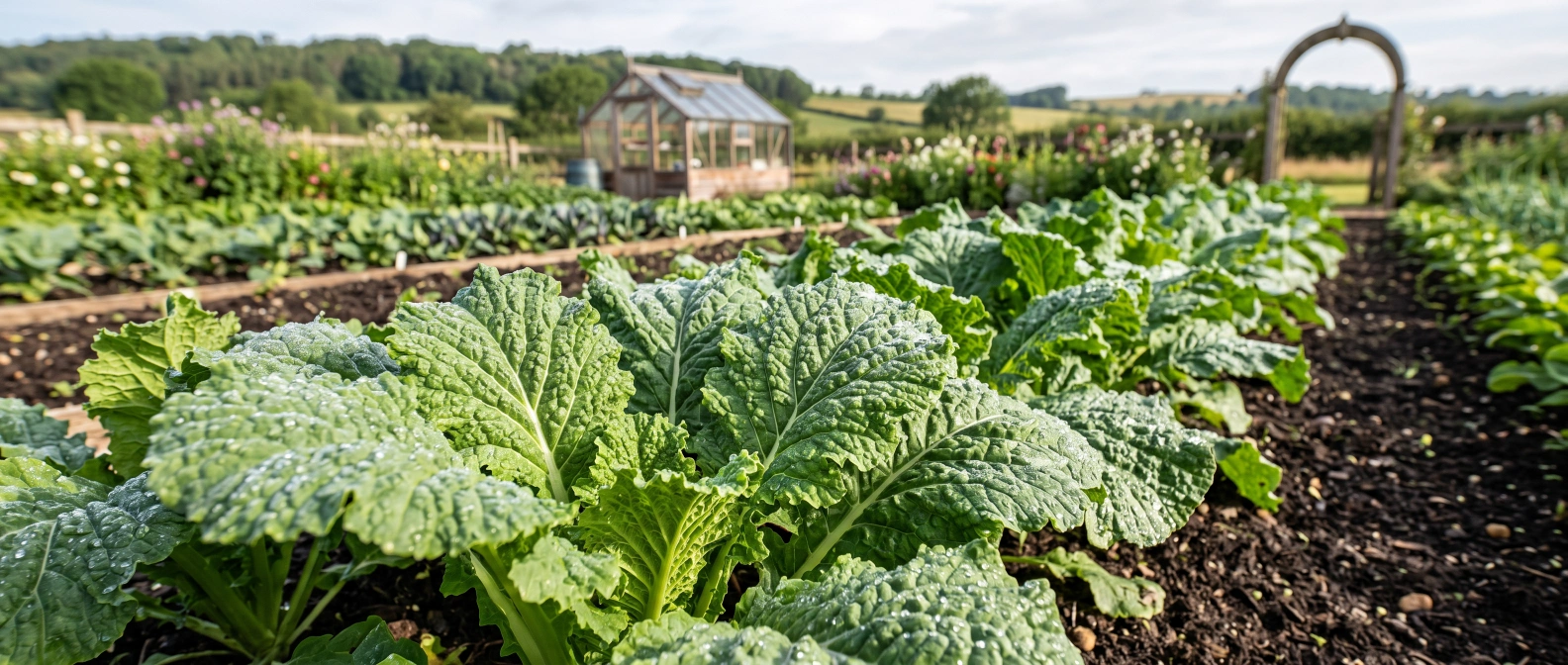
Fast-growing with a genuinely strong, spicy flavour, per the crop database's own description, and more bolt-resistant in cool weather than most leafy brassicas. It sits right next to this hub's Brassica rapa Asian greens and shares a similar look, but is botanically its own species -- the exception, not the rule.
Water need
Genuinely more drought-tolerant than pak choi or Chinese cabbage -- one of the tougher, lower-maintenance greens on this hub.
Calories at a glance
270 kcal/kg -- grown for its strong, distinctive flavour and fast turnaround rather than as a calorie crop (scale is log-based across all 55 core crops in the calculator).
Temperature Range by Month
Month on the bottom, temperature up the side. The pale green background is what the plant can survive at all -- fatal above or below it, labelled directly on the chart where that applies to your zone. The coral band is its ideal range, and only fades in during the months this zone would actually have the crop in the ground -- reusing the exact same sowing/harvesting data as the calendar further down the page. The blue line is real monthly climate data (not a modelled estimate) for a representative rural/agricultural location in this zone -- a small farming town or agricultural research station rather than a major city, to avoid the warmer bias city weather stations have. For the actual verdict on how well this crop does in your zone, see the badge at the top of the page -- that's based on the site's own researched yield figures, not this chart.
Quick Start: Sowing to Storage
- Sow direct in cool conditions. Sow direct in early spring or autumn -- mustard greens is genuinely more prone to bolting in the heat of high summer than in cooler weather.
- Thin to final spacing. Thin seedlings once established, leaving enough room for leaves to bulk up without overcrowding.
- Harvest outer leaves as needed. Pick outer leaves regularly once plants are established, leaving the centre growing point to keep producing new leaves.
- Pick before flavour gets too strong. Younger leaves have a milder mustard heat; older, larger leaves develop a genuinely stronger, spicier flavour -- pick according to how strong you want it.
- Use fresh, or cook down like other greens. Use fresh in salads when young, or cook down like kale or spinach once leaves are larger and the flavour has intensified.
Sowing & Harvesting Calendar
Pick your zone under "Temperature Range by Month" above and this updates too. Most zones show spring and autumn windows either side of the hottest months, consistent with its cool-weather bolt resistance.
Calories & Yield
Tropical gives the best yield here, and every zone shows at least a challenging window.
| Climate Zone | Yield per plant | Calories per plant | Viability |
|---|---|---|---|
| Tropical / Humid | 3.0 kg | 810 kcal | Viable -- best yield |
| Subtropical | 2.5 kg | 675 kcal | Viable |
| Mediterranean | 2.5 kg | 675 kcal | Viable |
| Temperate Maritime | 2.0 kg | 540 kcal | Viable |
| Temperate Continental | 2.0 kg | 540 kcal | Viable |
| Cool / Boreal | 0.9 kg | 243 kcal | Challenging (60% yield) |
| Arid / Semi-Arid | 0.9 kg | 243 kcal | Challenging (60% yield) |
| Highland / Alpine | 0.9 kg | 243 kcal | Challenging (60% yield) |
Figures per plant sown, from the site's own crop database. Boreal, Arid and Alpine already reflect the 60% penalty applied to challenging zones.
Varieties Worth Knowing
Mustard greens vary a lot in leaf texture and how much heat/spiciness they bring -- from mild, spinach-like types to genuinely fiery ones. All the varieties below are open-pollinated (OP), meaning seed saved from them breeds true and is worth keeping under this site's seed-saving approach; none are F1 hybrids.
Seed Saving -- Quick Guide
Mustard greens and mustard grown for seed are the same species (Brassica juncea) and will cross with each other and other mustard-greens varieties -- but not with cabbage, kale or pak choi-type crops, different species despite the shared name.
SERVINGS, NOT DAILY CALORIES This works out plate-sized servings of mustard greens from your seed during its fresh harvest window only, not your group's full daily calorie needs. For that, use the main calculator.
BIENNIAL FOR SEED Mustard greens are grown as an annual for eating, but are biennial for seed -- most varieties need to overwinter before flowering and setting seed the following year. Plants grow through year one, a few overwintered plants flower and set seed in year two, and that seed is only ready to sow in year three. If you're starting from scratch with no ongoing seed supply, that means having enough seed on hand for both year one's and year two's sowing up front. Plan for roughly double the seed quantity below if that's your situation.
Estimated for your selected zone above, using this site's own germination, loss and yield figures for mustard greens -- a helping is roughly what you'd put on a plate as part of a meal with other veg. Treat it as a planning estimate, not a promise.
Storage & Preservation
Fresh mustard greens keep for about a week refrigerated -- similar to this hub's other leafy Asian greens.
For longer-term preservation, it blanches and freezes well for cooked dishes, and pickling or fermenting is a well-established traditional route to a much longer-keeping product.
Growing Mustard Greens Without Bought Inputs
A genuinely tough, low-fuss crop -- its strong flavour compounds that make it distinctive also seem to make it somewhat less attractive to pests than milder brassica leaves.
Flea beetles are still worth watching for on young seedlings, the same risk faced by this hub's other brassicas.
Fine mesh over young plants until they're established is a simple, genuinely effective input-free defence.
Frequently Asked Questions
Does mustard greens cross-pollinate with pak choi or mizuna?
No -- and this is worth knowing precisely because it looks like it should. Mustard greens is Brassica juncea, a genuinely different species from pak choi, mizuna and Chinese cabbage (all Brassica rapa) and from turnip too. Despite the family resemblance and sitting right next to them on this hub, different species don't cross under ordinary garden conditions.
Does mustard greens cross with kale, cabbage or broccoli?
No -- those are Brassica oleracea, a third different species again. Mustard greens is genuinely isolated from every other crop on this hub, cross-pollination-wise, making it one of the lowest-risk seed-saving choices in the whole Brassicas category.
Why is mustard greens described as bolt-resistant in cool weather?
The crop database notes it specifically: bolt-resistant in cool weather. Like most brassicas grown for leaves, mustard greens is prone to running to flower prematurely in heat or long daylight -- cool conditions genuinely help keep it in leafy growth for longer before it bolts.