
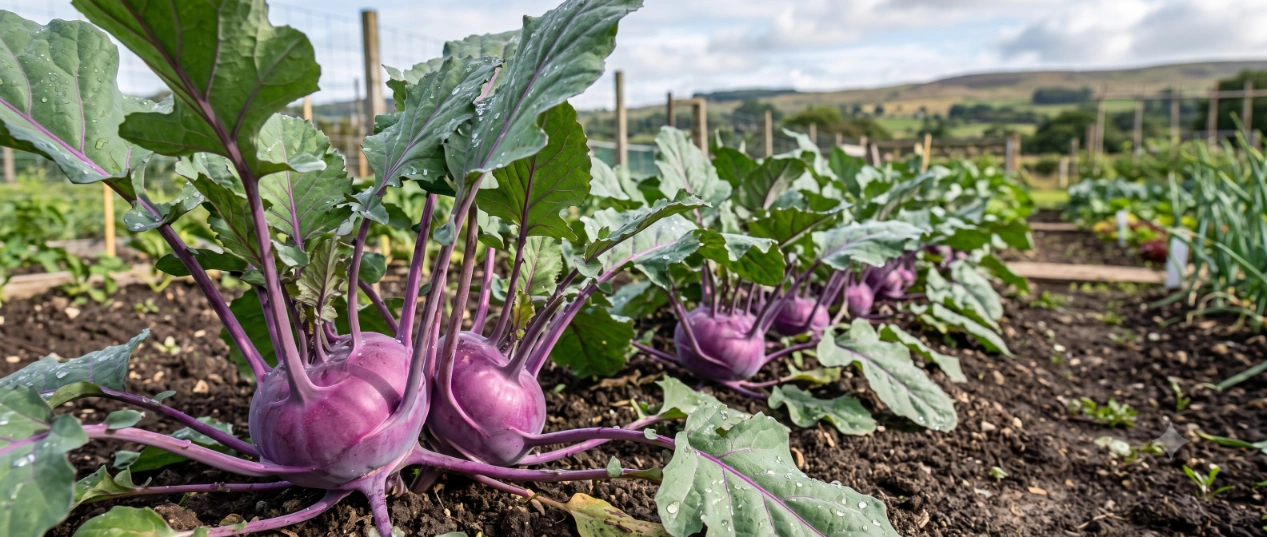
The odd one out in this brassica cluster -- fast rather than slow, sown in repeated small batches rather than once, and at its best picked young rather than left to grow. Both the swollen stem and the leaves are edible, and in the site's own crop database it's the only crop in this whole family rated fully viable in every single climate zone, including Arid, with no yield penalty anywhere. That combination of speed, flexibility and a short, forgiving growing window makes it a useful crop to have in rotation even where its slower relatives struggle.
Water need
Shallow-rooted and dries out faster than deeper-rooted brassicas -- frequent, consistent watering matters more than total volume.
Calories at a glance
270 kcal/kg -- low compared to calorie staples like potatoes or dried beans (scale is log-based across all 55 crops in the calculator, staples included, so vegetables don't all bunch at the bottom).
Temperature Range by Month
Month on the bottom, temperature up the side. The pale green background is what the plant can survive at all -- fatal above or below it, labelled directly on the chart where that applies to your zone. The coral band is its ideal range, and only fades in during the months this zone would actually have the crop in the ground -- reusing the exact same sowing/harvesting data as the calendar further down the page. The blue line is real monthly climate data (not a modelled estimate) for a representative rural/agricultural location in this zone -- a small farming town or agricultural research station rather than a major city, to avoid the warmer bias city weather stations have. For the actual verdict on how well this crop does in your zone, see the badge at the top of the page -- that's based on the site's own researched yield figures, not this chart.
Quick Start: Sowing to Harvest
- Sow in succession. Sow a short row every 2-3 weeks through the season rather than one large batch -- kohlrabi matures fast and doesn't hold well once ready, so staggering sowings keeps a steady supply instead of a single glut that turns woody before you can use it all.
- Thin or space. Direct-sow or transplant with roughly 20-25cm between plants. Kohlrabi is a smaller, quicker plant than most of its relatives and doesn't need the space cabbage or Brussels sprouts do.
- Water frequently. Kohlrabi is shallow-rooted and dries out faster than deeper-rooted brassicas. Keep soil consistently moist -- a check in growth from drought stress is a common cause of a bulb splitting or turning woody early.
- Harvest young. Pick once the bulb reaches about golf-ball to tennis-ball size, typically 6-8 weeks after sowing. Don't wait for it to get bigger -- unlike most of its relatives, there's no benefit to leaving kohlrabi standing longer, only a loss of texture.
Sowing & Harvesting Calendar
Pick your zone under "Temperature Range by Month" above and this updates too. The Sow row: green is the normal safe sowing window, amber is pushing the season by roughly a month either side with basic outdoor protection (cold frame, fleece, cloche), blue is starting seed indoors or under glass for an even earlier transplant. Notice most zones show two separate sow windows rather than one continuous block -- that's the succession-sowing pattern showing up directly in the data, a spring batch and a late-summer batch rather than one long season. The Harvest row shows the corresponding windows, with no extended "still pickable" tail -- kohlrabi doesn't improve by waiting.
Calories & Yield
Kohlrabi is a quick, low-bulk nutrition crop, not a calorie staple -- about 270 kcal per kg, and individual plants yield less than most of its brassica relatives since the edible part is a modest bulb rather than a full head. What it gives up in bulk per plant, it makes up for in speed and the ability to succession-sow multiple batches through a season.
| Climate Zone | Yield per plant | Calories per plant | Viability |
|---|---|---|---|
| Tropical / Humid | 0.2 kg | 54 kcal | Viable |
| Subtropical | 0.3 kg | 81 kcal | Viable |
| Mediterranean | 0.3 kg | 81 kcal | Viable |
| Temperate Maritime | 0.3 kg | 81 kcal | Viable |
| Temperate Continental | 0.3 kg | 81 kcal | Viable |
| Cool / Boreal | 0.2 kg | 54 kcal | Viable |
| Arid / Semi-Arid | 0.1 kg | 27 kcal | Viable |
| Highland / Alpine | 0.2 kg | 54 kcal | Viable |
Figures per plant sown, from the site's own crop database. Kohlrabi is the only crop in this brassica cluster that's fully "Viable" in Arid zones rather than "challenging" or not viable at all -- yields are modest everywhere, but there's no zone-specific yield penalty applied anywhere, unlike broccoli, cauliflower or summer cabbage.
Varieties Worth Knowing
Kohlrabi varieties mainly differ in skin colour and how large the bulb can grow before turning woody. All the varieties below are open-pollinated (OP), meaning seed saved from them breeds true and is worth keeping under this site's seed-saving approach; none are F1 hybrids.
Seed Saving -- Quick Guide
Kohlrabi crosses freely with kale, broccoli, cauliflower, cabbage and Brussels sprouts -- all one species (Brassica oleracea). It's biennial, so saving true seed takes a two-year cycle.
SERVINGS, NOT DAILY CALORIES This works out plate-sized servings of kohlrabi from your seed during its fresh harvest window only, not your group's full daily calorie needs. For that, use the main calculator.
BIENNIAL Kohlrabi is a biennial, not an annual -- it doesn't produce seed in its first year. Plants grow through year one, a few overwintered plants flower and set seed in year two, and that seed is only ready to sow in year three. If you're starting from scratch with no ongoing seed supply, that means having enough seed on hand for both year one's and year two's sowing up front. Plan for roughly double the seed quantity below if that's your situation.
Estimated for your selected zone above, using this site's own germination, loss and yield figures for kohlrabi -- a helping is roughly what you'd put on a plate as part of a meal with other veg. Treat it as a planning estimate, not a promise.
Storage & Preservation
Kohlrabi keeps about 2-4 weeks in cool conditions depending on climate zone -- similar territory to cauliflower, and a fresh-eating crop more than a long-term storage one. Trim the leaves off before storing, as they draw moisture out of the bulb and shorten its keeping time.
For longer preservation: ferment or pickle it much like you would cabbage (chopped or grated, in a vinegar brine or a simple salt ferment), or blanch and freeze it, though the texture softens more than fresh. It doesn't have kale or winter cabbage's option of just leaving it in the ground.
Growing Kohlrabi Without Bought Inputs
Kohlrabi shares the same pest profile as the rest of the brassica family -- cabbage white caterpillars, flea beetle, aphids -- and exactly which one causes trouble depends heavily on where you are. What works almost everywhere instead:
Floating row covers or fine insect netting are the single most effective input-free defence -- they physically exclude the large majority of common brassica pests regardless of which one is active locally, with no identification needed.
Companion planting helps too: aromatic herbs like dill, oregano or thyme interplanted nearby mask the scent brassica pests use to find their host, and nasturtiums nearby often draw pests away as a sacrificial trap crop.
Crop rotation matters as much as pest defence -- avoid growing any brassica in the same bed two years running. This breaks the life cycle of soil-borne problems like clubroot, which can persist in soil for years without a host to reset the clock.
Keeping pace with the succession schedule is kohlrabi's biggest zero-input lever specifically -- since a bulb left too long only gets worse, staying on top of sowing and harvesting every couple of weeks costs nothing but attention and avoids losing a batch to woodiness.
Frequently Asked Questions
Why does my kohlrabi turn woody and tough?
It's been left too long. Kohlrabi is at its best picked young and tender, roughly golf-ball to tennis-ball sized -- unlike kale or winter cabbage, there's no advantage to leaving it standing longer. Past that point the bulb gets increasingly fibrous and loses the texture that makes it worth eating.
Are the leaves edible too?
Yes -- both the swollen stem (the part usually called the bulb) and the leaves are edible, cooked much like any other brassica green. It's a genuine two-for-one crop, unlike most of its relatives where only one part is used.
Why is kohlrabi viable even in Arid zones when other brassicas here aren't?
It's fast, shallow-rooted and tolerant of poor soil, so a short growing window between extremes of heat is enough to get a crop -- unlike slower relatives that need a long, mild season. In the site's own crop database, kohlrabi is the only crop in this brassica cluster rated fully viable in every single zone, with no yield penalty anywhere.
Can I save seed if I'm also growing other brassicas?
Only carefully. Kohlrabi can cross-pollinate with kale (oleracea-type), broccoli, cauliflower, cabbage (summer and winter/Savoy), Brussels sprouts and purple sprouting broccoli if more than one is left to flower nearby at the same time. Keep varieties about half a mile (800m) apart for home use, or only let one flower per season.
How much heat and cold can kohlrabi survive?
Established plants tolerate moderate frost down to around -4°C (24°F), but young plants are more vulnerable, and kohlrabi is noticeably less hardy than kale or Brussels sprouts overall -- don't assume it can be left standing through a deep winter the way they can.
How long does it keep after harvest?
About 2-4 weeks in cool conditions depending on climate zone, similar territory to cauliflower. It's a fresh-eating crop more than a long-term storage one.
Is kohlrabi a good calorie crop for self-sufficiency?
No -- about 270 kcal per kg, and individual plants yield less than most of its brassica relatives since the edible part is a modest-sized bulb rather than a full head. Grow it for quick turnaround and variety, and let calorie-dense staple crops carry a household's energy needs.
How long does the seed stay viable?
Around 4-5 years if kept cool, dark and dry, similar to other Brassica oleracea seed, though germination rates decline gradually each year even within that window. Test old seed before relying on it for a full planting.
Do I need pesticides to grow kohlrabi?
No. Floating row covers or fine insect netting physically exclude most common brassica pests without needing to identify which one you're dealing with, and companion planting, crop rotation and hand-picking cover the rest for a home-scale planting.