
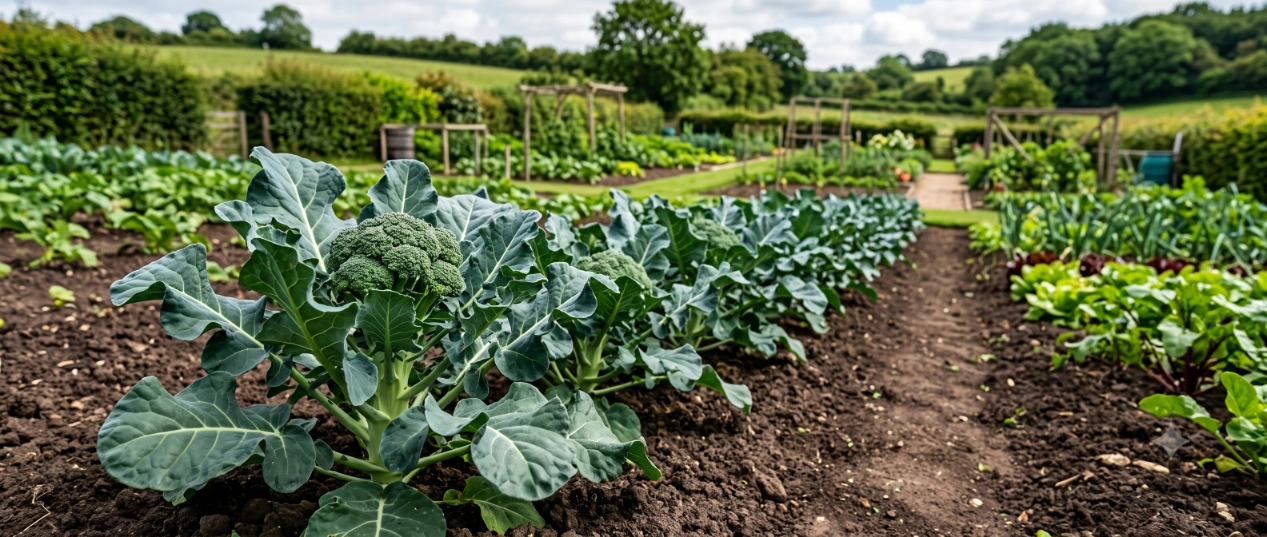
One of the most nutrient-dense vegetables you can grow -- broccoli packs more vitamin C by weight than an orange, plus meaningful folate and fibre, which matters when a diet leans hard on stored grains and root vegetables. It doesn't behave like most brassicas, though: rather than months of steady cut-and-come-again leaves, each plant gives one concentrated harvest window -- a main head, then a few weeks of smaller side shoots -- so getting the sowing timing right to dodge summer heat matters more here than it does for kale or cabbage.
Water need
Shallow-rooted and quick to bolt or turn bitter if it dries out while the head is forming -- keep watering consistent right up to harvest.
Calories at a glance
340 kcal/kg -- low compared to calorie staples like potatoes or dried beans (scale is log-based across all 55 crops in the calculator, staples included, so vegetables don't all bunch at the bottom).
Temperature Range by Month
Month on the bottom, temperature up the side. The pale green background is what the plant can survive at all -- fatal above or below it, labelled directly on the chart where that applies to your zone. The coral band is its ideal range, and only fades in during the months this zone would actually have the crop in the ground -- reusing the exact same sowing/harvesting data as the calendar further down the page. The blue line is real monthly climate data (not a modelled estimate) for a representative rural/agricultural location in this zone -- a small farming town or agricultural research station rather than a major city, to avoid the warmer bias city weather stations have. For the actual verdict on how well this crop does in your zone, see the badge at the top of the page -- that's based on the site's own researched yield figures, not this chart.
Quick Start: Sowing to Harvest
- Sow. Direct-sow or start indoors 4-6 weeks before transplanting. Broccoli germinates readily in cool soil, down to about 4-7°C, but avoid sowing into a stretch of hot weather -- heat-stressed seedlings are more likely to button (form tiny, premature heads) later.
- Transplant & space. Move seedlings out once they have 4-5 true leaves. Give plants about 45-60cm (18-24in) of space -- broccoli is a bigger, hungrier plant than most brassicas and resents crowding.
- Tend through the season. Keep watering consistent, especially as the head forms -- moisture stress at this stage is the single biggest cause of small or bitter heads. Feed with a nitrogen-rich source early, then ease off once heads start forming.
- Cut the main head. Harvest while the head is still tight and dark green, before individual yellow flower buds start to show -- typically 10-16 weeks after sowing depending on variety and climate. Cut at an angle a few centimetres below the head.
- Keep cutting side shoots. Most varieties keep producing smaller side shoots from the leaf joints for several more weeks after the main head is cut. Once those slow down, the plant is done -- pull it and rotate the bed.
Sowing & Harvesting Calendar
Pick your zone under "Temperature Range by Month" above and this updates too. The Sow row: green is the normal safe sowing window, amber is pushing the season by roughly a month either side with basic outdoor protection (cold frame, fleece, cloche), blue is starting seed indoors or under glass for an even earlier transplant. The Harvest row shows the main-head window -- unlike kale, broccoli doesn't stand in the ground through winter waiting to be picked, so there's no extended "still pickable" tail here. Once that window closes (and you've worked through any side-shoot flush after the main head), that planting is finished.
Calories & Yield
Broccoli is a nutrition crop, not a calorie staple -- about 340 kcal per kg, similar to kale and well below true calorie staples. Grow it for vitamin C, folate and fibre, and let calorie-dense crops carry the bulk of your energy needs.
| Climate Zone | Yield per plant | Calories per plant | Viability |
|---|---|---|---|
| Tropical / Humid | 0.4 kg | 136 kcal | Viable |
| Subtropical | 0.5 kg | 170 kcal | Viable |
| Mediterranean | 0.5 kg | 170 kcal | Viable |
| Temperate Maritime | 0.5 kg | 170 kcal | Viable -- best zone |
| Temperate Continental | 0.5 kg | 170 kcal | Viable |
| Cool / Boreal | 0.3 kg | 102 kcal | Viable |
| Arid / Semi-Arid | 0.12 kg | 41 kcal | Viable -- challenging (60% yield) |
| Highland / Alpine | 0.3 kg | 102 kcal | Viable |
Figures per plant sown, from the site's own crop database. Arid-zone figures already include the 60% yield penalty the calculator applies to "challenging" growing seasons there -- broccoli is grown through the cool season in Arid zones specifically to dodge the heat. Maritime, Mediterranean, Subtropical and Continental all tie numerically, but the crop database singles out Maritime as the most reliable of the four.
Varieties Worth Knowing
Broccoli varieties differ in earliness, side-shoot production and cold tolerance. All the varieties below are open-pollinated (OP), meaning seed saved from them breeds true and is worth keeping under this site's seed-saving approach; none are F1 hybrids.
Seed Saving -- Quick Guide
Broccoli crosses freely with kale, cauliflower, cabbage, Brussels sprouts and kohlrabi -- all one species (Brassica oleracea). It's also biennial, and since the part you eat is the unopened flower head, saving seed means reserving whole plants that are never harvested.
SERVINGS, NOT DAILY CALORIES This works out plate-sized servings of broccoli from your seed during its fresh harvest window only, not your group's full daily calorie needs. For that, use the main calculator.
BIENNIAL Broccoli is a biennial, not an annual -- it doesn't produce seed in its first year. Plants grow through year one, a few overwintered plants flower and set seed in year two, and that seed is only ready to sow in year three. If you're starting from scratch with no ongoing seed supply, that means having enough seed on hand for both year one's and year two's sowing up front. Plan for roughly double the seed quantity below if that's your situation.
Estimated for your selected zone above, using this site's own germination, loss and yield figures for broccoli -- a helping is roughly what you'd put on a plate as part of a meal with other veg. Treat it as a planning estimate, not a promise.
Storage & Preservation
Broccoli has essentially no storage life at ambient temperature -- cut heads start losing quality within days, and the crop database's own figures reflect that (0 weeks storable, fresh use only). Refrigerated, a cut head keeps about 3-5 days before quality drops off fast.
For real preservation: blanch and freeze is by far the most reliable method, and broccoli freezes exceptionally well, holding good texture and colour for 10-12 months. It can also be pickled (chopped florets in a vinegar brine) or fermented, though both change the texture more than freezing does. Unlike kale, there's no "leave it in the garden" storage option here -- once a head is ready, cut it.
Growing Broccoli Without Bought Inputs
Broccoli shares the same pest profile as the rest of the brassica family -- cabbage white caterpillars, flea beetle, aphids -- and exactly which one causes trouble depends heavily on where you are. What works almost everywhere instead:
Floating row covers or fine insect netting are the single most effective input-free defence -- they physically exclude the large majority of common brassica pests regardless of which one is active locally, with no identification needed.
Companion planting helps too: aromatic herbs like dill, oregano or thyme interplanted nearby mask the scent brassica pests use to find their host, and nasturtiums nearby often draw pests away as a sacrificial trap crop.
Crop rotation matters as much as pest defence -- avoid growing broccoli, or any brassica, in the same bed two years running. This breaks the life cycle of soil-borne problems like clubroot, which can persist in soil for years without a host to reset the clock.
Consistent watering is broccoli's biggest zero-input lever specifically -- since heat and drought stress are what actually trigger bolting, keeping the root zone evenly moist (mulch helps a lot here) does more to protect your harvest than any pest control does.
Frequently Asked Questions
Is Calabrese the same as broccoli?
Yes -- Calabrese is simply the common name for the standard green sprouting broccoli most gardeners grow, Brassica oleracea var. italica. It isn't a separate species, so there's no identification step needed here the way there is with kale.
Can I save broccoli seed if I'm also growing kale or cabbage?
Only carefully. Broccoli can cross-pollinate with kale (oleracea-type), cauliflower, cabbage, Brussels sprouts, kohlrabi and purple sprouting broccoli if more than one is left to flower nearby at the same time. Keep varieties about half a mile (800m) apart for home use, or only let one flower per season.
How much heat and cold can broccoli survive?
Established plants tolerate light frost down to around -7°C (20°F), but broccoli is actually more heat-sensitive than cold-sensitive in practice -- sustained heat above about 27-29°C (80-85°F) is far more likely to ruin a crop by causing it to bolt than an ordinary frost is to kill it.
Why did my broccoli flower before I could harvest it?
That's bolting, usually triggered by heat stress or the plant simply reaching maturity in warm conditions. Once the individual flower buds on the head start to open and show yellow, it's past its best -- still edible but increasingly bitter. Consistent watering and timing sowing to avoid peak summer heat both reduce the risk.
How long does broccoli keep after picking?
Only a few days even refrigerated, and it has essentially no ambient storage life at all -- unlike kale, there's no leave-it-standing option here. For anything beyond a few days, blanch and freeze it promptly after cutting.
Is broccoli a good calorie crop for self-sufficiency?
No -- broccoli provides about 340 kcal per kg, similar to kale and well below calorie staples like potatoes or dried beans. Grow it for vitamin C, folate and fibre, and let calorie-dense staple crops carry the bulk of a household's energy needs.
How long does broccoli seed stay viable?
Around 4-5 years if kept cool, dark and dry, similar to other Brassica oleracea seed, though germination rates decline gradually each year even within that window. Test old seed before relying on it for a full planting.
Do I need pesticides to grow broccoli?
No. Floating row covers or fine insect netting physically exclude most common brassica pests without needing to identify which one you're dealing with, and companion planting, crop rotation and hand-picking cover the rest for a home-scale planting.