
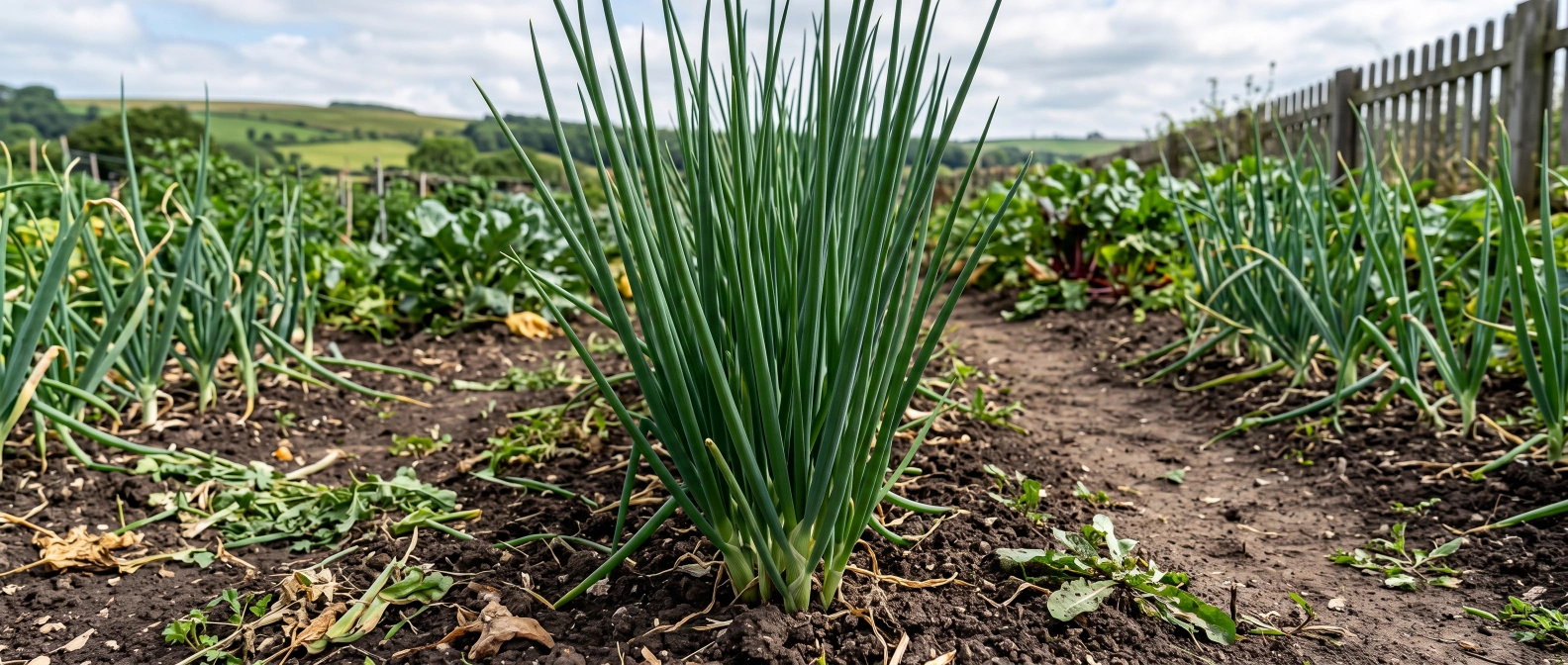
A perennial clumping onion, per the crop database's own description, harvested leaf by leaf across most of the year. Genuinely the odd one out on this hub in the best way: plant it once and an established clump keeps producing for years, unlike every other allium here, which are grown fresh from seed, sets or cloves each cycle.
Water need
Genuinely tough and low-maintenance once an established clump has settled in -- one of the more drought-tolerant crops on this hub.
Calories at a glance
320 kcal/kg -- similar territory to spring onion, valued more for its year-round availability than raw calorie density (scale is log-based across all 55 core crops in the calculator).
Temperature Range by Month
Month on the bottom, temperature up the side. The pale green background is what the plant can survive at all -- fatal above or below it, labelled directly on the chart where that applies to your zone. The coral band is its ideal range, and only fades in during the months this zone would actually have the crop in the ground -- reusing the exact same sowing/harvesting data as the calendar further down the page. The blue line is real monthly climate data (not a modelled estimate) for a representative rural/agricultural location in this zone -- a small farming town or agricultural research station rather than a major city, to avoid the warmer bias city weather stations have. For the actual verdict on how well this crop does in your zone, see the badge at the top of the page -- that's based on the site's own researched yield figures, not this chart.
Quick Start: Sowing to Storage
- Sow direct or start in modules. Sow direct or start in modules for transplanting -- Welsh onion establishes readily either way.
- Let clumps establish before heavy picking. Give new plants a full season to establish into a proper clump before harvesting heavily -- this builds the base for years of future picking.
- Harvest by thinning the clump. Pull or cut individual stems from the outside of the clump as needed, leaving the centre to keep producing -- the same cut-and-come-again logic as a perennial herb.
- Divide established clumps every few years. Lift and split a clump every 3-4 years once it gets crowded -- this both multiplies your stock and keeps individual plants vigorous.
- Use fresh through most of the year. Because it's genuinely perennial and harvestable across most of the year in mild zones, there's little need to think about long-term storage -- pick what you need, when you need it.
Sowing & Harvesting Calendar
Pick your zone under "Temperature Range by Month" above and this updates too. Notice how much wider the harvest window runs here than for onion or shallot -- a direct reflection of Welsh onion's genuine perennial, year-round-picking habit.
Calories & Yield
Tropical gives the best yield here, and every zone shows at least a challenging window -- Welsh onion is genuinely viable across the whole site.
| Climate Zone | Yield per plant | Calories per plant | Viability |
|---|---|---|---|
| Tropical / Humid | 3.0 kg | 960 kcal | Viable -- best yield |
| Subtropical | 2.5 kg | 800 kcal | Viable |
| Mediterranean | 2.5 kg | 800 kcal | Viable |
| Temperate Maritime | 2.0 kg | 640 kcal | Viable |
| Temperate Continental | 2.0 kg | 640 kcal | Viable |
| Cool / Boreal | 0.72 kg | 230.4 kcal | Challenging (60% yield) |
| Arid / Semi-Arid | 0.9 kg | 288 kcal | Challenging (60% yield) |
| Highland / Alpine | 0.72 kg | 230.4 kcal | Challenging (60% yield) |
Figures per established clump per year, from the site's own crop database. Boreal, Arid and Alpine already reflect the 60% penalty applied to challenging zones.
Varieties Worth Knowing
Welsh onion (the true perennial bunching onion, distinct from a young bulb onion sold as a "spring onion") has fewer named varieties in circulation, mainly Japanese-bred bunching types. Both below are open-pollinated (OP), meaning seed saved from them breeds true and is worth keeping under this site's seed-saving approach; neither is an F1 hybrid.
Seed Saving -- Quick Guide
Welsh onion is Allium fistulosum, a different species from onion, shallot and bulb-type spring onion (all Allium cepa) -- safe to grow alongside them without isolation concerns. It does cross with other true bunching-type spring onion and Welsh onion varieties.
SERVINGS, NOT DAILY CALORIES This works out plate-sized servings of Welsh onion from your seed during its fresh harvest window only, not your group's full daily calorie needs. For that, use the main calculator.
Estimated for your selected zone above, using this site's own germination, loss and yield figures for Welsh onion -- a helping is roughly what you'd put on a plate as part of a meal with other veg. Treat it as a planning estimate, not a promise.
Storage & Preservation
Fresh-cut stems keep for about a week refrigerated -- but because established clumps are harvestable across most of the year, there's genuinely little need to store much at once.
For longer-term preservation, chopped stems freeze well for use in cooked dishes, keeping usable stock on hand through the leanest part of winter in colder zones.
Growing Welsh Onion Without Bought Inputs
Genuinely one of the most trouble-free crops on this hub once established -- its perennial habit means minimal replanting effort year after year.
Onion fly and rust are the main risks, the same pressures this hub's other alliums face.
Good rotation and airflow between plants are simple, genuinely effective input-free measures.
Frequently Asked Questions
Does Welsh onion cross-pollinate with spring onion?
No, despite both being sold loosely as "spring onion" or "scallion" in shops. This site's own Spring Onion crop is Allium cepa, the same species as onion and shallot. Welsh onion is a genuinely different species, Allium fistulosum, and doesn't cross with any of them.
Is Welsh onion really a perennial?
Yes -- genuinely, and it's the only true multi-year perennial on this whole hub. Plant it once, and an established clump keeps producing and can be divided for more plants indefinitely, unlike onion, shallot, garlic and spring onion, which are all grown as annuals or biennials for eating.
Can I really harvest Welsh onion year-round?
The crop database says so directly: harvest leaves and bulbs year round. In practice this depends on your zone -- genuinely mild zones can pick from an established clump nearly continuously, while colder zones will see it die back through the hardest part of winter and resume in spring.