
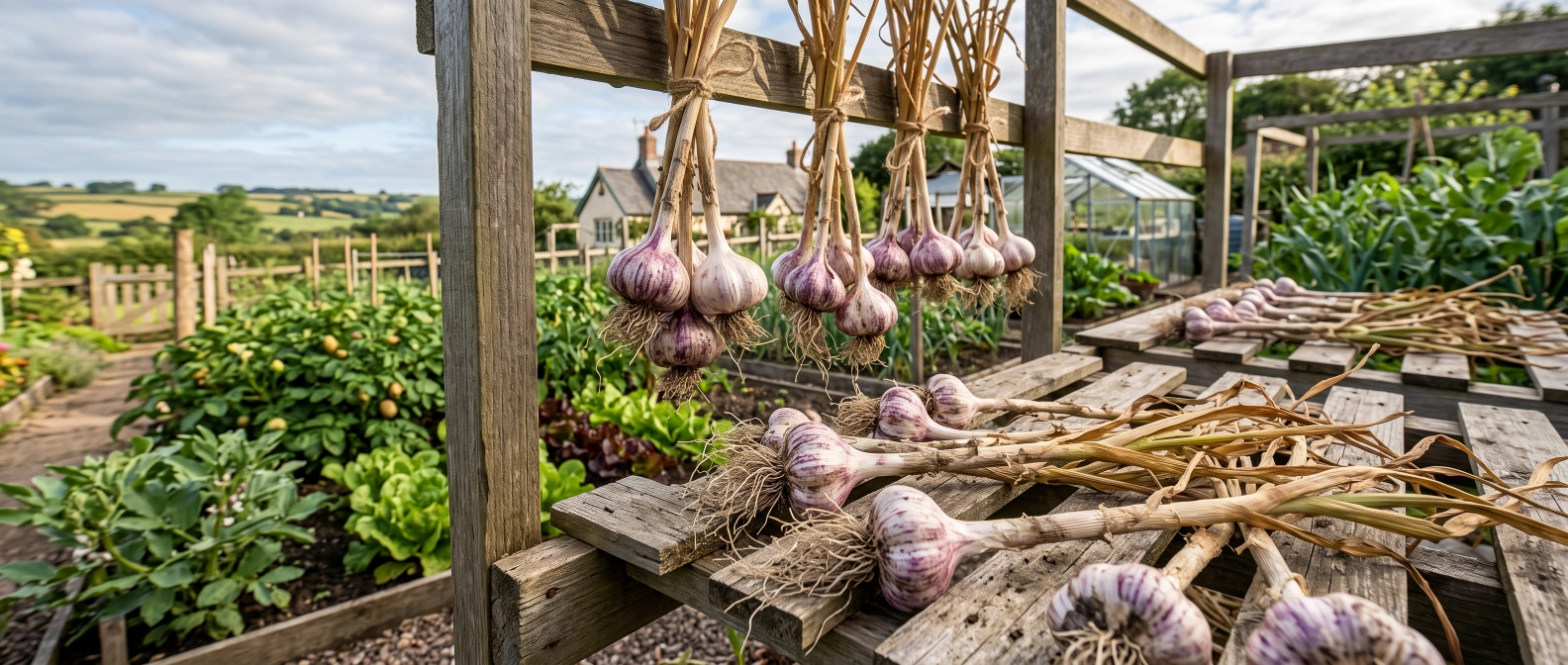
Plant in autumn, harvest the following summer, per the crop database's own description -- and an essential storage crop, among the most calorie-dense on this entire site. Hardneck varieties suit genuinely cold zones best, needing real winter cold to bulb up properly.
Water need
Genuinely drought-tolerant through much of its growth, though it wants a dry spell right before harvest to help bulbs cure properly in the ground.
Calories at a glance
1,490 kcal/kg -- genuinely one of the most calorie-dense crops on this whole site, far ahead of onion, leek or shallot (scale is log-based across all 55 core crops in the calculator).
Temperature Range by Month
Month on the bottom, temperature up the side. The pale green background is what the plant can survive at all -- fatal above or below it, labelled directly on the chart where that applies to your zone. The coral band is its ideal range, and only fades in during the months this zone would actually have the crop in the ground -- reusing the exact same sowing/harvesting data as the calendar further down the page. The blue line is real monthly climate data (not a modelled estimate) for a representative rural/agricultural location in this zone -- a small farming town or agricultural research station rather than a major city, to avoid the warmer bias city weather stations have. For the actual verdict on how well this crop does in your zone, see the badge at the top of the page -- that's based on the site's own researched yield figures, not this chart.
Quick Start: Planting to Storage
- Plant cloves in autumn. Split bulbs into individual cloves and plant the largest ones in autumn, per the crop database's own instruction -- this gives roots time to establish before winter.
- Choose hardneck for cold zones. In genuinely cold zones, choose hardneck varieties -- they need winter cold to bulb properly and tolerate harsh conditions better than softneck types.
- Remove scapes from hardneck varieties. Cut off the curling flower stalk (scape) that hardneck varieties send up in early summer -- removing it redirects the plant's energy into bulb size instead of a flower head that rarely sets useful seed anyway.
- Harvest once lower leaves brown. Lift bulbs once the lower third to half of the leaves have died back and browned -- pulling too early gives small bulbs, too late risks the bulb splitting open in the ground.
- Cure thoroughly before long-term storage. Dry bulbs somewhere warm, dry and airy for two to four weeks before storing -- proper curing is what genuinely makes garlic keep for months rather than weeks.
Planting & Harvesting Calendar
Pick your zone under "Temperature Range by Month" above and this updates too. Every zone shows an autumn planting window followed by a summer harvest the following year -- garlic's long season is the same shape everywhere it's grown, just shifted by climate.
Calories & Yield
Tropical gives the best yield here, and every zone shows at least a challenging window -- garlic is genuinely viable across the whole site.
| Climate Zone | Yield per plant | Calories per plant | Viability |
|---|---|---|---|
| Tropical / Humid | 8.0 kg | 11,920 kcal | Viable -- best yield |
| Subtropical | 7.0 kg | 10,430 kcal | Viable |
| Mediterranean | 7.0 kg | 10,430 kcal | Viable |
| Temperate Maritime | 5.0 kg | 7,450 kcal | Viable |
| Temperate Continental | 6.0 kg | 8,940 kcal | Viable |
| Cool / Boreal | 1.8 kg | 2,682 kcal | Challenging (60% yield) |
| Arid / Semi-Arid | 2.4 kg | 3,576 kcal | Challenging (60% yield) |
| Highland / Alpine | 1.8 kg | 2,682 kcal | Challenging (60% yield) |
Figures per plant sown (kg per bulb harvested), from the site's own crop database. Boreal, Arid and Alpine already reflect the 60% penalty applied to challenging zones.
Varieties Worth Knowing
Garlic splits into hardneck types (better cold-hardiness and flavour, shorter storage) and softneck types (milder, but the best long-term keepers) -- worth growing one of each if you can. Garlic is grown from saved cloves rather than true seed, so each variety below is marked true to type: replanting a saved clove reliably reproduces the same variety, the clove equivalent of this site's seed-saving approach for true-seed crops.
Seed Saving -- Quick Guide
Garlic almost never flowers and sets viable true seed in cultivation, so it's propagated from cloves rather than seed -- meaning cross-pollination isn't a practical concern at all. The real long-term risk is gradual virus build-up in saved stock, not crossing.
SERVINGS, NOT DAILY CALORIES This works out plate-sized servings of garlic from your planting bulbs during its fresh harvest window only, not your group's full daily calorie needs. For that, use the main calculator.
Estimated for your selected zone above, using this site's own germination, loss and yield figures for garlic -- a helping is roughly what you'd put on a plate as part of a meal with other veg. Treat it as a planning estimate, not a promise.
Storage & Preservation
Properly cured bulbs are one of the most genuinely long-storing crops on this whole site -- kept cool, dry and well-ventilated, garlic can keep for 6-10 months depending on variety.
Softneck varieties generally store longest; hardneck varieties are somewhat shorter-keeping but often more cold-hardy in the ground. Braiding softneck bulbs is a traditional, genuinely practical way to store and display a harvest at once.
Growing Garlic Without Bought Inputs
Genuinely one of the lowest-maintenance crops on this site once planted -- it needs very little attention through its long autumn-to-summer growing season.
Rust and white rot are the main disease risks, the same pressures onion and leek face.
Good rotation (avoiding the same ground for alliums more than once every 3-4 years) and generous spacing for airflow are simple, genuinely effective input-free measures.
Frequently Asked Questions
Does garlic cross-pollinate with onion, shallot or spring onion?
Essentially no, and for a genuinely different reason than a species mismatch. Garlic almost never flowers and sets true seed in cultivation -- softneck varieties rarely bolt at all, and hardneck varieties produce a flower stalk (the "scape") whose flower heads are typically sterile or produce few if any viable seeds. Garlic is propagated from cloves, not seed, which sidesteps the cross-pollination question that matters so much for onion, shallot and spring onion.
What does "seed saving" mean for a crop that doesn't really flower?
For garlic, it means saving cloves, not true seed. Set aside your best, largest, disease-free bulbs from each harvest and replant their cloves in autumn -- this is the real, standard way garlic varieties are maintained and passed on, generation after generation.
Why does the crop database say hardneck for cold zones?
Hardneck garlic varieties genuinely need a period of cold (vernalization) to form proper bulbs, and tolerate harsh winters better than softneck types -- making them the better choice in genuinely cold zones. Softneck varieties generally prefer milder winters and store somewhat longer once cured.