
A long, mostly warm growing year with just one genuinely milder season gives far more flexibility here than a sharply seasonal climate allows. The rotation below makes use of that flexibility, while still timing the big moments, sowing and major compost applications, to land on wetter stretches rather than fighting a dry spell.
A Simple Three-Bed Rotation
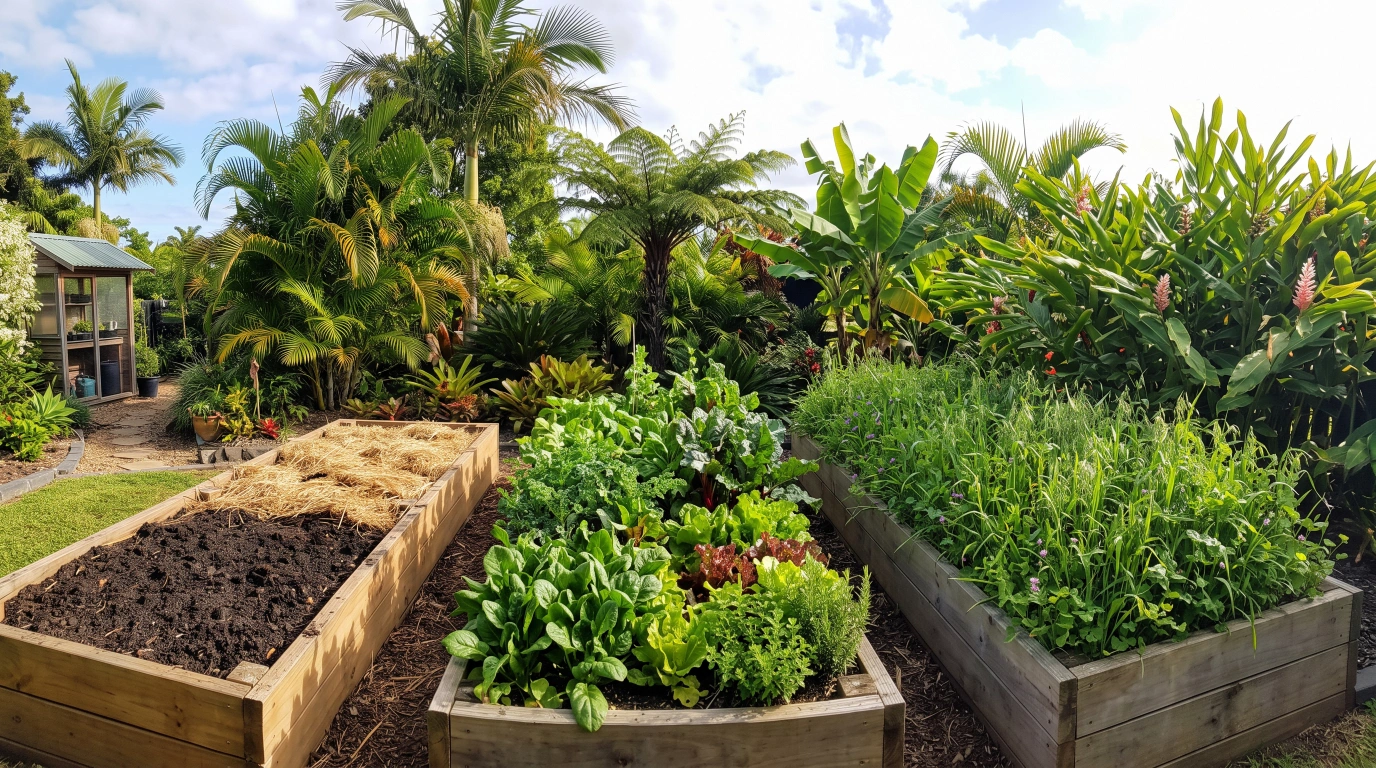
Rotating a small number of beds through a main growth stage, a milder-season stage, and a rebuild stage keeps both soil fertility and the compost supply in balance. Because this climate allows a wider sowing window than a sharply seasonal one, treat the timings below as flexible ranges to fit around whatever wet or dry stretch is actually happening, not fixed dates.
| Bed / Stage | Timing | Compost Action |
|---|---|---|
| Bed A -- Main warm-season crop | Started as a wetter stretch begins, grown on through the long warm run | Top-dress with finished compost right before sowing, mulch immediately |
| Bed B -- Milder-season crop | Sown through the one genuinely milder stretch of the year | Lighter top-dress; growth is slower but steadier here |
| Bed C -- Green manure / rebuild | Sown whenever a bed comes free, grown on and chopped before the next crop | Chop-and-drop into soil; feeds the following bed in rotation |
Timing Around Rain, Not the Calendar
Wherever possible, time major compost applications and plantings to coincide with a wetter stretch, per the rain-first approach in Chapter 11, rather than sticking to a fixed date regardless of what the weather is actually doing. This climate's flexibility is exactly what makes that possible, there's rarely a single narrow window you have to hit, so it's worth waiting a week or two for the right conditions rather than planting or composting into a dry spell out of habit.
Keeping the Compost Supply in Step
The two-chamber timing from Chapter 3 naturally lines up with a rotation like this, one chamber finishing while the other fills means there's generally a fresh batch ready roughly when the next bed needs one. Green manures grown in the rebuild stage, covered in Chapter 12, add a second source of fertility into the same rotation, chopped and dropped directly rather than needing to pass through the heap at all.
Frequently Asked Questions
Why is this rotation more flexible than one for a sharply seasonal climate?
Because the growing year here is long and mostly warm, with only one genuinely milder, though rarely severe, season rather than a hard winter shutdown. Crops can often be started across a much wider window than they could in a sharply seasonal climate like boreal or Mediterranean conditions, so the rotation is built around flexibility rather than a small number of fixed sowing dates.
Should I apply compost on a fixed schedule or wait for the right conditions?
Time major compost applications and plantings to coincide with wetter stretches rather than fighting a dry spell on a fixed calendar date. Because rainfall here is episodic, working with the weather that's actually arriving does more good than sticking rigidly to a schedule regardless of conditions.
How does the two-chamber system fit into this rotation?
The two-chamber timing covered earlier lines up naturally with a rotation of a few beds, one chamber can be finishing while the other is actively filling, so there's generally a batch of compost ready roughly when a bed in the rotation needs one, rather than everything converging on a single moment.