
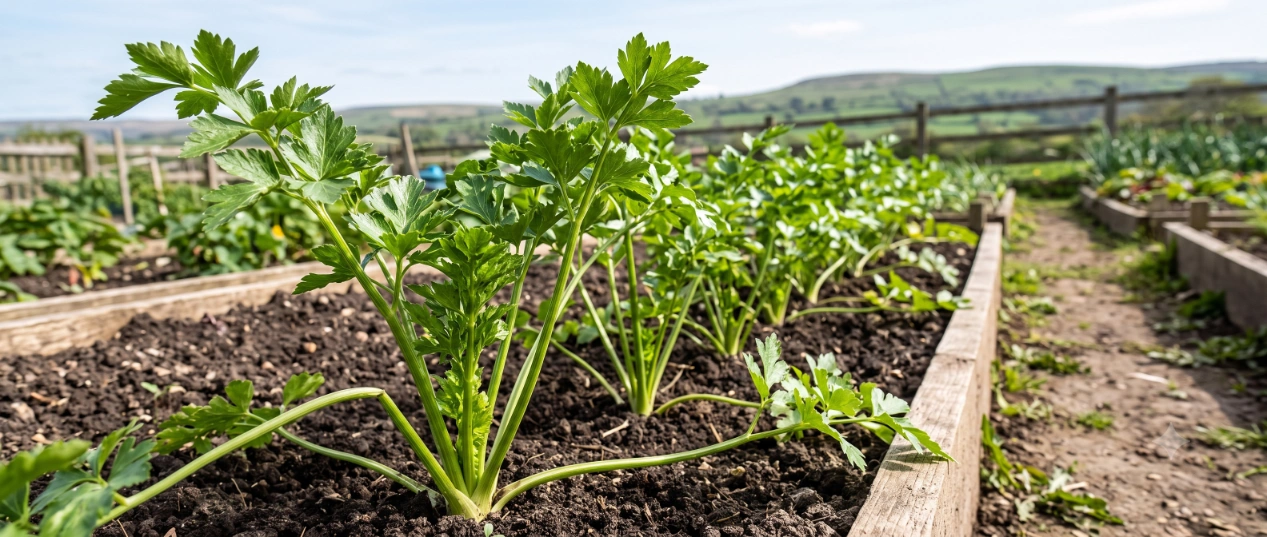
Parsnip shares carrot's family and its long-taproot growing habit, but the resemblance stops at the harvest. It's one of the hardiest living-larder crops on this site -- roots left standing in the ground actually taste better after a hard frost -- and unlike carrot or beetroot, its seed barely lasts a year, so fresh seed each season is close to essential rather than just good practice. It's also more calorie-dense than either of them, a genuinely useful addition to a winter garden rather than just a nutritional extra.
Water need
Steady moisture while roots are developing helps prevent forking and splitting -- once established, mature plants tolerate short dry spells reasonably well.
Calories at a glance
750 kcal/kg -- more calorie-dense than carrot or beetroot, though still well below true calorie staples like potatoes (scale is log-based across all 55 crops in the calculator).
Temperature Range by Month
Month on the bottom, temperature up the side. The pale green background is what the plant can survive at all -- fatal above or below it, labelled directly on the chart where that applies to your zone. The coral band is its ideal range, and only fades in during the months this zone would actually have the crop in the ground -- reusing the exact same sowing/harvesting data as the calendar further down the page. The blue line is real monthly climate data (not a modelled estimate) for a representative rural/agricultural location in this zone -- a small farming town or agricultural research station rather than a major city, to avoid the warmer bias city weather stations have. For the actual verdict on how well this crop does in your zone, see the badge at the top of the page -- that's based on the site's own researched yield figures, not this chart.
Quick Start: Sowing to Harvest
- Use fresh seed. Parsnip seed loses viability fast -- buy fresh each year, or sow saved seed the very next season rather than storing it, and sow more thickly than you think you need since germination rates drop quickly with age.
- Sow direct. Like carrot, parsnip doesn't transplant well -- sow direct into loose, deeply-dug, stone-free soil that lets the long taproot grow straight.
- Thin and be patient. Thin seedlings once they're large enough to handle. Parsnip germinates slowly and grows a long season -- don't expect visible progress for weeks.
- Leave standing once mature. Once roots reach usable size, there's no rush -- leave them in the ground and dig only what you need. A hard frost actually improves the flavour by converting some starches to sugars.
- Dig through winter as needed. Lift roots through winter as required, mulching in the coldest zones to keep the ground workable enough to dig. Finish lifting before spring regrowth starts, or the roots turn woody and bitter.
Sowing & Harvesting Calendar
Pick your zone under "Temperature Range by Month" above and this updates too. The Sow row: green is the normal safe sowing window, amber is pushing the season by roughly a month either side with basic outdoor protection, blue is an even earlier under-glass start. The Harvest row has two shades: solid green is the main harvest window, while the striped tail is parsnip's real advantage -- it doesn't need lifting or storing elsewhere, so you just leave it standing and dig what you need right through winter. Where that carries on past December, the calendar keeps going into a second year rather than cutting it off.
Calories & Yield
Parsnip is more calorie-dense than carrot or beetroot at about 750 kcal per kg, though still well short of a true staple. Not viable in Tropical or Arid zones -- it needs the cool, long season neither provides.
| Climate Zone | Yield per plant | Calories per plant | Viability |
|---|---|---|---|
| Tropical / Humid | -- | -- | Not viable |
| Subtropical | 0.2 kg | 150 kcal | Viable |
| Mediterranean | 0.25 kg | 188 kcal | Viable |
| Temperate Maritime | 0.25 kg | 188 kcal | Viable |
| Temperate Continental | 0.25 kg | 188 kcal | Viable |
| Cool / Boreal | 0.2 kg | 150 kcal | Viable |
| Arid / Semi-Arid | -- | -- | Not viable |
| Highland / Alpine | 0.2 kg | 150 kcal | Viable |
Figures per plant sown, from the site's own crop database.
Varieties Worth Knowing
Parsnip varieties mostly differ in root shape and disease resistance -- long tapered roots need deep, stone-free soil, while shorter blunt types cope better with heavier ground. All the varieties below are open-pollinated (OP), meaning seed saved from them breeds true and is worth keeping under this site's seed-saving approach; none are F1 hybrids.
Seed Saving -- Quick Guide
Parsnip's biggest crossing risk isn't another cultivated variety -- it's wild parsnip, the same species, which grows freely as a roadside and hedgerow weed across much of its range.
SERVINGS, NOT DAILY CALORIES This works out plate-sized servings of parsnip from your seed during its fresh harvest window only, not your group's full daily calorie needs. For that, use the main calculator.
BIENNIAL Parsnip is a biennial, not an annual -- it doesn't produce seed in its first year. Roots grow in year one, a few overwintered roots flower and set seed in year two, and that seed is only ready to sow in year three -- and parsnip seed barely keeps a season, so you can't bank several years' worth in advance the way you can with carrot. If you're starting from scratch with no ongoing seed supply, plan for enough seed on hand for both year one's and year two's sowing up front. Plan for roughly double the seed quantity below if that's your situation.
Estimated for your selected zone above, using this site's own germination, loss and yield figures for parsnip -- a helping is roughly what you'd put on a plate as part of a meal with other veg. Treat it as a planning estimate, not a promise.
Storage & Preservation
This is parsnip's real standout feature: the site's own crop data models it as a living larder, the same way as kale and winter cabbage. There's no digging-and-storing step at all in most viable zones -- roots are left standing in the ground and dug as needed right through winter, with flavour actually improving after the first hard frost converts some of the root's starches to sugars.
In the coldest zones where the ground freezes too hard to dig, a thick mulch keeps it workable, or roots can be lifted in bulk before the worst freeze and stored the same way as carrot -- layered in slightly damp sand in a cool shed or cellar. Beyond fresh use, parsnip also freezes well (blanched first) if you want to process a surplus.
Growing Parsnips Without Bought Inputs
Parsnip's biggest real threat is canker, a fungal disease, not an insect -- it causes black or orange rot at the crown of the root and can ruin an otherwise good harvest.
Good drainage is the single most effective input-free defence against canker, which is worsened by waterlogged soil -- avoid heavy, poorly-drained ground or improve it with organic matter before sowing.
Avoiding root damage while weeding and thinning matters more here than for most root crops -- wounds in the root's shoulder are a common entry point for canker.
Crop rotation reduces canker and other soil-borne problems building up from growing parsnip (or its relatives, carrot and celeriac) in the same spot repeatedly.
A physical barrier -- fine mesh or a solid barrier at least 60cm tall -- deals with carrot fly where it's a problem, the same defence used for carrot itself.
Frequently Asked Questions
Why does parsnip need fresh seed every year when carrot and beetroot don't?
Parsnip seed is genuinely short-lived -- reliably viable for only about 1-2 years even in cool, dark, dry storage, well behind carrot's 3 years or beetroot's 4-6. If you're saving your own, sow it the following year rather than banking it for later, and sow thickly since older parsnip seed also germinates less reliably than most.
Does parsnip cross-pollinate with carrot or other crops in this database?
No -- despite sharing the Apiaceae family with carrot and celeriac, parsnip is a different genus and doesn't cross with either. The real risk is wild parsnip, the same species as cultivated parsnip and, like wild carrot, a real hedgerow and roadside plant in many regions.
How cold and hot can parsnip survive?
Extremely cold-hardy -- among the most frost-resistant vegetables covered on this site, tolerating roughly -18°C to 27°C (0°F to 81°F), with flavour actually improving after a hard frost converts some of the root's starches to sugars. Heat, not cold, is parsnip's limiting factor.
Can I really just leave parsnips in the ground all winter?
Yes -- this is parsnip's real advantage over most root vegetables here. The site's own crop data models it as a living larder: leave roots standing and dig only what you need, whenever you need it, right through winter in most viable zones. There's no digging-and-storing step required at all unless your ground freezes too hard to dig.
Is parsnip a good calorie crop for self-sufficiency?
More calorie-dense than carrot or beetroot -- around 750 kcal per kg, though still well short of a true staple like potato. Combined with its living-larder storage, it's a genuinely useful winter crop rather than just a nutritional extra.
What is canker and how do I protect against it without sprays?
Canker is a fungal disease that causes black or orange rot at the crown of the root, worsened by waterlogged soil, root damage, and growing parsnip in the same spot repeatedly. Good drainage, crop rotation, avoiding root damage while weeding, and growing a canker-resistant variety are the main input-free defences -- there's no effective spray for it anyway.
Do I need pesticides to grow parsnips?
No. Carrot fly can attack parsnip the same way it attacks carrot, and the same physical barrier defence works -- fine mesh or a solid barrier at least 60cm tall. Canker (see above) is a bigger real-world concern than any insect pest, and it's managed by growing conditions and variety choice, not spraying.