
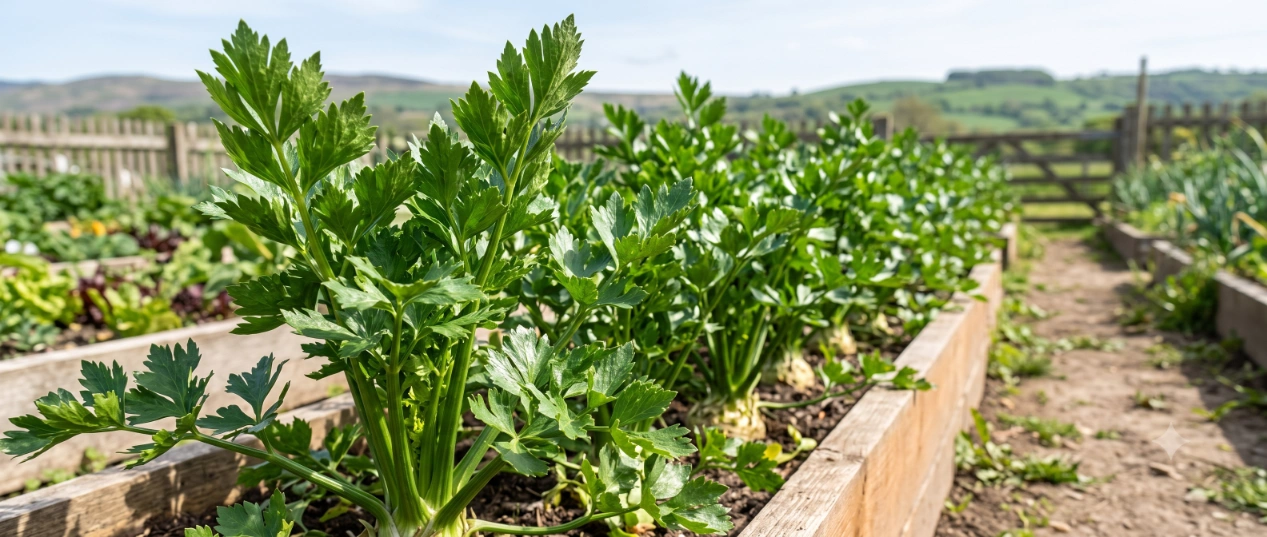
Celeriac shares a plant family with carrot and parsnip but is a different genus from both, so it doesn't cross with either -- what it crosses with instead is celery, its own same-species cousin, which isn't grown elsewhere on this site. Its real challenge is time: a genuinely long season that needs starting under cover in late winter, months before anything else here goes in the ground.
Water need
Needs steady moisture all season -- drying out even briefly checks growth and can trigger the root to split or bolt.
Calories at a glance
420 kcal/kg -- ahead of turnip, swede and carrot on this site's own scale (scale is log-based across all 55 crops in the calculator).
Temperature Range by Month
Month on the bottom, temperature up the side. The pale green background is what the plant can survive at all -- fatal above or below it, labelled directly on the chart where that applies to your zone. The coral band is its ideal range, and only fades in during the months this zone would actually have the crop in the ground -- reusing the exact same sowing/harvesting data as the calendar further down the page. The blue line is real monthly climate data (not a modelled estimate) for a representative rural/agricultural location in this zone -- a small farming town or agricultural research station rather than a major city, to avoid the warmer bias city weather stations have. For the actual verdict on how well this crop does in your zone, see the badge at the top of the page -- that's based on the site's own researched yield figures, not this chart.
Quick Start: Sowing to Harvest
- Start early, under cover. Sow indoors or under cover in February or March -- celeriac's long season means it needs a head start most other root crops on this site don't.
- Harden off and transplant carefully. Once frost risk has passed, harden the young plants off gradually before transplanting -- celeriac resents root disturbance, so handle the rootball gently and plant at the same depth it was growing at.
- Keep it consistently watered. Celeriac needs steady moisture all season -- drying out even briefly checks growth and can trigger the root to split or bolt.
- Remove side shoots and lower leaves. Through summer, strip off any small side shoots and yellowing lower leaves from the crown to help the root bulk up rather than the foliage.
- Harvest from autumn, or leave standing in mild zones. Roots are ready from autumn once they've reached a reasonable size. In mild zones they can be left in the ground and dug as needed through winter; in colder zones, lift before a hard freeze and store in a cool shed.
Sowing & Harvesting Calendar
Pick your zone under "Temperature Range by Month" above and this updates too. The Sow row shows the under-cover start window for this crop's long season. The Harvest row has two shades: solid green is the main harvest window, while the striped tail reflects the living-larder option covered in Storage & Preservation below -- realistic only in your zone's milder winters.
Calories & Yield
Celeriac is a reasonable calorie crop at about 420 kcal per kg -- ahead of turnip, swede and carrot on this site's own scale. Mediterranean and Continental zones give the best yields here.
| Climate Zone | Yield per plant | Calories per plant | Viability |
|---|---|---|---|
| Tropical / Humid | -- | -- | Not viable |
| Subtropical | 0.6 kg | 252 kcal | Viable |
| Mediterranean | 0.7 kg | 294 kcal | Viable -- best yield |
| Temperate Maritime | 0.6 kg | 252 kcal | Viable |
| Temperate Continental | 0.7 kg | 294 kcal | Viable -- best yield |
| Cool / Boreal | 0.5 kg | 210 kcal | Viable |
| Arid / Semi-Arid | -- | -- | Not viable |
| Highland / Alpine | 0.4 kg | 168 kcal | Viable |
Figures per plant sown, from the site's own crop database.
Varieties Worth Knowing
Celeriac has fewer widely-known named varieties than most root crops -- most seed catalogues lean on a small handful of long-established heirlooms rather than a big range. All the varieties below are open-pollinated (OP), meaning seed saved from them breeds true and is worth keeping under this site's seed-saving approach; none are F1 hybrids.
Seed Saving -- Quick Guide
Celeriac and celery are the same species grown for different parts of the plant -- if you're saving seed from one, the other has to be kept well away or you'll get an unpredictable hybrid.
SERVINGS, NOT DAILY CALORIES This works out plate-sized servings of celeriac from your seed during its fresh harvest window only, not your group's full daily calorie needs. For that, use the main calculator.
BIENNIAL Celeriac is a biennial, not an annual -- it doesn't produce seed in its first year. Roots grow in year one, a few overwintered roots flower and set seed in year two, and that seed is only ready to sow in year three. If you're starting from scratch with no ongoing seed supply, that means having enough seed on hand for both year one's and year two's sowing up front. Plan for roughly double the seed quantity below if that's your situation.
Estimated for your selected zone above, using this site's own germination, loss and yield figures for celeriac -- a helping is roughly what you'd put on a plate as part of a meal with other veg. Treat it as a planning estimate, not a promise.
Storage & Preservation
The site's own crop data calls celeriac a crop that stores well in soil or a cool shed -- in mild zones, roots can be left in the ground and dug as needed right through winter, the same living-larder approach as parsnip and swede.
In colder zones where the ground freezes solid, lift before that happens, trim the leaves back to the crown, and store the unwashed roots in slightly damp sand in a cool shed or cellar, where they'll keep for several months.
Growing Celeriac Without Bought Inputs
Celery fly (leaf miner) is the main pest to watch for -- its larvae tunnel inside the leaves, leaving pale, papery blotches that weaken the plant if left unchecked.
Fine mesh from transplanting onward is the simplest input-free defence -- it physically excludes the adult fly before it can lay eggs on the leaves.
Consistent watering does double duty here -- besides preventing splitting and bolting, well-fed, unstressed plants are generally more resilient to pest and disease pressure than plants checked by drought.
Frequently Asked Questions
Why does celeriac need starting so much earlier than the other root vegetables here?
Because it's slow -- celeriac needs a long growing season and is usually started under cover in February or March, months before it goes outside, to give the bulbous root time to size up before autumn. Skip the early start and it simply won't be ready.
Does celeriac cross-pollinate with carrot or parsnip?
No -- despite sharing the same plant family (Apiaceae), celeriac is a different genus from both carrot (Daucus) and parsnip (Pastinaca). Different genera don't cross, so celeriac can flower for seed without any risk to or from those two.
What does celeriac actually need isolating from, then?
Celery -- it's the same species, Apium graveolens, just bred for the root rather than the stalks -- and other celeriac varieties. Celery isn't grown elsewhere on this site, so in practice this mainly means keeping different celeriac varieties apart. Wild celery growing near coastal areas is the outside risk, similar to wild carrot on the Carrot page.
How cold and hot can celeriac survive?
Roughly -6°C to 27°C (21°F to 81°F), with light frost improving flavour much like parsnip and carrot. It's more particular in the middle of that range than most root crops here -- more than about nine nights below 12°C can trigger premature bolting, and above roughly 27°C the root turns fibrous and strongly flavoured.
Is celeriac a good calorie crop for self-sufficiency?
Reasonable -- around 420 kcal per kg, ahead of turnip, swede and carrot on this site's own scale. Its long season is the real cost, so it suits gardeners who can commit a bed to one crop from late winter through to the following spring.
Do I need pesticides to grow celeriac?
No. Celery fly (leaf miner) is the main pest to watch for -- its larvae tunnel inside the leaves, leaving pale blotches -- and fine mesh from planting out onward keeps the adult fly from laying eggs in the first place, without needing any bought spray.