
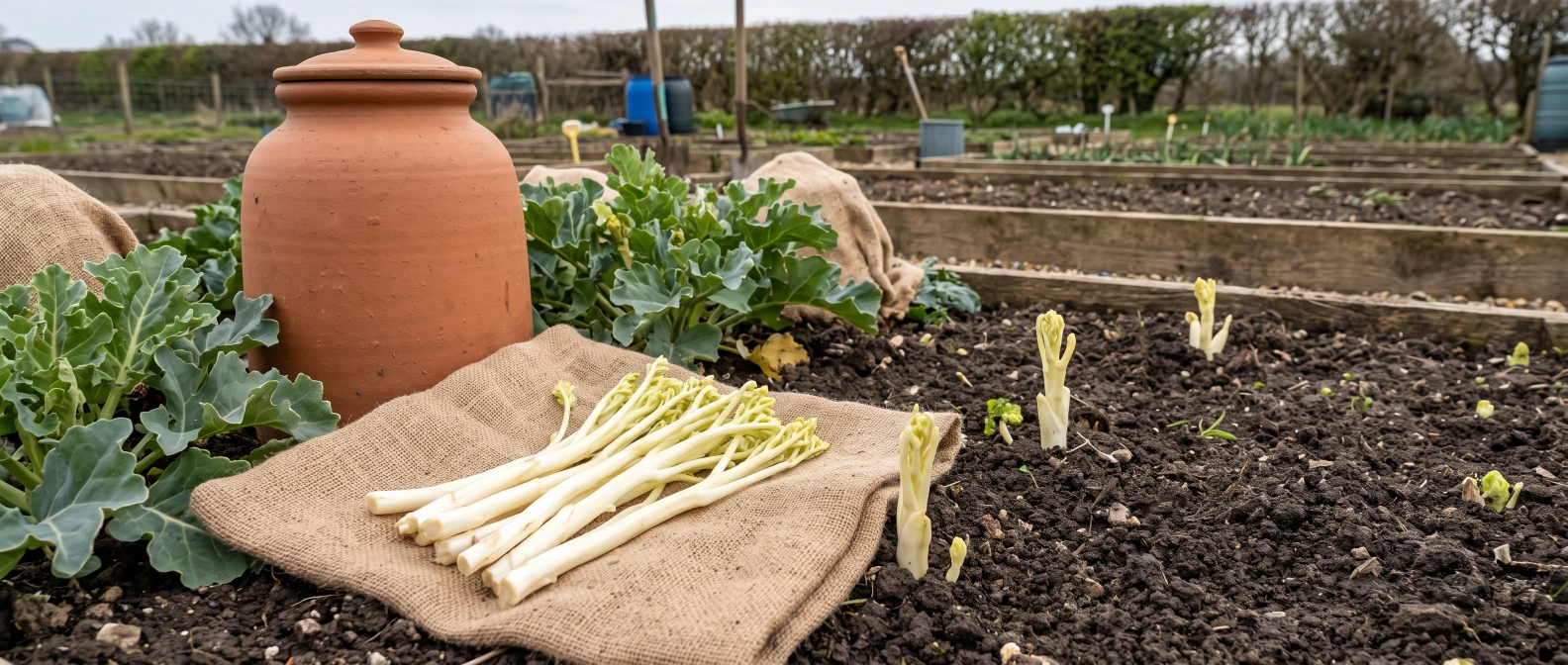
A hardy UK coastal native, per the crop database's own description, grown for shoots forced in spring exactly like asparagus. Establishment takes patience -- two to three years before the first proper forcing -- but a mature crown then rewards that wait for many years running.
Water need
A genuinely tough coastal plant, adapted to free-draining shingle beaches -- it tolerates dry spells far better than most brassicas.
Calories at a glance
290 kcal/kg -- grown mainly for its distinctive forced shoots rather than as a bulk calorie crop (scale is log-based across all 55 core crops in the calculator).
Temperature Range by Month
Month on the bottom, temperature up the side. The pale green background is what the plant can survive at all -- fatal above or below it, labelled directly on the chart where that applies to your zone. The coral band is its ideal range, and only fades in during the months this zone would actually have shoots being forced -- reusing the exact same calendar data as further down the page. The blue line is real monthly climate data (not a modelled estimate) for a representative rural/agricultural location in this zone -- a small farming town or agricultural research station rather than a major city, to avoid the warmer bias city weather stations have. For the actual verdict on how well this crop does in your zone, see the badge at the top of the page -- that's based on the site's own researched yield figures, not this chart.
Quick Start: Planting to Storage
- Plant root cuttings or crowns. Plant root cuttings (thongs) or established crowns into deep, well-drained, sandy soil, reflecting its native coastal shingle habitat.
- Let the plant establish for two to three years. Don't force or harvest a young plant in its first couple of years -- let it build a strong root system to support forcing later.
- Force an established crown in early spring. Cover the crown with a forcing pot or bucket to exclude light as new growth begins, producing pale, tender blanched shoots.
- Harvest shoots once 15-20cm tall. Cut the blanched shoots once they reach a usable length, then remove the forcing pot to let the plant recover in full light.
- Rest the crown for the remainder of the year. Only force each crown once a year, then let it grow away freely afterward to rebuild reserves for next spring's harvest.
Planting & Harvesting Calendar
Pick your zone under "Temperature Range by Month" above and this updates too. This shows the planting window for new crowns and the annual forcing/harvest window for an already-established plant -- not the two-to-three-year wait before that first proper harvest, which applies everywhere regardless of zone.
Calories & Yield
These figures are per plant, per year, once past the two-to-three-year establishment wait. Mediterranean gives the best yield here, and it's not viable outdoors in the Tropical, Subtropical or Arid zones.
| Climate Zone | Yield per plant | Calories per plant | Viability |
|---|---|---|---|
| Tropical / Humid | 0.00 kg | 0 kcal | Not viable outdoors |
| Subtropical | 0.00 kg | 0 kcal | Not viable outdoors |
| Mediterranean | 1.50 kg | 435 kcal | Viable -- best yield |
| Temperate Maritime | 1.20 kg | 348 kcal | Viable |
| Temperate Continental | 1.20 kg | 348 kcal | Viable |
| Cool / Boreal | 0.48 kg | 139.2 kcal | Challenging (60% yield) |
| Arid / Semi-Arid | 0.00 kg | 0 kcal | Not viable outdoors |
| Highland / Alpine | 0.48 kg | 139.2 kcal | Challenging (60% yield) |
Figures per established plant per year, from the site's own crop database. Boreal and Alpine already reflect the 60% penalty applied to challenging zones.
A note on varieties: sea kale is mostly grown as a single undifferentiated type -- "Lily White" is the one named selection sometimes offered, but real named-cultivar diversity is genuinely thin.
Seed Saving -- Quick Guide
Sea kale shares a plant family with cabbage and kale but a different genus, so it won't cross with them -- though most growers propagate it from root cuttings rather than seed anyway, for a more reliably true plant.
SERVINGS, NOT DAILY CALORIES This works out plate-sized servings of sea kale from your root cuttings during its fresh harvest window only, not your group's full daily calorie needs. For that, use the main calculator.
2-3 YEAR ESTABLISHMENT Sea kale needs two to three years to establish before you can force or harvest it -- take shoots too early and you weaken the plant for years afterward. The figures below show what an established crown produces each year, not what a new planting gives you straight away.
Estimated for your selected zone above, using this site's own germination, loss and yield figures for sea kale -- a helping is roughly what you'd put on a plate as part of a meal with other veg. Treat it as a planning estimate, not a promise.
Storage & Preservation
Forced shoots are at their best eaten fresh within a few days -- their delicate flavour and texture don't hold well in storage.
There's no meaningful long-term preservation route for this crop -- it's a genuine seasonal delicacy rather than something to bank for later.
Growing Sea Kale Without Bought Inputs
Genuinely low-maintenance once established -- its coastal origins make it naturally tolerant of poor, free-draining soil and salt-laden winds that would trouble most other vegetables.
Flea beetle on young leaves is the main pest to watch, much as on other brassica-family crops.
A layer of grit or sand worked into heavy soil at planting time is a simple, genuinely effective input-free measure that mimics its natural shingle habitat.
Frequently Asked Questions
Does sea kale cross-pollinate with the Brassicas hub?
No. Sea kale is Crambe maritima -- in the Brassicaceae family, but its own separate genus, Crambe. Every crop on this site's Brassicas hub is Brassica oleracea, a different genus entirely, so there's no cross-pollination risk between them despite the family resemblance.
How is sea kale forced, and why bother?
Cover an established crown in early spring with a forcing pot, bucket, or upturned bin to exclude light, the same principle used on rhubarb. Denied light, the emerging shoots stay pale, tender and mild rather than turning tough and bitter in full sun -- genuinely the whole point of growing it this way.
How long before a sea kale plant is ready to harvest?
Give a young plant two to three years to establish a strong root system before forcing it for the first time -- take shoots too early and you weaken the plant for years afterward.