
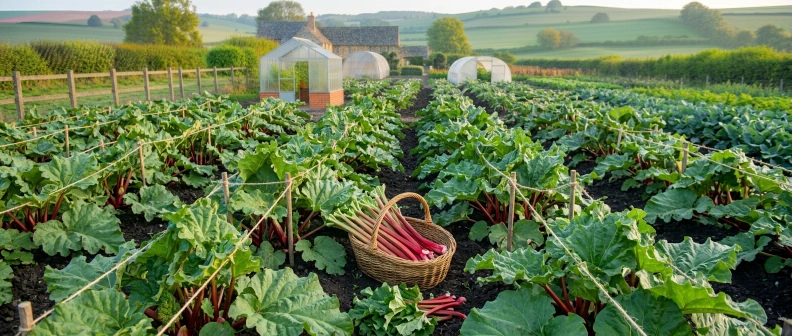
Plant crowns, harvest from year 2, and a rhubarb crown stays productive for 10+ years -- per the crop database's own description. Its leaves are genuinely poisonous, concentrated with oxalic acid, so it's stems only, always. Its other standout trait is forcing: cover a crown to exclude light in late winter and it sends up the earliest, sweetest, palest pink stems of the whole season.
Water need
Wants consistently moist soil to keep producing thick, juicy stems -- it's a genuinely thirsty plant during its main growing months, even though the crown itself survives dry spells once dormant.
Calories at a glance
880 kcal/kg -- a genuinely solid contributor for a perennial, though grown mainly for its early-season stems rather than as a staple calorie crop (scale is log-based across all 55 crops in the calculator).
Temperature Range by Month
Month on the bottom, temperature up the side. The pale green background is what the plant can survive at all -- fatal above or below it, labelled directly on the chart where that applies to your zone. The coral band is its ideal range, and only fades in during the months this zone would actually have stems being harvested -- reusing the exact same calendar data as further down the page. The blue line is real monthly climate data (not a modelled estimate) for a representative rural/agricultural location in this zone -- a small farming town or agricultural research station rather than a major city, to avoid the warmer bias city weather stations have. For the actual verdict on how well this crop does in your zone, see the badge at the top of the page -- that's based on the site's own researched yield figures, not this chart.
Quick Start: Planting to Storage
- Plant crowns in autumn or early spring. Plant dormant crowns with the growing point just below the soil surface, into a bed enriched with plenty of well-rotted organic matter.
- Let the crown establish for a full year. Don't harvest any stems in the first year -- let the plant build up its crown so it can support a proper harvest from year 2 onward.
- Harvest stems by pulling, not cutting. From year 2, pull stems from the outside of the crown with a firm twist rather than cutting, and always remove and discard the poisonous leaves before use.
- Force a crown for early pink stems. In late winter, cover a mature crown with a bucket or forcing pot to exclude light -- this produces pale, sweet, tender stems weeks ahead of the normal season.
- Let the crown rest after harvest. Stop pulling stems by mid-summer and let the crown build up reserves for next year -- a rested crown is what supports 10+ years of production.
Planting & Harvesting Calendar
Pick your zone under "Temperature Range by Month" above and this updates too. This shows the planting window for new crowns and the annual harvest window for an already-established plant -- not the one-year wait before that first proper harvest, which applies everywhere regardless of zone.
Calories & Yield
These figures are per plant, per year, once past the one-year establishment wait. Subtropical, Mediterranean, Maritime and Continental zones share the best yield here.
| Climate Zone | Yield per plant | Calories per plant | Viability |
|---|---|---|---|
| Tropical / Humid | 1.50 kg | 1,320 kcal | Viable |
| Subtropical | 2.00 kg | 1,760 kcal | Viable -- best yield |
| Mediterranean | 2.00 kg | 1,760 kcal | Viable -- best yield |
| Temperate Maritime | 2.00 kg | 1,760 kcal | Viable -- best yield |
| Temperate Continental | 2.00 kg | 1,760 kcal | Viable -- best yield |
| Cool / Boreal | 1.50 kg | 1,320 kcal | Viable |
| Arid / Semi-Arid | 0.30 kg | 264 kcal | Challenging (60% yield) |
| Highland / Alpine | 1.20 kg | 1,056 kcal | Viable |
Figures per established plant per year, from the site's own crop database. Arid's yield already reflects the 60% penalty applied to challenging zones -- 0.50kg raw becomes 0.30kg actual.
Varieties Worth Knowing
Rhubarb varieties mainly differ in stem colour and how early they crop. Rhubarb is normally propagated by dividing an established crown rather than from true seed, so each variety below is marked true to type: a division from a named variety reliably reproduces it, the crown equivalent of this site's seed-saving approach for true-seed crops.
Seed Saving -- Quick Guide
Rhubarb is almost always propagated by dividing the crown rather than seed -- named varieties don't come true from seed even in isolation, since seedlings are highly variable.
SERVINGS, NOT DAILY CALORIES This works out plate-sized servings of rhubarb from your crowns during its fresh harvest window only, not your group's full daily calorie needs. For that, use the main calculator.
HARVEST FROM YEAR 2 Rhubarb needs a full first year to establish before you can harvest it -- don't pull any stems in year one, or you'll weaken the crown. The figures below show what an established crown produces from year two onward, not what a brand-new planting gives you straight away.
Estimated for your selected zone above, using this site's own germination, loss and yield figures for rhubarb -- a helping is roughly what you'd put on a plate as part of a meal with other veg. Treat it as a planning estimate, not a promise.
Storage & Preservation
Fresh stems keep for one to two weeks refrigerated. For longer-term storage, rhubarb freezes exceptionally well -- chop into pieces and freeze directly, no blanching required.
It also stews down into preserves and cordial that keep for months, a genuinely practical way to bank an early-season glut for later in the year.
Growing Rhubarb Without Bought Inputs
Rhubarb is a genuinely hardy, low-fuss perennial once established -- its main ongoing need is a yearly mulch of garden compost or well-rotted manure worked around the crown to keep it productive for its full 10+ year lifespan.
Crown rot in waterlogged soil is the main problem to avoid, rather than any specific pest.
Good drainage and a raised bed or mound if your soil is heavy are simple, genuinely effective input-free measures.
Frequently Asked Questions
Are rhubarb leaves really poisonous?
Yes -- genuinely, not just a folk warning. The crop database is direct: leaves poisonous, stems only. Rhubarb leaves contain concentrated oxalic acid, and only the stems are safe to eat. Always remove and discard the leaves before cooking or storing.
How does forcing rhubarb under a bucket work?
Cover an established crown with a bucket, forcing pot, or anything that excludes light in late winter. Denied light, the plant sends up pale pink, tender, sweeter stems weeks earlier than an uncovered crown would produce -- a genuine, distinctive technique the crop database itself calls out.
How soon can you harvest rhubarb after planting?
From year 2 per the crop database -- a much shorter wait than asparagus, though still not a harvest in the first year. Once established, it's productive for 10+ years.
Is rhubarb a fruit or a vegetable?
Botanically a vegetable -- it's the leaf stalk of the plant, not a fruit -- though it's almost always cooked and eaten sweetened like one. This site lists it under vegetables for that reason.