
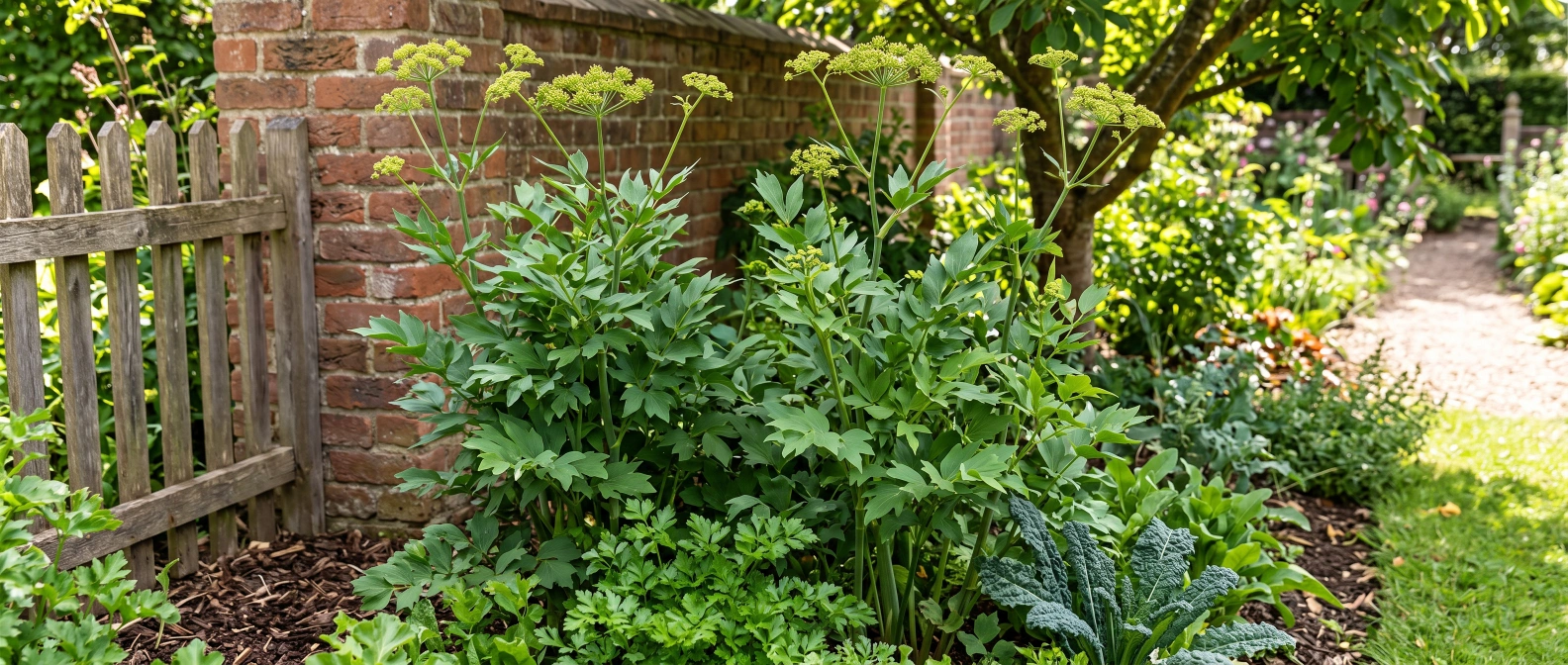
A hardy perennial herb and vegetable, per the crop database's own description, with a strong celery flavour and genuinely very tall growth -- established plants can tower well over head height. Once planted, a single clump keeps producing year after year with minimal fuss.
Water need
Wants reliably moist soil to support its tall, lush growth -- consistent with its Apiaceae relatives like celery, which share the same thirsty habit.
Calories at a glance
650 kcal/kg -- used sparingly as a seasoning herb rather than eaten in bulk, so calorie density matters less here than flavour (scale is log-based across all 55 core crops in the calculator).
Temperature Range by Month
Month on the bottom, temperature up the side. The pale green background is what the plant can survive at all -- fatal above or below it, labelled directly on the chart where that applies to your zone. The coral band is its ideal range, and only fades in during the months this zone would actually have the crop in active growth -- reusing the exact same calendar data as further down the page. The blue line is real monthly climate data (not a modelled estimate) for a representative rural/agricultural location in this zone -- a small farming town or agricultural research station rather than a major city, to avoid the warmer bias city weather stations have. For the actual verdict on how well this crop does in your zone, see the badge at the top of the page -- that's based on the site's own researched yield figures, not this chart.
Quick Start: Sowing to Storage
- Sow or divide in spring. Sow seed in spring, or divide an established clump, into a permanent position with room for its eventual size.
- Let the plant establish. Allow a young plant a full season to build a strong root system before harvesting heavily.
- Harvest young leaves regularly. Pick young leaves and stalks through the growing season, using them sparingly given their strong, concentrated flavour.
- Cut back after flowering. Cut the tall flower stems back after they finish, encouraging fresh new leaf growth for a second flush.
- Let the crown die back for winter. Allow top growth to die back naturally over winter -- the perennial root survives and resprouts vigorously each spring.
Sowing & Harvesting Calendar
Pick your zone under "Temperature Range by Month" above and this updates too. As a genuine standing perennial, lovage can be picked across most of the growing season once established.
Calories & Yield
Tropical gives the best yield here, and it's not viable outdoors in the Arid zone.
| Climate Zone | Yield per plant | Calories per plant | Viability |
|---|---|---|---|
| Tropical / Humid | 3.00 kg | 1,950 kcal | Viable -- best yield |
| Subtropical | 2.50 kg | 1,625 kcal | Viable |
| Mediterranean | 2.50 kg | 1,625 kcal | Viable |
| Temperate Maritime | 2.00 kg | 1,300 kcal | Viable |
| Temperate Continental | 2.00 kg | 1,300 kcal | Viable |
| Cool / Boreal | 0.72 kg | 468 kcal | Challenging (60% yield) |
| Arid / Semi-Arid | 0.00 kg | 0 kcal | Not viable outdoors |
| Highland / Alpine | 0.72 kg | 468 kcal | Challenging (60% yield) |
Figures per established plant per year, from the site's own crop database. Boreal and Alpine already reflect the 60% penalty applied to challenging zones.
A note on varieties: lovage is mostly grown as a single undifferentiated type -- real named-cultivar diversity is genuinely thin.
Seed Saving -- Quick Guide
Lovage is an insect-pollinated umbellifer that doesn't cross with carrot, parsley, celery or alexanders -- all different genera within the same family.
SERVINGS, NOT DAILY CALORIES This works out plate-sized servings of lovage from your seed during its fresh harvest window only, not your group's full daily calorie needs -- lovage is grown for flavour, not calories. For that, use the main calculator.
Estimated for your selected zone above, using this site's own germination, loss and yield figures for lovage -- a helping is a rough herb-scale portion, not a plate-filling side. Treat it as a planning estimate, not a promise.
Storage & Preservation
Fresh leaves keep for about a week refrigerated, similar to most leafy herbs.
Leaves also dry and freeze well, a genuinely practical way to preserve its strong flavour for use throughout the year in soups and stocks.
Growing Lovage Without Bought Inputs
A genuinely hardy, low-fuss perennial once established -- its main ongoing need is a yearly mulch of garden compost or well-rotted manure to support its tall, vigorous growth.
Few pests bother it seriously -- aphids on soft new growth are about the only real early risk.
A strong jet of water or hand-squashing keeps aphid numbers down without any bought input.
Frequently Asked Questions
Is lovage related to celery?
Not directly, though it tastes strikingly like it. Lovage (Levisticum officinale) is in the Apiaceae family -- the same family as celery, carrot, parsnip and Alexanders -- but its own separate genus, so it's a family relative rather than a genuine cross-pollination partner for any of them.
How tall does lovage actually grow?
Very tall, per the crop database's own description -- established plants can reach well over head height by midsummer, among the largest herbs grown on this whole site.
How is lovage used in the kitchen?
Its leaves and stalks bring a concentrated, almost overpowering celery flavour, so it's typically used sparingly to season soups and stocks rather than eaten in bulk like a leafy green.