
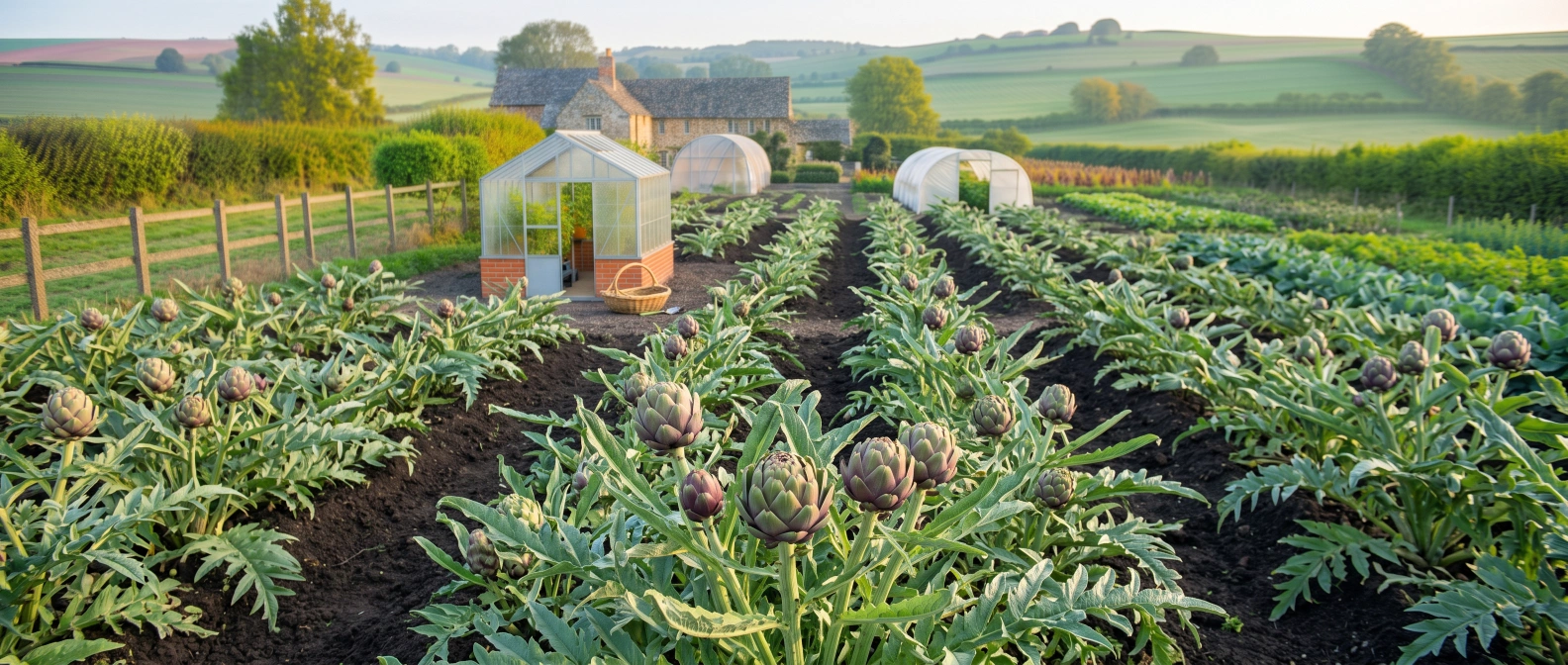
What you eat is the unopened flower bud -- harvest it before the flower opens, per the crop database's own instruction. Leave it, and it becomes a striking purple thistle-like flower. Grown from offsets or seed and productive for 5+ years, a mature plant is impressive enough to double as a windbreak. Its real cross-pollination story is cardoon: same species, different variety, grown for stems instead of buds.
Water need
Needs consistent moisture to keep buds forming well, especially through summer -- more demanding than asparagus once established, though its large root system still helps it cope with short dry spells.
Calories at a glance
470 kcal/kg -- a genuinely useful, moderate calorie contribution alongside its dual role as an ornamental windbreak (scale is log-based across all 55 crops in the calculator).
Temperature Range by Month
Month on the bottom, temperature up the side. The pale green background is what the plant can survive at all -- fatal above or below it, labelled directly on the chart where that applies to your zone. The coral band is its ideal range, and only fades in during the months this zone would actually have buds being harvested -- reusing the exact same calendar data as further down the page. The blue line is real monthly climate data (not a modelled estimate) for a representative rural/agricultural location in this zone -- a small farming town or agricultural research station rather than a major city, to avoid the warmer bias city weather stations have. For the actual verdict on how well this crop does in your zone, see the badge at the top of the page -- that's based on the site's own researched yield figures, not this chart.
Quick Start: Planting to Storage
- Grow from offsets or seed. Plant rooted offsets from an established plant, or sow seed in a warm spot in early spring -- offsets give a true-to-type plant and a faster first harvest than seed.
- Give plants room to grow large. Space plants generously -- mature globe artichokes are large, architectural plants, part of why they double as a windbreak.
- Harvest buds before the flower opens. Cut the central bud first while it's still tightly closed, then side buds as they follow -- once a bud opens into flower it's past its best for eating.
- Cut back after harvest. Once the harvest window ends, cut spent flowering stems back to encourage the plant to put energy into next year's crown.
- Mulch and protect over winter. In cooler zones, mulch heavily around the crown before winter -- globe artichoke is less cold-hardy than asparagus or rhubarb and benefits from extra protection.
Planting & Harvesting Calendar
Pick your zone under "Temperature Range by Month" above and this updates too. Boreal, Arid and Alpine zones are all marked challenging here -- globe artichoke wants a genuinely mild, moist climate to do its best.
Calories & Yield
These figures are per plant, per year, once established. Subtropical and Mediterranean zones give the best yield here.
| Climate Zone | Yield per plant | Calories per plant | Viability |
|---|---|---|---|
| Tropical / Humid | 0.40 kg | 188 kcal | Viable |
| Subtropical | 0.50 kg | 235 kcal | Viable -- best yield |
| Mediterranean | 0.50 kg | 235 kcal | Viable -- best yield |
| Temperate Maritime | 0.45 kg | 211.5 kcal | Viable |
| Temperate Continental | 0.45 kg | 211.5 kcal | Viable |
| Cool / Boreal | 0.15 kg | 70.5 kcal | Challenging (60% yield) |
| Arid / Semi-Arid | 0.12 kg | 56.4 kcal | Challenging (60% yield) |
| Highland / Alpine | 0.15 kg | 70.5 kcal | Challenging (60% yield) |
Figures per established plant per year, from the site's own crop database. Boreal, Arid and Alpine already reflect the 60% penalty applied to challenging zones.
Varieties Worth Knowing
Globe artichoke varieties differ in bud colour, size and whether they'll reliably produce from seed in the first year. All the varieties below are open-pollinated (OP), meaning seed saved from them breeds true and is worth keeping under this site's seed-saving approach; none are F1 hybrids.
Seed Saving -- Quick Guide
Globe artichoke crosses with cardoon -- the same species, different variety group -- and most growers propagate by dividing offsets rather than seed anyway, since that's the only way to guarantee a true-to-type plant.
SERVINGS, NOT DAILY CALORIES This works out plate-sized servings of globe artichoke from your offsets or seed during its fresh harvest window only, not your group's full daily calorie needs. For that, use the main calculator.
PERENNIAL ESTABLISHMENT Globe artichoke needs time to establish before it fruits properly -- offsets from an established plant reach full cropping faster than seed. The figures below show what an established plant produces each year, not what a brand-new planting gives you in its first season.
Estimated for your selected zone above, using this site's own germination, loss and yield figures for globe artichoke -- a helping is roughly what you'd put on a plate as part of a meal with other veg. Treat it as a planning estimate, not a promise.
Storage & Preservation
Fresh buds keep for one to two weeks refrigerated, but for longer-term storage the usual routes are blanching and freezing, or preserving hearts in oil or vinegar.
Whichever method, harvest buds while still tightly closed -- once a bud starts opening its eating quality drops quickly.
Growing Globe Artichoke Without Bought Inputs
A well-fed, well-watered globe artichoke is a genuinely trouble-free plant -- its biggest ongoing need is consistent moisture and a yearly feed of garden compost or well-rotted manure worked in around the crown.
Aphids and slugs can target young growth, especially on emerging spring shoots.
A strong jet of water for aphids and hand-picking slugs at dusk are simple, genuinely effective input-free measures.
Frequently Asked Questions
What part of the globe artichoke do you actually eat?
The unopened flower bud -- the crop database is explicit that you harvest it before the flower opens. Leave a bud on the plant and it opens into a large purple thistle-like flower, which is what you'd want if you were deliberately letting a plant go to seed instead.
Does globe artichoke cross-pollinate with cardoon?
Yes -- genuinely, since globe artichoke and cardoon are the same species, Cynara cardunculus, just different varieties bred for different parts of the plant (buds for artichoke, stems for cardoon). If you're growing both and saving seed from either, treat them as a real cross-pollination risk, not a background worry.
Can globe artichoke really be used as a windbreak?
Yes -- the crop database calls it an impressive plant that also makes a windbreak. Mature plants grow large and architectural, tall enough to genuinely shelter more tender crops planted on their leeward side.
How long does a globe artichoke plant keep producing?
5+ years per the crop database, making it a genuine long-term perennial investment, though a shorter one than asparagus.