
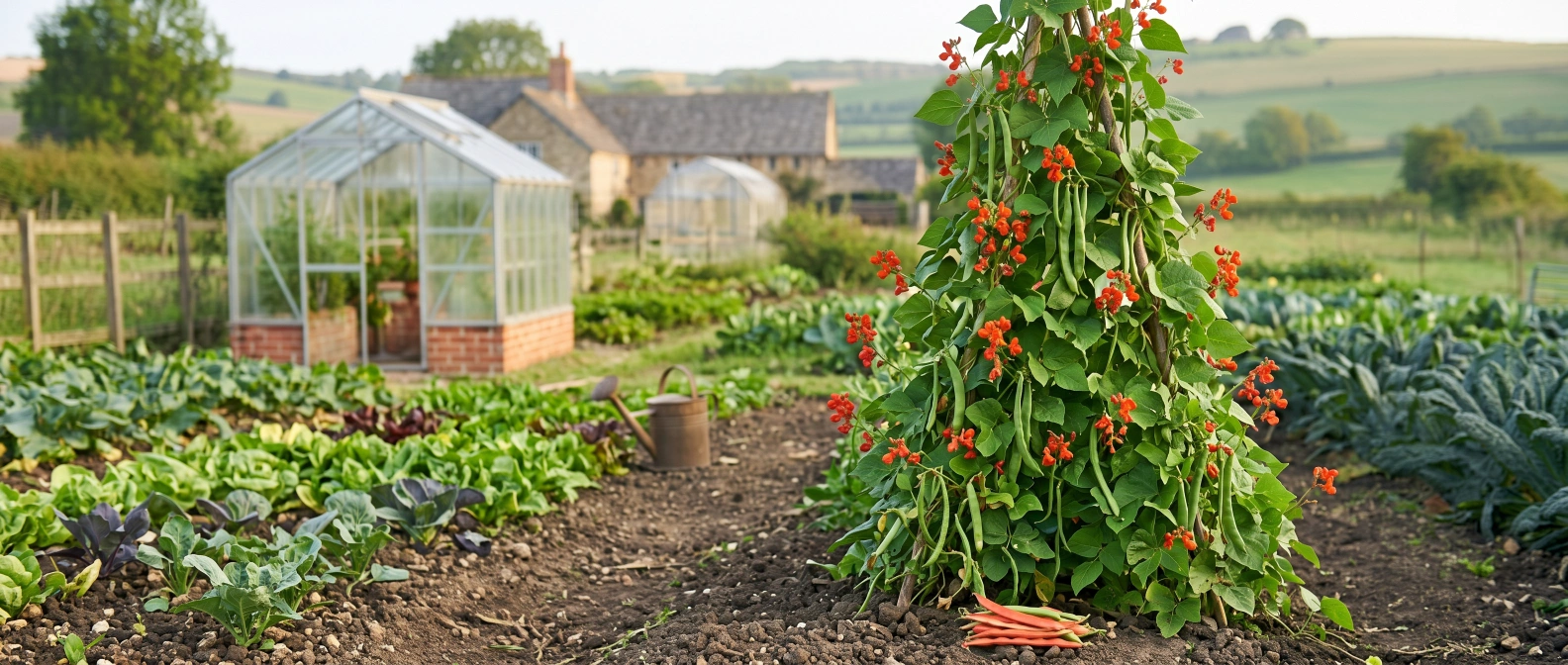
Runner bean shares the word "bean" with French bean and Borlotti but is a genuinely different species -- Phaseolus coccineus rather than Phaseolus vulgaris -- and doesn't cross with either. Its own showy red flowers tell you everything about its seed-saving risk: they're built to attract bees, and documented outcrossing runs up to 40%, closer to broad bean's risk profile than to common bean's modest self-pollination. Czar, the white-seeded variety named in the crop database, is the classic choice for drying rather than fresh eating.
Water need
Notably thirsty while flowering and podding -- inconsistent watering is a common cause of flowers dropping before they set at all.
Calories at a glance
3,350 kcal/kg dried -- essentially matching broad bean and common bean in this site's calorie-dense pulse tier (scale is log-based across all 55 crops in the calculator).
Temperature Range by Month
Month on the bottom, temperature up the side. The pale green background is what the plant can survive at all -- fatal above or below it, labelled directly on the chart where that applies to your zone. The coral band is its ideal range, and only fades in during the months this zone would actually have the crop in the ground -- reusing the exact same sowing/harvesting data as the calendar further down the page. The blue line is real monthly climate data (not a modelled estimate) for a representative rural/agricultural location in this zone -- a small farming town or agricultural research station rather than a major city, to avoid the warmer bias city weather stations have. For the actual verdict on how well this crop does in your zone, see the badge at the top of the page -- that's based on the site's own researched yield figures, not this chart.
Quick Start: Sowing to Drying
- Sow direct after frost risk has passed. Sow direct once frost risk is over and the soil has warmed -- like common bean, runner bean is frost-tender and won't forgive an early start.
- Provide a tall, sturdy support. Runner bean is a vigorous climber and needs a genuinely sturdy support from the start -- a simple cane wigwam or row of poles works well.
- Keep watering steady through flowering. Runner bean is notably thirsty while flowering and podding -- inconsistent watering is a common cause of flowers dropping before they set pods at all.
- Leave pods on the plant to dry fully, choosing a white-seeded variety for drying. For dried beans, choose a variety bred for drying (Czar is a classic white-seeded choice) and leave pods on the plant until they've dried and rattle when shaken.
- Shell, finish drying, and store. Shell the dried pods, spread the beans out somewhere warm and airy for a final week, then store in sealed jars.
Sowing & Harvesting Calendar
Pick your zone under "Temperature Range by Month" above and this updates too. Notice Tropical and Arid show no window at all -- this site's own yield data marks runner bean as not viable in either.
Calories & Yield
Runner bean is a genuine calorie staple when dried at about 3,350 kcal per kg -- essentially matching broad bean and common bean. Mediterranean and Maritime zones give the best yields here.
| Climate Zone | Yield per plant | Calories per plant | Viability |
|---|---|---|---|
| Tropical / Humid | -- | -- | Not viable |
| Subtropical | 0.15 kg | 502.5 kcal | Viable |
| Mediterranean | 0.18 kg | 603 kcal | Viable -- best yield |
| Temperate Maritime | 0.18 kg | 603 kcal | Viable -- best yield |
| Temperate Continental | 0.17 kg | 569.5 kcal | Viable |
| Cool / Boreal | 0.1 kg | 335 kcal | Viable |
| Arid / Semi-Arid | -- | -- | Not viable |
| Highland / Alpine | 0.1 kg | 335 kcal | Viable |
Figures per plant sown, dried weight, from the site's own crop database.
Varieties Worth Knowing
Runner bean varieties differ mainly in flower colour and seed colour. All the varieties below are open-pollinated (OP), meaning seed saved from them breeds true and is worth keeping under this site's seed-saving approach; none are F1 hybrids.
Seed Saving -- Quick Guide
Runner bean is insect-pollinated with real outcrossing risk between varieties -- and it's a different species from common bean (Phaseolus coccineus vs P. vulgaris), so it won't cross with that group.
SERVINGS, NOT DAILY CALORIES This works out plate-sized servings of runner bean from your seed during its fresh harvest window only, not your group's full daily calorie needs. For that, use the main calculator.
Estimated for your selected zone above, using this site's own germination, loss and yield figures for runner bean -- a helping is roughly what you'd put on a plate as part of a meal with other veg. Treat it as a planning estimate, not a promise.
Storage & Preservation
Grown here specifically for dried storage -- pods are left on the vine to fully mature and dry, then shelled and stored in sealed jars.
Stored this way in a cool, dry place, dried runner beans keep for years rather than months, the same storage league as wheat, oats and this site's other dried staples.
Growing Runner Bean Without Bought Inputs
Runner bean is a relatively trouble-free crop -- blackfly is the main pest worth watching for, clustering on soft growing tips similar to broad bean's aphid problem.
Consistent watering does double duty here -- besides preventing flower drop, well-fed, unstressed plants are generally more resilient to pest pressure than plants checked by drought.
Like other legumes, runner bean fixes some of its own nitrogen, a modest soil benefit worth factoring into a wider rotation alongside its own tall, space-efficient growth habit -- a good crop for training up a fence or trellis where ground space is limited.
Frequently Asked Questions
Is runner bean the same species as French bean or Borlotti?
No -- despite sharing the word "bean," runner bean (Phaseolus coccineus) is a genuinely different species from common bean (Phaseolus vulgaris, which covers both Borlotti/Haricot and French bean on this site). They don't cross-pollinate with each other.
Why does runner bean need more isolation than French bean?
Its flowers are the reason -- runner bean's showy red (or white, in some varieties) flowers are specifically attractive to bees and other pollinators, and documented outcrossing runs up to 40%. Common bean's flowers are far less conspicuous and mostly self-pollinate before insects even find them.
How cold and hot can runner bean survive?
It's frost-tender, roughly 0°C to 29°C, and needs all frost risk to have passed before sowing. It also prefers slightly cooler summer temperatures than common bean, and can struggle to set pods through prolonged heat above about 29°C.
Why isn't runner bean viable in Tropical or Arid zones on this site?
Tropical heat and humidity work against a crop that prefers cooler summers and struggles to set pods in sustained heat, while genuine aridity removes the steady moisture runner bean needs through its long flowering and podding season.
Is runner bean a good calorie crop for self-sufficiency?
Very good -- around 3,350 kcal per kg dried, essentially matching broad bean and common bean in the same calorie-dense pulse tier as wheat.