
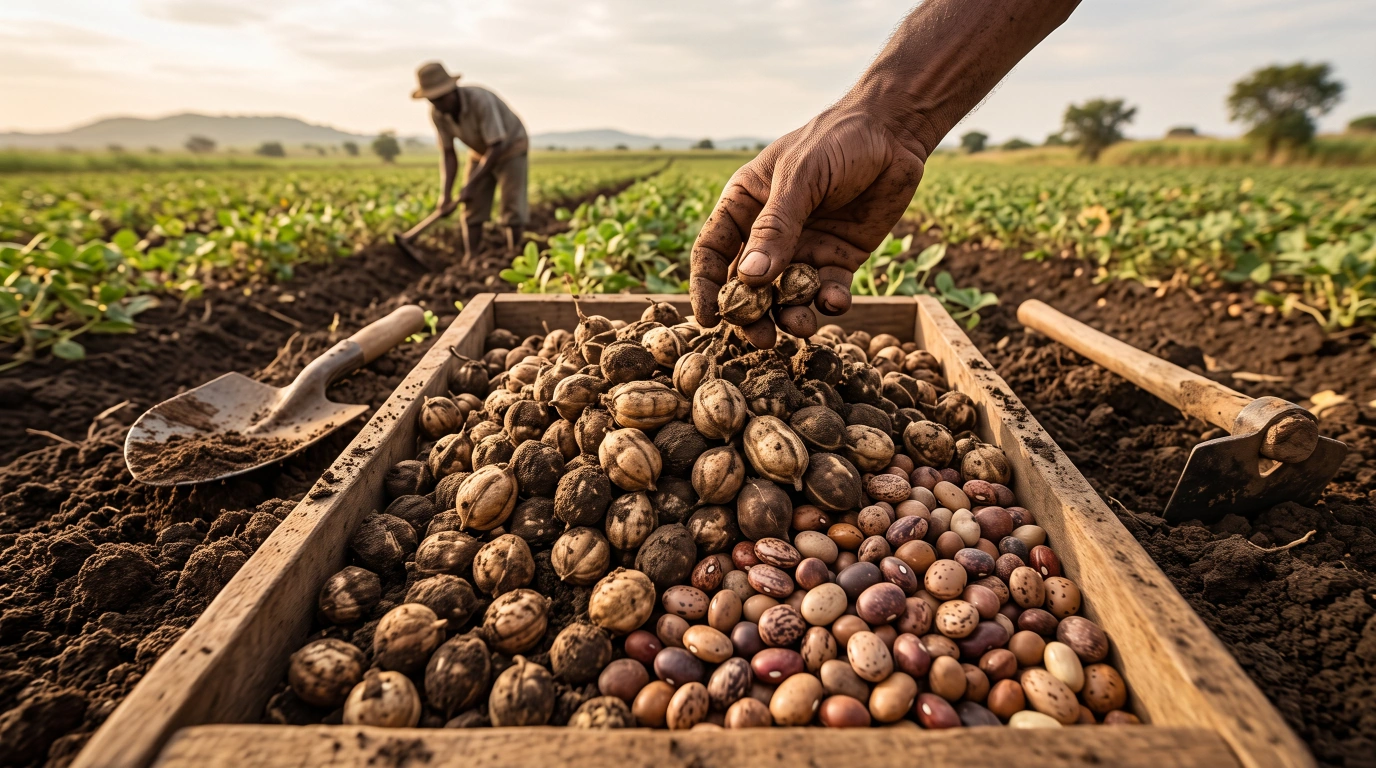
Bambara groundnut is an underground bean and genuinely drought tolerant, per the crop database's own description, and ranks as the third most important African legume. It's genuinely geocarpic -- its pods mature underground, the same strategy peanut uses -- but the resemblance is convergent evolution rather than close relatedness: bambara groundnut is genus Vigna, while peanut is genus Arachis. Self-pollinating with low outcrossing.
Water need
Genuinely drought tolerant per the crop database -- valued across Africa for cropping on poor, dry soils where other legumes struggle.
Calories at a glance
3,600 kcal/kg dried -- a genuine calorie staple, in the same league as the site's other dried pulses (scale is log-based across all 55 core crops in the calculator).
Temperature Range by Month
Month on the bottom, temperature up the side. The pale green background is what the plant can survive at all -- fatal above or below it, labelled directly on the chart where that applies to your zone. The coral band is its ideal range, and only fades in during the months this zone would actually have the crop in the ground -- reusing the exact same sowing/harvesting data as the calendar further down the page. The blue line is real monthly climate data (not a modelled estimate) for a representative rural/agricultural location in this zone -- a small farming town or agricultural research station rather than a major city, to avoid the warmer bias city weather stations have. For the actual verdict on how well this crop does in your zone, see the badge at the top of the page -- that's based on the site's own researched yield figures, not this chart.
Quick Start: Sowing to Drying
- Sow direct once the soil is warm. Sow seed direct once the soil has genuinely warmed -- bambara groundnut is a warm-season crop and needs sustained heat to establish.
- Keep soil loose for pod entry. Keep the soil around the base loose and workable, so developing pods can push down and mature underground as they naturally do.
- Water sparingly once established. Ease off watering once plants are established -- bambara groundnut's real drought tolerance means it copes well with a dry season.
- Dig pods once foliage dies back. Lift the underground pods once the foliage yellows and dies back, much as you would with peanut, even though the two are different genera.
- Dry and shell before storing. Dry the dug pods fully, then shell and give the beans a final week of airing indoors before storing in an airtight container.
Sowing & Harvesting Calendar
Pick your zone under "Temperature Range by Month" above and this updates too. Maritime, Continental, Boreal and Alpine show no window at all, since this site's own yield data marks bambara groundnut as not viable in those zones.
Calories & Yield
Bambara groundnut is a genuine calorie staple when dried at about 3,600 kcal per kg -- Tropical gives the best yield here, and it's not viable at all in Maritime, Continental, Boreal or Alpine zones.
| Climate Zone | Yield per plant | Calories per plant | Viability |
|---|---|---|---|
| Tropical / Humid | 2.0 kg | 7200 kcal | Viable -- best yield |
| Subtropical | 1.8 kg | 6480 kcal | Viable |
| Mediterranean | 0.72 kg | 2592 kcal | Challenging (60% yield) |
| Temperate Maritime | -- | -- | Not viable |
| Temperate Continental | -- | -- | Not viable |
| Cool / Boreal | -- | -- | Not viable |
| Arid / Semi-Arid | 1.5 kg | 5400 kcal | Viable |
| Highland / Alpine | -- | -- | Not viable |
Figures per plant sown, dried weight, from the site's own crop database. Mediterranean already reflects the 60% penalty applied to challenging zones.
A note on varieties: Bambara groundnut is mostly grown as regional landrace populations, distinguished by seed coat colour (cream, red, black, speckled) rather than widely marketed named cultivars -- real, verifiable named-variety diversity for home growers is genuinely thin.
Seed Saving -- Quick Guide
Bambara groundnut is self-pollinating, with pods forming underground much like peanut -- essentially no crossing risk to manage, even between varieties.
SERVINGS, NOT DAILY CALORIES This works out plate-sized servings of bambara groundnut from your seed during its fresh harvest window only, not your group's full daily calorie needs. For that, use the main calculator.
Estimated for your selected zone above, using this site's own germination, loss and yield figures for bambara groundnut -- a helping is roughly what you'd put on a plate as part of a meal with other veg. Treat it as a planning estimate, not a promise.
Storage & Preservation
Bambara groundnut is grown here specifically for dried storage -- pods are dug once foliage dies back, dried fully, then shelled and given a final week of airing indoors before going into an airtight container.
Stored this way in a cool, dry place, dried bambara groundnut keeps for a genuinely long time -- years rather than months, the same storage league as this site's other dried pulses.
Growing Bambara Groundnut Without Bought Inputs
Bambara groundnut's genuine drought tolerance and reliable cropping on poor soils are themselves an input-free advantage -- it's valued across Africa precisely because it needs so little from the grower.
Few pests bother it seriously once established -- keeping soil loose around the base so pods can enter the ground properly matters more than any pest control here.
Bambara groundnut fixes its own nitrogen via bacteria in root nodules, genuinely improving the soil for whatever's grown there next -- factor that into a wider rotation plan, not just a calorie one.
Frequently Asked Questions
Is bambara groundnut closely related to peanut?
No -- not closely, despite both being called "groundnut" and both podding underground. Peanut is Arachis hypogaea, genus Arachis, while bambara groundnut is Vigna subterranea, genus Vigna. Both are in the wider bean family Fabaceae, but the underground-podding habit they share is a case of convergent evolution, not close kinship.
Why does bambara groundnut pod underground?
It's genuinely geocarpic -- after flowering, the stalk pushes the developing pod down into the soil to mature, the same underground-podding strategy peanut uses, even though the two plants arrived at it independently as separate genera.
How important is bambara groundnut as a food crop?
Genuinely significant -- the crop database calls it the third most important African legume, and it's valued in particular for cropping reliably on poor, dry soils where other legumes struggle.