
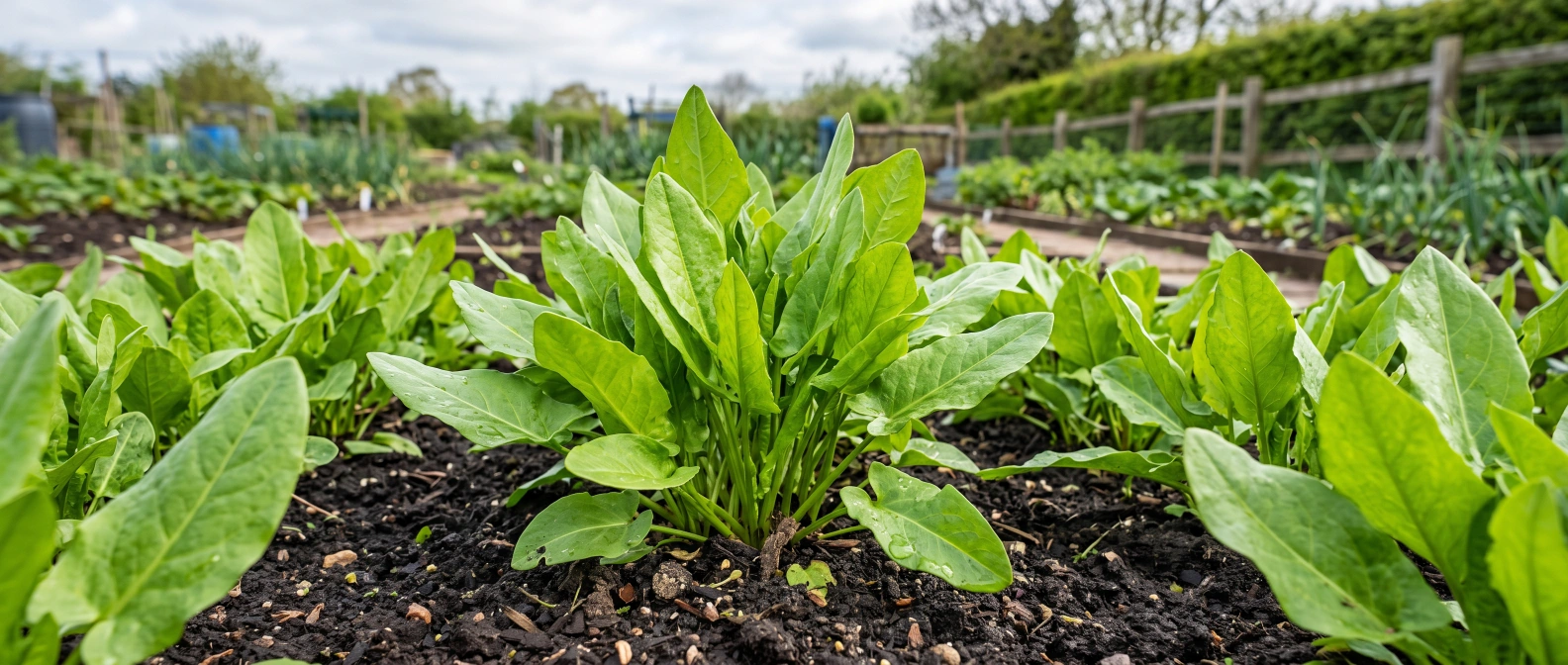
A genuine perennial with a distinctive lemony flavour, per the crop database's own description, harvested from spring right through to autumn. That tang comes from real oxalic acid -- the same compound behind rhubarb's toxic leaves, though at a much lower, ordinarily safe level here. Sorrel shares rhubarb's plant family but is a different genus, so the two don't cross-pollinate.
Water need
Wants consistent moisture to keep leaves tender through its long spring-to-autumn picking season.
Calories at a glance
220 kcal/kg -- grown for its distinctive lemony flavour and low-maintenance perennial habit rather than calorie density (scale is log-based across all 55 core crops in the calculator).
Temperature Range by Month
Month on the bottom, temperature up the side. The pale green background is what the plant can survive at all -- fatal above or below it, labelled directly on the chart where that applies to your zone. The coral band is its ideal range, and only fades in during the months this zone would actually have the crop in the ground -- reusing the exact same sowing/harvesting data as the calendar further down the page. The blue line is real monthly climate data (not a modelled estimate) for a representative rural/agricultural location in this zone -- a small farming town or agricultural research station rather than a major city, to avoid the warmer bias city weather stations have. For the actual verdict on how well this crop does in your zone, see the badge at the top of the page -- that's based on the site's own researched yield figures, not this chart.
Quick Start: Sowing to Storage
- Sow direct or start in modules. Sow direct or start in modules for transplanting -- sorrel establishes readily either way.
- Let plants establish before heavy picking. Give new plants a season to establish into a proper clump before harvesting heavily.
- Harvest outer leaves from spring to autumn. Pick outer leaves as needed across the whole growing season, per the crop database's own description, leaving the centre to keep producing.
- Remove flower stalks to keep leaves coming. Cut off flower stalks as they appear unless you're saving seed -- this keeps the plant's energy going into leaf production instead.
- Divide established clumps every few years. Lift and split a clump every 3-4 years once it gets crowded -- this multiplies your stock and keeps plants vigorous.
Sowing & Harvesting Calendar
Pick your zone under "Temperature Range by Month" above and this updates too. Arid shows no window at all -- one of the few zones where this otherwise hardy perennial genuinely struggles.
Calories & Yield
Tropical, Subtropical and Mediterranean zones tie for the best yield here, and the crop simply isn't viable in Arid conditions.
| Climate Zone | Yield per plant | Calories per plant | Viability |
|---|---|---|---|
| Tropical / Humid | 2.0 kg | 440 kcal | Viable -- best yield |
| Subtropical | 2.0 kg | 440 kcal | Viable -- best yield |
| Mediterranean | 2.0 kg | 440 kcal | Viable -- best yield |
| Temperate Maritime | 1.5 kg | 330 kcal | Viable |
| Temperate Continental | 1.5 kg | 330 kcal | Viable |
| Cool / Boreal | 1.0 kg | 220 kcal | Viable |
| Arid / Semi-Arid | -- | -- | Not viable |
| Highland / Alpine | 0.6 kg | 132 kcal | Challenging (60% yield) |
Figures per established plant per year, from the site's own crop database. Boreal is fully viable with no penalty; Alpine already reflects the 60% penalty applied to challenging zones.
Varieties Worth Knowing
Sorrel has fewer named varieties than most leafy greens, but a genuinely distinct colour variant exists alongside the standard type. Both below are open-pollinated (OP), meaning seed saved from them breeds true and is worth keeping under this site's seed-saving approach; neither is an F1 hybrid.
Seed Saving -- Quick Guide
Sorrel shares an unusual trait with spinach and asparagus: it's often dioecious, with individual plants either male or female, so a reliable seed crop may need more than one clump growing together.
SERVINGS, NOT DAILY CALORIES This works out plate-sized servings of sorrel from your seed during its fresh harvest window only, not your group's full daily calorie needs. For that, use the main calculator.
Estimated for your selected zone above, using this site's own germination, loss and yield figures for sorrel -- a helping is roughly what you'd put on a plate as part of a meal with other veg. Treat it as a planning estimate, not a promise.
Storage & Preservation
Fresh leaves keep for about a week refrigerated -- similar to most tender leafy greens.
For longer-term preservation, sorrel cooks down and freezes well as a puree or soup base, a traditional and genuinely practical way to bank a harvest for later use.
Growing Sorrel Without Bought Inputs
Genuinely one of the toughest, most trouble-free perennials on this site once established, needing minimal ongoing attention.
Slugs are the main pest to watch, especially on young growth in spring.
Hand-picking slugs at dusk is a simple, genuinely effective input-free measure.
Frequently Asked Questions
Why does sorrel taste so lemony?
Genuinely from real oxalic acid content -- the same compound that makes rhubarb leaves dangerous, though at a much lower, generally safe-to-eat level in sorrel's leaves. Anyone with a genuine reason to limit oxalates (such as a history of certain kidney stones) should eat it in moderation, the same sensible caution that applies to spinach and chard too.
Does sorrel cross-pollinate with rhubarb?
No -- despite sharing the same plant family, Polygonaceae, sorrel is a different genus, Rumex, from rhubarb's Rheum. Different genera don't cross under ordinary garden conditions.
Is sorrel really a perennial?
Yes -- the crop database confirms it directly. Alongside Good King Henry, sorrel is one of only two genuine multi-year perennials on this whole hub, harvested from spring right through to autumn once established.