
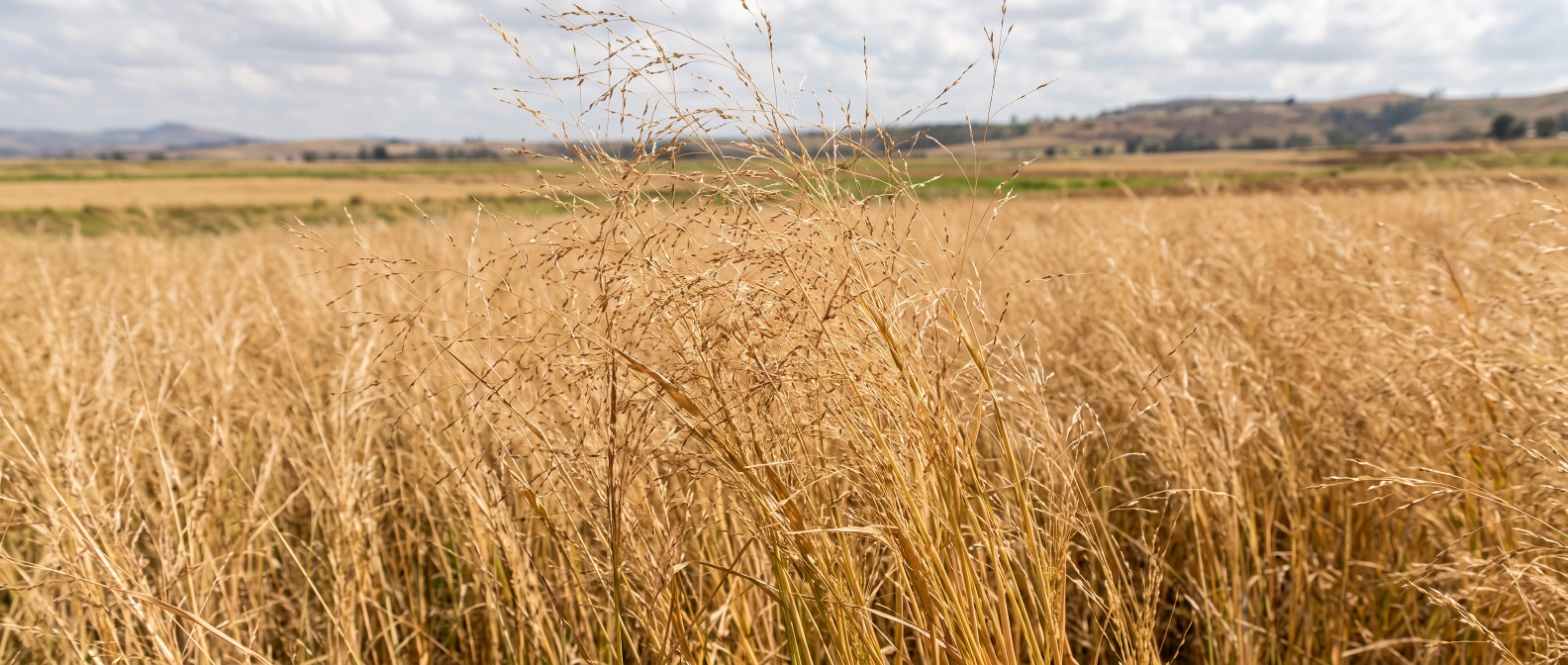
An Ethiopian staple grain, per the crop database's own description, with genuinely the smallest seeds of any major cultivated grain -- and genuinely high iron and calcium alongside that. A warm-season crop, self-pollinating like the rest of this hub's cereals, with no crossing risk from any other grain grown here.
Water need
A genuinely drought-tolerant African staple, adapted to growing regions with limited and unreliable rainfall.
Calories at a glance
3,620 kcal/kg -- one of the most calorie-dense crops on this entire site, in line with the other grains on this hub (scale is log-based across all 55 core crops in the calculator).
Temperature Range by Month
Month on the bottom, temperature up the side. The pale green background is what the plant can survive at all -- fatal above or below it, labelled directly on the chart where that applies to your zone. The coral band is its ideal range, and only fades in during the months this zone would actually have the crop in the ground -- reusing the exact same sowing/harvesting data as the calendar further down the page. The blue line is real monthly climate data (not a modelled estimate) for a representative rural/agricultural location in this zone -- a small farming town or agricultural research station rather than a major city, to avoid the warmer bias city weather stations have. For the actual verdict on how well this crop does in your zone, see the badge at the top of the page -- that's based on the site's own researched yield figures, not this chart.
Quick Start: Sowing to Storage
- Sow direct into warm soil. Broadcast or drill the tiny seed shallowly into warm soil once frost risk has passed, since teff is a genuine warm-season crop.
- Thin if broadcast too thickly. Thin overcrowded seedlings if sown by broadcasting, giving remaining plants room to tiller and bulk up their seed heads.
- Let the crop mature fully. Allow the fine, feathery seed heads to mature and dry on the plant before cutting.
- Cut, thresh and winnow. Cut the dry plants, thresh to release the tiny seeds, then winnow carefully given how small and light the grain is.
- Store dry. Store the cleaned grain somewhere cool, dark and dry, where it keeps well as a genuine long-term staple.
Sowing & Harvesting Calendar
Pick your zone under "Temperature Range by Month" above and this updates too. Teff has no viable outdoor window at all in the Boreal or Alpine zones, reflecting its genuine warm-season, frost-sensitive nature.
Calories & Yield
Tropical gives the best yield here, and it's not viable outdoors in the Boreal or Alpine zones.
| Climate Zone | Yield per plant | Calories per plant | Viability |
|---|---|---|---|
| Tropical / Humid | 2.00 kg | 7,240 kcal | Viable -- best yield |
| Subtropical | 1.80 kg | 6,516 kcal | Viable |
| Mediterranean | 1.50 kg | 5,430 kcal | Viable |
| Temperate Maritime | 0.48 kg | 1,737.6 kcal | Challenging (60% yield) |
| Temperate Continental | 0.72 kg | 2,606.4 kcal | Challenging (60% yield) |
| Cool / Boreal | 0.00 kg | 0 kcal | Not viable outdoors |
| Arid / Semi-Arid | 1.50 kg | 5,430 kcal | Viable |
| Highland / Alpine | 0.00 kg | 0 kcal | Not viable outdoors |
Figures per plant sown, from the site's own crop database. Maritime and Continental already reflect the 60% penalty applied to challenging zones.
Varieties Worth Knowing
Teff is mostly distinguished by seed colour rather than a wide range of named cultivars. Both below are open-pollinated (OP), meaning seed saved from them breeds true and is worth keeping under this site's seed-saving approach; neither is an F1 hybrid.
Seed Saving -- Quick Guide
Teff is mostly self-pollinating with very low crossing risk. The main skill is harvest care -- it's the smallest cultivated grain and shatters easily once ripe.
SERVINGS, NOT DAILY CALORIES This works out plate-sized servings of teff from your seed during its fresh harvest window only, not your group's full daily calorie needs. For that, use the main calculator.
Estimated for your selected zone above, using this site's own germination, loss and yield figures for teff -- a helping is roughly what you'd put on a plate as part of a meal with other veg. Treat it as a planning estimate, not a promise.
Storage & Preservation
The site's own crop data points to the classic dry-grain route: thresh, winnow and store dry.
Kept cool, dry and pest-proof, teff grain keeps exceptionally well -- a genuinely long-term storable staple, traditionally milled into flour close to the time of use.
Growing Teff Without Bought Inputs
A genuinely low-input crop, tolerant of poor soils and unreliable rainfall -- part of why it's remained a staple across its native growing regions for millennia.
Birds can target ripening seed heads, much like other small-grained crops on this hub.
Netting over ripening seed heads is a simple, genuinely effective input-free defence against birds.
Frequently Asked Questions
Does teff cross-pollinate with any other grain on this site?
No. Teff is Eragrostis tef -- in the grass family, Poaceae, but its own genus, Eragrostis. Wheat, oats, barley, maize and rice are all different genera again, so there's genuinely no crossing risk between teff and any other grain on this hub.
Why are teff seeds so small?
Teff has the smallest seed of any major cultivated grain -- the crop database's own description calls them out directly as tiny seeds. A single handful contains thousands of individual grains, which is part of why it's traditionally milled whole into flour rather than dehulled like larger grains.
What makes teff nutritionally distinctive?
Genuinely high iron and calcium content, per the crop database's own description -- well above most staple grains gram for gram, alongside being naturally gluten-free.