
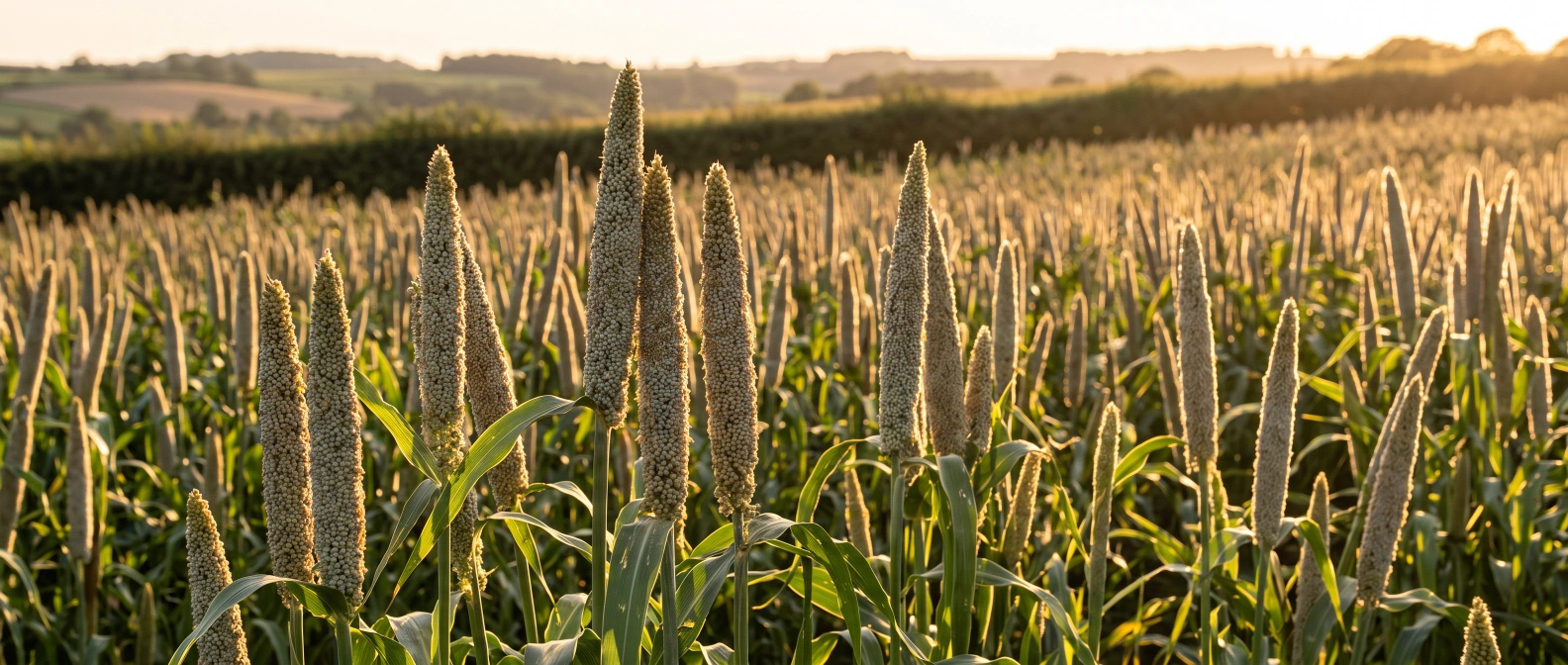
A genuinely exceptional drought-tolerant African grain, per the crop database's own description -- outyielding maize in dry conditions where maize would struggle or fail. Its floral biology sets it apart from the rest of this hub: where most cereals here self-pollinate safely, pearl millet's flower timing makes real cross-pollination the norm, not the exception.
Water need
Genuinely one of the most drought-tolerant cereal crops grown anywhere -- the crop database's own comparison to maize under dry conditions says it plainly.
Calories at a glance
3,780 kcal/kg -- among the most calorie-dense crops on this entire site, in line with the other grains on this hub (scale is log-based across all 55 core crops in the calculator).
Temperature Range by Month
Month on the bottom, temperature up the side. The pale green background is what the plant can survive at all -- fatal above or below it, labelled directly on the chart where that applies to your zone. The coral band is its ideal range, and only fades in during the months this zone would actually have the crop in the ground -- reusing the exact same sowing/harvesting data as the calendar further down the page. The blue line is real monthly climate data (not a modelled estimate) for a representative rural/agricultural location in this zone -- a small farming town or agricultural research station rather than a major city, to avoid the warmer bias city weather stations have. For the actual verdict on how well this crop does in your zone, see the badge at the top of the page -- that's based on the site's own researched yield figures, not this chart.
Quick Start: Sowing to Storage
- Sow direct into warm soil. Sow direct once the soil is reliably warm and frost risk has passed, since pearl millet is a genuine warm-season crop.
- Thin to final spacing. Thin seedlings once established, giving plants room to develop their tall, candle-shaped seed heads.
- Isolate if saving true-to-type seed. Keep flowering plants well isolated from other pearl millet varieties if seed purity matters, given its genuine outcrossing habit.
- Let heads mature and dry. Allow the candle-shaped seed heads to mature and dry fully on the plant before cutting.
- Thresh, winnow and store dry. Thresh the dry heads to release the grain, winnow to remove chaff, then store dry for long-term keeping.
Sowing & Harvesting Calendar
Pick your zone under "Temperature Range by Month" above and this updates too. Pearl millet has no viable outdoor window at all in the Boreal or Alpine zones, reflecting its genuine warm-season, frost-sensitive nature.
Calories & Yield
Tropical gives the best yield here, and it's not viable outdoors in the Boreal or Alpine zones.
| Climate Zone | Yield per plant | Calories per plant | Viability |
|---|---|---|---|
| Tropical / Humid | 4.00 kg | 15,120 kcal | Viable -- best yield |
| Subtropical | 3.50 kg | 13,230 kcal | Viable |
| Mediterranean | 3.00 kg | 11,340 kcal | Viable |
| Temperate Maritime | 0.90 kg | 3,402 kcal | Challenging (60% yield) |
| Temperate Continental | 1.50 kg | 5,670 kcal | Challenging (60% yield) |
| Cool / Boreal | 0.00 kg | 0 kcal | Not viable outdoors |
| Arid / Semi-Arid | 3.00 kg | 11,340 kcal | Viable |
| Highland / Alpine | 0.00 kg | 0 kcal | Not viable outdoors |
Figures per plant sown, from the site's own crop database. Maritime and Continental already reflect the 60% penalty applied to challenging zones. Note Arid stays fully viable here, genuinely unusual for a crop of this calorie density on this site.
A note on varieties: pearl millet is mostly grown as regional landrace populations rather than widely marketed named cultivars -- real, verifiable named-variety diversity for home growers is genuinely thin.
Seed Saving -- Quick Guide
Unlike most small grains, pearl millet is wind-pollinated with a flowering structure that actively favours cross-pollination between plants -- isolation matters more here than for oats, wheat or barley.
SERVINGS, NOT DAILY CALORIES This works out plate-sized servings of pearl millet from your seed during its fresh harvest window only, not your group's full daily calorie needs. For that, use the main calculator.
Estimated for your selected zone above, using this site's own germination, loss and yield figures for pearl millet -- a helping is roughly what you'd put on a plate as part of a meal with other veg. Treat it as a planning estimate, not a promise.
Storage & Preservation
The site's own crop data points to the classic dry-grain route: thresh, winnow and store dry.
Kept cool, dry and pest-proof, pearl millet grain keeps well -- a genuinely long-term storable staple, though its higher oil content than some grains means it's best milled closer to the time of use.
Growing Pearl Millet Without Bought Inputs
A genuinely low-input crop bred for marginal, drought-prone conditions -- tolerant of poor soils where maize and even sorghum can struggle.
Birds can target ripening seed heads, much like other grain crops on this hub.
Netting over ripening seed heads is a simple, genuinely effective input-free defence against birds.
Frequently Asked Questions
Does pearl millet need isolation for seed saving?
Yes -- genuinely, and this is the real story here. Unlike wheat, oats, barley, rice, teff and fonio, all of which self-pollinate before their flowers fully open, pearl millet's flower heads are protogynous: the female stigmas emerge and become receptive before that same head's own pollen is shed. This floral timing pushes the plant toward cross-pollination with other pearl millet flowering nearby, so real isolation distance matters for keeping a variety true.
How drought tolerant is pearl millet really?
Genuinely exceptional -- the crop database is direct: higher yield than maize in dry conditions. It's one of the most drought-resilient cereal crops grown anywhere, developed for exactly the low-and-unreliable-rainfall regions where maize would fail.
Does pearl millet cross-pollinate with maize or other grains here?
No. Pearl millet (Pennisetum glaucum) and maize (Zea mays) are different genera, so despite both being genuine outcrossers, they don't cross with each other or with any other grain on this hub.