
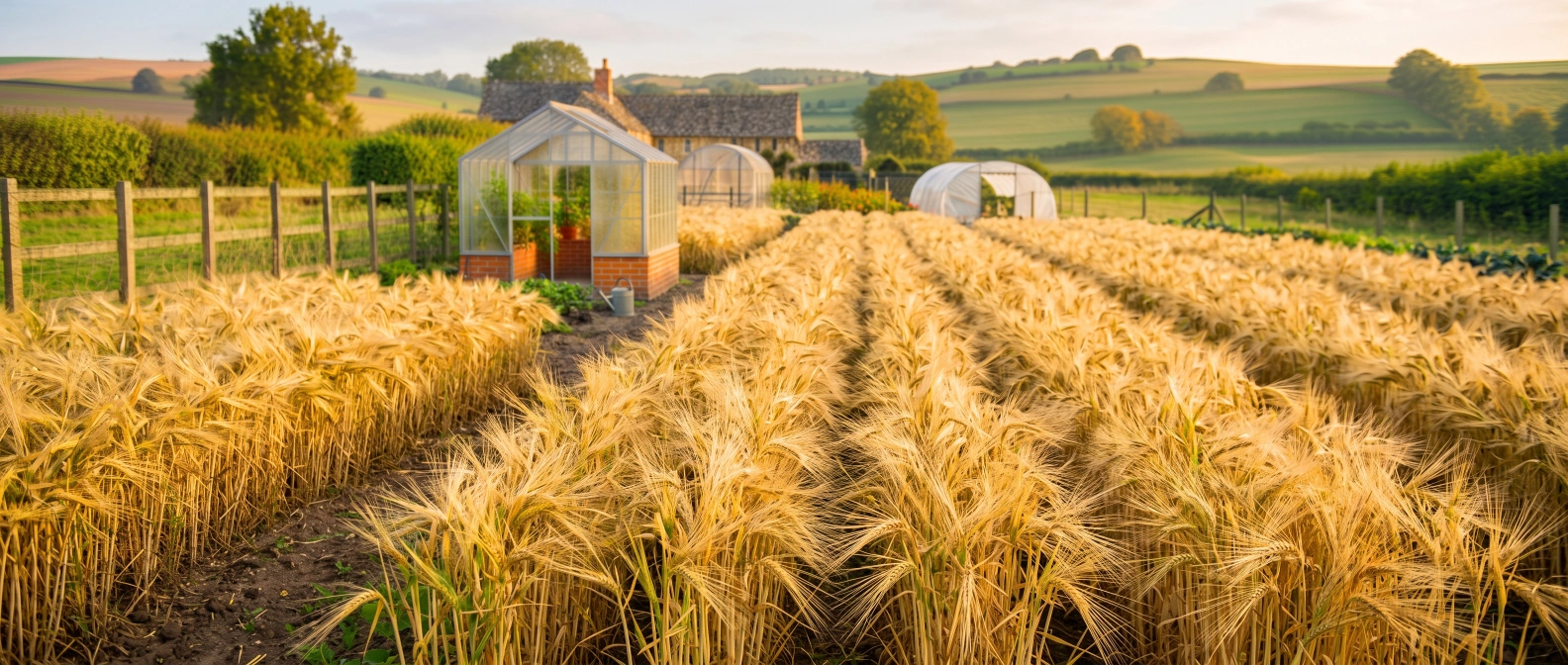
Barley is one of the most self-pollinating cereals of all, and genuinely low-risk for seed saving. Its real practical note is variety choice: the crop database specifically recommends hull-less barley for "grid-down" processing, since ordinary hulled barley needs dehulling equipment most home growers simply won't have. At around 3,540 kcal per kg, it's also one of the most calorie-dense crops on this entire site.
Water need
Genuinely low-input once established, similar to wheat and oats -- one of barley's real strengths as a homestead staple.
Calories at a glance
3,540 kcal/kg -- one of the most calorie-dense crops on this entire site (scale is log-based across all 55 crops in the calculator).
Temperature Range by Month
Month on the bottom, temperature up the side. The pale green background is what the plant can survive at all -- fatal above or below it, labelled directly on the chart where that applies to your zone. The coral band is its ideal range, and only fades in during the months this zone would actually have the crop in the ground -- reusing the exact same sowing/harvesting data as the calendar further down the page. The blue line is real monthly climate data (not a modelled estimate) for a representative rural/agricultural location in this zone -- a small farming town or agricultural research station rather than a major city, to avoid the warmer bias city weather stations have. For the actual verdict on how well this crop does in your zone, see the badge at the top of the page -- that's based on the site's own researched yield figures, not this chart.
Quick Start: Sowing to Storage
- Choose a hull-less variety. Select a hull-less variety specifically if hand-processing without equipment is the plan -- it threshes cleanly and skips the dehulling step ordinary barley needs.
- Sow for your zone's window. Sow in autumn in milder zones or spring in cooler ones, following your zone's own sowing window, the same pattern as wheat and oats.
- Sow into a reasonably prepared bed. Broadcast or drill seed into a weed-free bed for the best establishment.
- Let it grow largely unattended through the season. Like wheat and oats, barley needs relatively little ongoing input once established.
- Harvest, stook and thresh. Cut the ripe crop, stook to finish drying, then thresh -- a hull-less variety threshes clean by hand, unlike hulled types.
Sowing & Harvesting Calendar
Pick your zone under "Temperature Range by Month" above and this updates too. Notice Tropical shows no window at all -- this site's own yield data marks barley as not viable there, the same limit as wheat.
Calories & Yield
Barley is a genuine staple grain at about 3,540 kcal per kg. Mediterranean and Continental zones give the same best yield ratio here, and it isn't viable at all in Tropical.
| Climate Zone | Yield ratio | Calories per kg planted | Viability |
|---|---|---|---|
| Tropical / Humid | -- | -- | Not viable |
| Subtropical | 13× | 46,020 kcal | Viable |
| Mediterranean | 22× | 77,880 kcal | Viable -- best yield |
| Temperate Maritime | 18× | 63,720 kcal | Viable |
| Temperate Continental | 22× | 77,880 kcal | Viable -- best yield |
| Cool / Boreal | 13× | 46,020 kcal | Viable |
| Arid / Semi-Arid | 18× | 63,720 kcal | Viable |
| Highland / Alpine | 11× | 38,940 kcal | Viable |
Figures per kg of seed grain sown, from the site's own crop database -- a yield ratio, since barley is sown by weight rather than as individual plants. Barley is one of the more zone-flexible grains here, notably including a real yield in Arid.
Varieties Worth Knowing
Barley is mostly sold by row-type rather than a wide range of named heirloom cultivars -- this is a genuine, practical distinction rather than branding. Both below are open-pollinated (OP), meaning seed saved from them breeds true and is worth keeping under this site's seed-saving approach; neither is an F1 hybrid.
Seed Saving -- Quick Guide
Barley is cleistogamous -- flowers self-pollinate before they even open -- so different varieties can be grown right next to each other with very low crossing risk.
SERVINGS, NOT DAILY CALORIES This works out plate-sized servings of barley from your seed during its fresh harvest window only, not your group's full daily calorie needs. For that, use the main calculator.
Estimated for your selected zone above, using this site's own germination, loss and yield figures for barley -- a helping is roughly what you'd put on a plate as part of a meal with other veg. Treat it as a planning estimate, not a promise.
Storage & Preservation
The site's own crop data describes the classic route: stook and thresh, then store the dried grain -- the same method as wheat and oats, with the added note that hull-less varieties are specifically recommended for easier hand-processing.
Kept cool, dry and pest-proof, barley grain keeps for years -- a genuinely long-term storable staple.
Growing Barley Without Bought Inputs
Barley is a relatively trouble-free crop at garden scale -- rust and mildew are the main risks, worsened by humid, still conditions, the same shape of problem as wheat and oats.
Choosing resistant varieties where these are known local problems is the most effective input-free defence available.
Crop rotation alongside wheat and oats reduces soil-borne disease build-up the same way it does for the site's other cereals -- avoid growing all three in the same spot repeatedly.
Frequently Asked Questions
Why does the crop database recommend hull-less barley specifically?
Because ordinary hulled barley needs a dehulling step before the grain is usable, and that normally means mechanical equipment most home growers won't have access to in a genuine grid-down situation. Hull-less varieties thresh cleanly enough by hand that this whole extra processing stage simply isn't needed.
Does barley cross-pollinate with wheat or oats?
No -- barley is a different genus from both, and is itself one of the most self-pollinating cereals of all, with pollen shed before the flower opens. A small (roughly 10%) chance of cross-pollination between barley varieties still exists, more than wheat's, but it remains a genuinely low-risk crop for seed saving.
How cold and hot can barley survive?
Roughly -8°C to 29°C for the growing plant, though flowering and ripening stages are far more frost-sensitive, damaged by temperatures as mild as -1.5°C to -3°C. Heat above about 25°C is already past barley's optimal range, and stress builds from there.
Why isn't barley viable in Tropical zones on this site?
Barley is a genuinely temperate cereal that needs a real seasonal temperature swing to develop properly, the same underlying reason wheat isn't viable in Tropical zones either.
Is barley a good calorie crop for self-sufficiency?
Yes -- at around 3,540 kcal per kg it's one of the most calorie-dense crops on this entire site, and combined with a good yield ratio in the right zone, it's a genuine staple grain.