
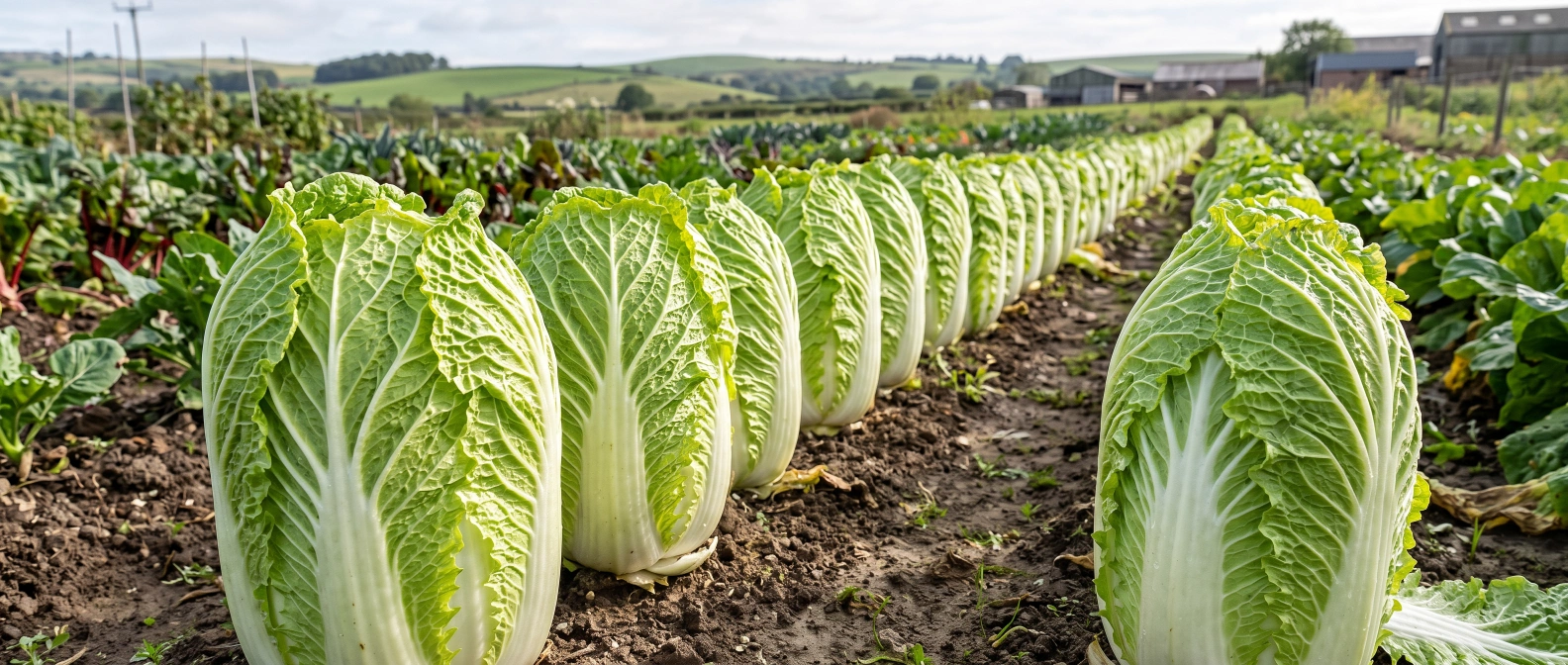
Needs genuinely cool weather to avoid bolting, per the crop database's own description, and stands out from its two Brassica rapa siblings on this hub as a real storage crop -- pak choi and mizuna are fresh-eating only, but well-formed Chinese cabbage heads keep for weeks in the right conditions.
Water need
Needs consistent moisture to head up properly -- irregular watering is a real trigger for both bolting and split heads.
Calories at a glance
160 kcal/kg -- grown for its texture, storage value and fresh eating quality rather than as a calorie crop (scale is log-based across all 55 core crops in the calculator).
Temperature Range by Month
Month on the bottom, temperature up the side. The pale green background is what the plant can survive at all -- fatal above or below it, labelled directly on the chart where that applies to your zone. The coral band is its ideal range, and only fades in during the months this zone would actually have the crop in the ground -- reusing the exact same sowing/harvesting data as the calendar further down the page. The blue line is real monthly climate data (not a modelled estimate) for a representative rural/agricultural location in this zone -- a small farming town or agricultural research station rather than a major city, to avoid the warmer bias city weather stations have. For the actual verdict on how well this crop does in your zone, see the badge at the top of the page -- that's based on the site's own researched yield figures, not this chart.
Quick Start: Sowing to Storage
- Time sowing for cool conditions. Sow in early spring or, better, late summer for an autumn crop -- Chinese cabbage genuinely needs cool weather to avoid bolting before it heads up.
- Give plants plenty of room. Space plants generously -- a well-formed head needs more room than pak choi or mizuna to bulk up properly.
- Keep watering consistent. Water evenly through growth -- irregular watering is a real trigger for bolting and can also cause heads to split.
- Harvest once heads feel firm. Cut heads once they feel solid and tightly wrapped when squeezed -- a loose, open head is still developing.
- Cure briefly before long-term storage. Let cut heads dry off in a cool spot for a day before moving to longer-term cool, humid storage -- this genuinely extends how long they keep.
Sowing & Harvesting Calendar
Pick your zone under "Temperature Range by Month" above and this updates too. Sow windows here run narrower than pak choi's or mizuna's in most zones -- a direct reflection of how much more bolt-prone Chinese cabbage is outside genuinely cool weather.
Calories & Yield
Tropical gives the best yield here, and it's the highest per-plant yield of the three Brassica rapa greens on this hub.
| Climate Zone | Yield per plant | Calories per plant | Viability |
|---|---|---|---|
| Tropical / Humid | 3.5 kg | 560 kcal | Viable -- best yield |
| Subtropical | 3.0 kg | 480 kcal | Viable |
| Mediterranean | 3.0 kg | 480 kcal | Viable |
| Temperate Maritime | 2.5 kg | 400 kcal | Viable |
| Temperate Continental | 2.5 kg | 400 kcal | Viable |
| Cool / Boreal | 0.9 kg | 144 kcal | Challenging (60% yield) |
| Arid / Semi-Arid | 0.9 kg | 144 kcal | Challenging (60% yield) |
| Highland / Alpine | 0.9 kg | 144 kcal | Challenging (60% yield) |
Figures per plant sown, from the site's own crop database. Boreal, Arid and Alpine already reflect the 60% penalty applied to challenging zones.
Varieties Worth Knowing
Most Chinese cabbage sold today is an F1 hybrid bred for uniformity, so it won't breed true from saved seed. The two traditional heirloom types below are the reliable open-pollinated (OP) exceptions, distinguished mainly by head shape.
Seed Saving -- Quick Guide
Chinese cabbage crosses freely with pak choi, mizuna and turnip -- all one species (Brassica rapa), a completely different species from the cabbage/kale group. It's biennial, so saving true seed takes a two-year cycle.
SERVINGS, NOT DAILY CALORIES This works out plate-sized servings of Chinese cabbage from your seed during its fresh harvest window only, not your group's full daily calorie needs. For that, use the main calculator.
BIENNIAL FOR SEED Chinese cabbage is grown as an annual for eating, but is biennial for seed -- most varieties need to overwinter before flowering and setting seed the following year. Plants grow through year one, a few overwintered plants flower and set seed in year two, and that seed is only ready to sow in year three. If you're starting from scratch with no ongoing seed supply, that means having enough seed on hand for both year one's and year two's sowing up front. Plan for roughly double the seed quantity below if that's your situation.
Estimated for your selected zone above, using this site's own germination, loss and yield figures for Chinese cabbage -- a helping is roughly what you'd put on a plate as part of a meal with other veg. Treat it as a planning estimate, not a promise.
Storage & Preservation
Firm, well-formed heads keep for several weeks in cool, humid storage -- a real, genuine storage crop, unlike pak choi and mizuna, per the crop database's own description.
For longer-term preservation, it's the classic base for fermented kimchi -- a well-established traditional route to a product that keeps for months.
Growing Chinese Cabbage Without Bought Inputs
Genuinely rewards a good feed of compost or well-rotted manure before planting -- forming a solid head takes real nutrition, more than its looser-leaved rapa siblings need.
Flea beetles and slugs are the main threats to young plants, the same risk faced by this hub's other brassicas.
Fine mesh over young plants, and hand-picking slugs at dusk, are simple, genuinely effective input-free measures.
Frequently Asked Questions
Does Chinese cabbage cross-pollinate with regular cabbage?
No, despite the shared name -- regular (winter/summer) cabbage on this hub is Brassica oleracea, a different species from Chinese cabbage's Brassica rapa. They genuinely don't cross under ordinary garden conditions. What Chinese cabbage DOES cross with is pak choi, mizuna (both also Brassica rapa, on this hub) and turnip (on the Root Vegetables & Tubers hub).
Is Chinese cabbage a good storage crop?
Yes -- the crop database calls it out directly as a good storage crop, unlike pak choi and mizuna, which are strictly fresh-eating greens. Firm, well-formed heads harvested at the right stage will keep for weeks in cool, humid storage.
Why does Chinese cabbage need cool weather?
The crop database is direct: needs cool weather to avoid bolting. Warm temperatures and long daylight push the plant to flower before it forms a proper head, so timing sowing for cool conditions genuinely matters more here than for pak choi or mizuna.