
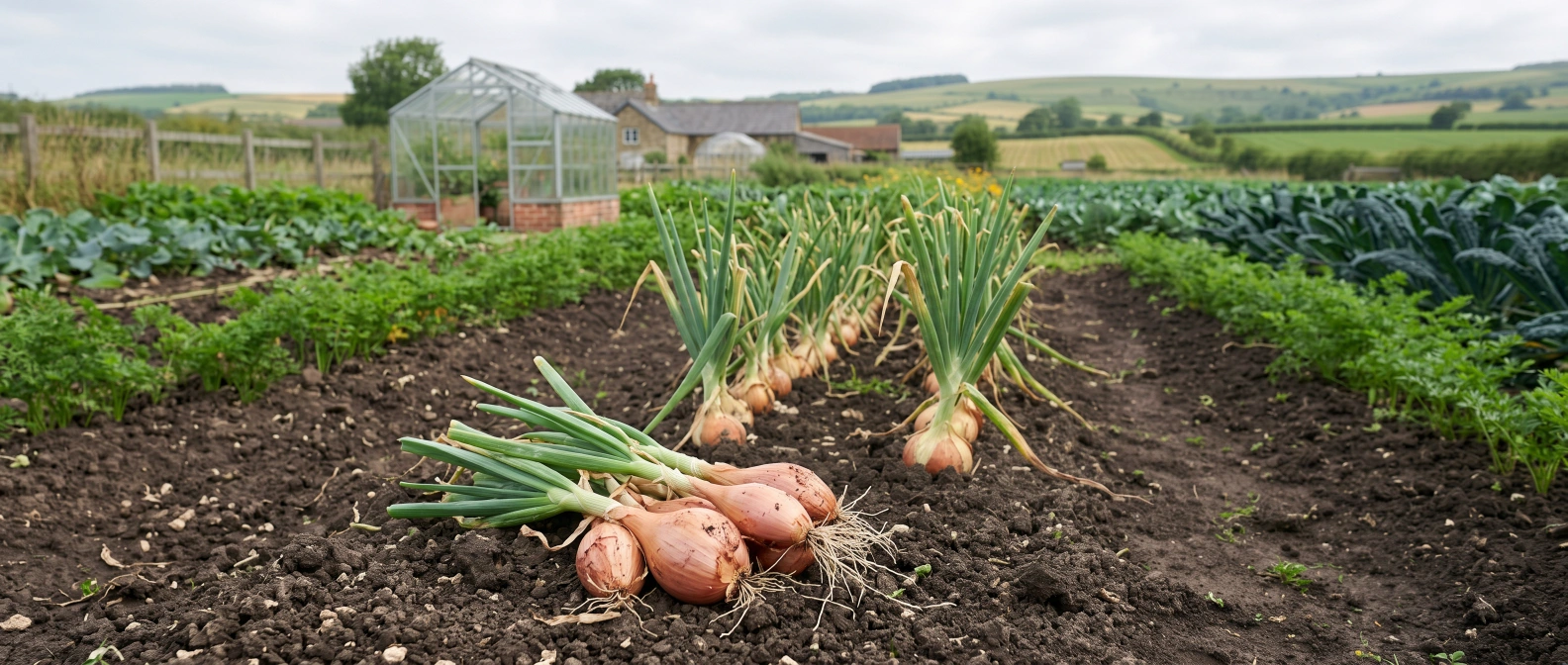
Shallot is officially the same species as onion -- reclassified back into Allium cepa in 2010 -- and genuinely cross-pollinates with both onion and this site's spring onion if left to flower together. What sets it apart in the ground is how it grows: plant one bulb and it splits into a cluster of 8-12 over the season, rather than swelling into a single larger bulb the way onion does. At 720 kcal per kg it's also the most calorie-dense allium on this site, with dry storage that outlasts onion's.
Water need
Similar needs to onion -- steady moisture while the cluster develops, then a dry spell as the tops fall to cure properly.
Calories at a glance
720 kcal/kg -- the highest of any allium on this site, ahead of leek and onion (scale is log-based across all 55 crops in the calculator).
Temperature Range by Month
Month on the bottom, temperature up the side. The pale green background is what the plant can survive at all -- fatal above or below it, labelled directly on the chart where that applies to your zone. The coral band is its ideal range, and only fades in during the months this zone would actually have the crop in the ground -- reusing the exact same sowing/harvesting data as the calendar further down the page. The blue line is real monthly climate data (not a modelled estimate) for a representative rural/agricultural location in this zone -- a small farming town or agricultural research station rather than a major city, to avoid the warmer bias city weather stations have. For the actual verdict on how well this crop does in your zone, see the badge at the top of the page -- that's based on the site's own researched yield figures, not this chart.
Quick Start: Planting to Storage
- Plant sets in early spring. Push individual shallot bulb sets into loose, well-drained soil in March or April, leaving the tip just showing above the surface -- or sow from seed in January or February if you're starting that way instead.
- Keep weed-free while young. Like onion, shallot's narrow leaves compete poorly with weeds -- hand-weed regularly while the clusters are establishing.
- Let each bulb multiply undisturbed. Each planted set splits into a cluster of 8-12 bulbs over the season -- there's nothing to do here except keep the bed weeded and reasonably watered while it happens.
- Lift once the tops fall over. The same signal as onion -- once most of the foliage has yellowed and fallen, ease the whole cluster out of the ground rather than pulling by the leaves.
- Cure and store. Dry the cluster thoroughly somewhere warm and airy for one to two weeks, then split the bulbs apart and store in a cool, dry, well-ventilated place -- shallot keeps even longer than onion this way.
Sowing & Harvesting Calendar
Pick your zone under "Temperature Range by Month" above and this updates too. The Sow row: green is the normal safe planting window, amber is pushing the season by roughly a month either side. The Harvest row shows the main lifting window -- shallot doesn't get the striped living-larder tail some other crops here do, since it's dried and stored rather than left in the ground.
Calories & Yield
Shallot is the most calorie-dense allium on this site at about 720 kcal per kg. Subtropical and Mediterranean zones give the best yields here.
| Climate Zone | Yield per plant | Calories per plant | Viability |
|---|---|---|---|
| Tropical / Humid | 0.08 kg | 57.6 kcal | Viable |
| Subtropical | 0.10 kg | 72 kcal | Viable -- best yield |
| Mediterranean | 0.10 kg | 72 kcal | Viable -- best yield |
| Temperate Maritime | 0.08 kg | 57.6 kcal | Viable |
| Temperate Continental | 0.08 kg | 57.6 kcal | Viable |
| Cool / Boreal | 0.06 kg | 43.2 kcal | Viable |
| Arid / Semi-Arid | 0.05 kg | 36 kcal | Viable |
| Highland / Alpine | 0.06 kg | 43.2 kcal | Viable |
Figures per bulb planted, from the site's own crop database -- remember each planted bulb yields a cluster of 8-12, so the practical harvest is larger than these per-set figures alone suggest. Shallot is viable in every one of this site's eight zones.
Varieties Worth Knowing
Shallot varieties mainly differ in colour, shape and flavour strength. Shallots are almost always grown from saved bulbs rather than true seed, so each variety below is marked true to type: replanting a saved bulb reliably reproduces the same variety, the bulb equivalent of this site's seed-saving approach for true-seed crops.
Seed Saving -- Quick Guide
Most shallots are propagated by saving and replanting bulb offsets rather than seed, which sidesteps crossing risk entirely. If grown from true seed, shallot crosses with onion -- both the same species (Allium cepa).
SERVINGS, NOT DAILY CALORIES This works out plate-sized servings of shallot from your seed during its fresh harvest window only, not your group's full daily calorie needs. For that, use the main calculator. (Most home growers propagate shallot from bulb sets instead -- see Seed Saving below -- but this site's yield figures are modelled on true seed.)
Estimated for your selected zone above, using this site's own germination, loss and yield figures for shallot -- a helping is roughly what you'd put on a plate as part of a meal with other veg. Treat it as a planning estimate, not a promise.
Storage & Preservation
The site's own crop data models shallot as a dry-storage crop, the same method as onion -- cured for a week or two somewhere warm and airy, then stored in a cool, dry, well-ventilated place.
Properly cured, shallot keeps for up to around 9 months -- genuinely longer than onion, according to the crop database's own notes, likely because the smaller individual bulbs cure faster and more completely all the way through.
Growing Shallots Without Bought Inputs
Shallot shares the same pest and disease risks as onion -- onion fly and onion white rot -- since they're the same species.
Fine mesh from planting onward excludes onion fly without any spray needed.
Crop rotation is essential against white rot -- once established in a bed it persists for many years, so never repeat shallot, onion, leek or spring onion in the same spot back to back.
Frequently Asked Questions
Is shallot really the same species as onion?
Yes, officially since 2010. Shallot used to be classified as its own species, Allium ascalonicum, but taxonomists folded it back into Allium cepa -- the same species as bulb onion -- since the difference between them was too small to justify keeping them apart. Practically, that means shallot cross-pollinates with onion and this site's spring onion if any of them flower nearby.
Why does one shallot bulb turn into a whole cluster?
It's simply how shallot grows -- each planted bulb splits and multiplies into a cluster of 8-12 new bulbs over the season, rather than swelling into one larger bulb the way onion does. That's the site's own crop data's headline reason it stores even better than onion: more, smaller bulbs cure faster and keep well.
How cold and hot can shallot survive?
Roughly -10°C to 30°C, with fall-planted sets tolerating winter temperatures down toward -10°C under mulch. Heat above about 30°C can push bulbs into premature dormancy and leave them undersized.
Can shallot be grown from seed instead of bulbs?
Yes -- the site's own crop data notes it can be grown from seed sown in January or February, or from bulb sets planted in March or April. Bulb sets are the more common and reliable route for most home gardeners.
Is shallot a good calorie crop for self-sufficiency?
Good -- around 720 kcal per kg, the highest of any allium covered on this site and well ahead of onion or leek. Combined with genuinely long dry storage, it's a solid, low-effort contributor to winter cooking rather than a bulk calorie source on its own.
Do I need pesticides to grow shallots?
No. Shallot shares onion fly and onion white rot risk with the rest of this site's alliums, and the same input-free defences apply -- fine mesh from planting and strict crop rotation, since white rot persists in soil for years once established.